All continents broke their average temperature record except for Oceania and Antarctica
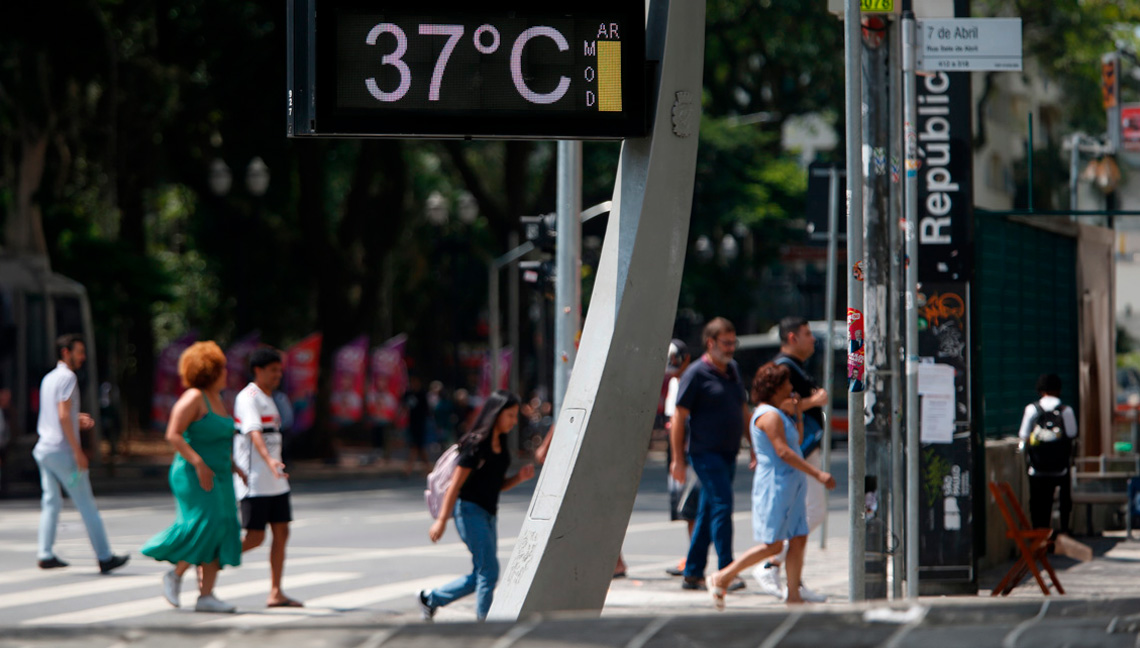
Day above 35 ºC temperature in São Paulo city, in September 2024
Paulo Pinto/Agência Brasil
On January 10, the World Meteorological Organization (WMO) announced the news that had been months in the making: 2024 had beaten 2023 to become the hottest year since the late-nineteenth century. Over the year, the global average surface temperature was 1.55 degrees Celsius (ºC) above the estimated average of 13.6 ºC for the preindustrial era (1850–1900). In 2023, the difference was 1.45 ºC, according to WMO calculations. It was the first time that global warming broke the 1.5 ºC barrier for a calendar year, from January to December.
The Paris Agreement, an international climate treaty signed in 2015, aims to reduce greenhouse gas emissions with the objective of limiting the global temperature increase to 1.5 ºC above preindustrial levels. Although it is still high, this level of warming is considered the acceptable ceiling to which countries would be able to adapt, with a reasonable degree of safety, to climate change and to mitigate its impacts on their territory and population.
The WMO figure has a margin of uncertainty of 0.13 °C and was calculated by analyzing and consolidating values from six independent climate services. Three are US institutions: the North American Space Agency (NASA), the National Oceanic and Atmospheric Administration (NOAA), and the nonprofit organization Berkeley Earth. The other three are the European Union’s Copernicus service, the UK’s Met Office, and the Japan Meteorological Agency. Due to the recent increase in global warming and the more frequent occurrence of extreme events, such as the wildfires in Los Angeles, a region subject to intense droughts and strong winds, the six services agreed to release their data for 2024 on the same day as a way of amplifying their warning. Usually, each organization releases its numbers at some point in January, on whichever day is most convenient for them.
Alexandre Affonso / Revista Pesquisa FAPESP
All six services, each of which uses a slightly different methodology and primary data, determined that 2024 was the warmest year since the second half of the nineteenth century. All six of the institutions calculated similar values for last year’s average temperature, with differences of no more than 0.16 ºC between them. Berkeley Earth and Copernicus recorded the highest global temperature increases over the preindustrial period in 2024, at 1.62 ºC and 1.6 ºC respectively. The lowest figure was obtained by the NOAA, with 2024 calculated at 1.46 ºC warmer than the late-nineteenth century. The measurements from the six centers confirm the upward trend in global temperatures, especially since the 2010s. The last 10 years were the 10 warmest years in recent history.
“The climate story is unfolding before our eyes. We didn’t have just one or two record years, but a full ten-year series, accompanied by devastating and extreme weather conditions, rising sea levels, and melting ice. All driven by record levels of greenhouse gases due to human activities,” said Argentine meteorologist Celeste Saulo, WMO’s secretary-general, in a press release about last year’s data.
With the exception of Oceania and Antarctica, average temperatures broke records on every continent in 2024. The same was true for average temperatures over oceans outside the polar latitudes. New records were set in every imaginable type of statistic obtained or compiled by climate services. An analysis of global and regional data by Berkeley Earth estimated that 104 countries broke their annual average temperature records in 2024. Almost three and a half billion people—40% of the earth’s population—experienced the hottest period of their lives, especially in Asia, Africa, Central and South America, and Eastern Europe.
Brazil was one of the places where 2024 was the hottest year on record. According to data from the National Institute of Meteorology (INMET), the country’s average temperature of 25.02 °C was the highest since records began in 1961. In 2023, now only Brazil’s second hottest year ever, the average temperature was 24.92 °C. The 2024 figure was 0.79 °C above the country’s historical average for 1991 to 2020. “What happened was what we expected, given the trend of records being broken year after year,” says INMET meteorologist Danielle Barros Ferreira.
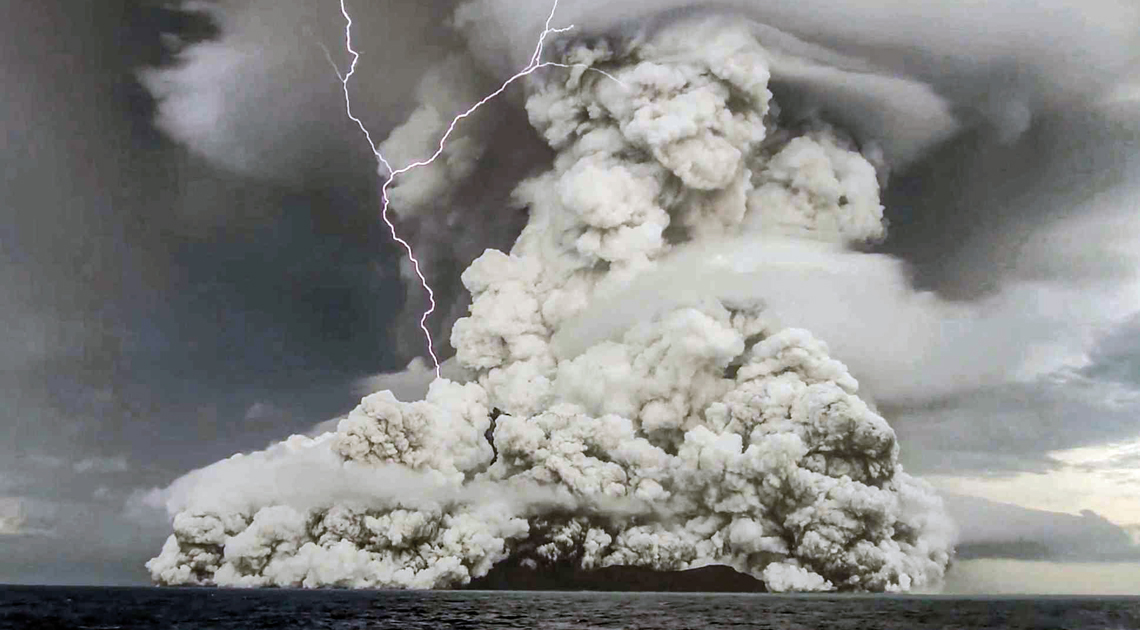
Tonga Meteorological ServiceThe 2022 eruption of an underwater volcano in the Tonga archipelago ejected 150 million tons of water vapor into the upper atmosphere, an event that may have contributed to global warming in the following two yearsTonga Meteorological Service
In four states, all in the north of the country, the heat was more than 1 ºC above the historical average: Roraima (1.6 ºC), Mato Grosso do Sul (1.5 ºC), Mato Grosso (1.4 ºC), and Rondônia (1.2 ºC). Because most of its territory has a tropical climate, the average temperature on the surface of Brazil is much higher than the global average. Even in a year when Earth’s average temperature was higher than ever in recent history, the global average was almost 10 degrees below Brazil’s, at 15.10 ºC according to the European service Copernicus.
The global heat record set in 2024 was not a surprise. With the exception of 2020, when the COVID-19 pandemic began, global emissions of greenhouse gases such as carbon dioxide, methane, and nitrous oxide have continued to rise (see Pesquisa FAPESP issue nº 346). It is thus impossible to predict any significant cooling of the earth’s climate in the short term. Since the 1970s, the global average temperature has been rising by around 0.2 °C per decade. Unexpected upward and downward fluctuations occur alongside this overall trend, which can provide temporary relief or further exacerbate the situation.
The pace of global warming over the past 10 years, however, is simply staggering. Temperatures in 2023 and 2024—the two hottest years since the nineteenth century—were so high that they exceeded climate model forecasts by about 0.2 °C. Instead of the projected 1.3 °C rise, global warming reached 1.5 °C prematurely in these two years.
Alexandre Affonso / Revista Pesquisa FAPESP
There is no doubt that the main driver of the rising temperature is the emission of greenhouse gases from human activities, such as the burning of fossil fuels, deforestation, and fires in forests and green areas. Some data, however, suggest that localized factors, some apparently temporary and others more long-term, may have amplified the upward trend in global temperatures in 2023 and 2024.
The list of secondary causes includes record levels of water vapor at the top of the atmosphere in 2024, a sharp reduction in low-altitude clouds (especially in 2023), and a decrease in the production of sulfur dioxide (SO2) particles (aerosols), a type of pollution released by ships on the ocean. Water vapor warms the atmosphere, while clouds and aerosols (despite being bad for human health) lower surface temperatures. The high volume of water vapor—in 2024, the levels measured in the upper atmosphere outside the polar zones were the highest they have been in 33 years—is partly attributed to the January 2022 eruption of the underwater volcano Hunga Tonga–Hunga Haʻapai, located near the Tonga archipelago in the South Pacific.
It was the largest underwater explosion ever recorded by modern instruments. The eruption injected approximately 150 million tons of water vapor into the upper atmosphere at altitudes above 50 kilometers, a quantity never observed before. The eruption of large volcanoes on land, such as the Pinatubo eruption in the Philippines in June 1991, releases large volumes of aerosols composed of sulfur dioxide, which can cool the earth’s climate for brief periods. These events carry aerosols into the stratosphere (the second layer of the atmosphere), partially blocking solar radiation from reaching the planet’s surface. When Hunga Tonga–Hunga Haʻapai erupted, it ejected much more water vapor into the atmosphere than aerosols, which may have contributed to the rise in temperatures over the past two years.
There is no consensus on the hypothesis among experts, however. “The quantity of greenhouse gases being emitted from human activity is twice what the planet could withstand without its atmospheric temperature increasing,” points out meteorologist Gilvan Sampaio, general coordinator of earth sciences at the Brazilian National Institute for Space Research (INPE). “The last El Niño also contributed to the record heat of the last two years.”
Apu Gomes/Getty ImagesLast year’s drier weather intensified January’s wildfires in the Los Angeles areaApu Gomes/Getty Images
El Niño is a periodic natural phenomenon characterized by unusual warming of surface waters in the Equatorial Pacific. This change warms the planet and alters rainfall patterns and droughts in various parts of the world. The most recent El Niño started in June 2023 and ended in May 2024. It was strong, but it didn’t break any records directly related to the phenomenon. The Pacific has since entered a neutral phase that now appears to be heading towards a weak La Niña (the opposite of El Niño), when waters in this region of the ocean cool down.
Historically, the occurrence of La Niña tends to slow down the dominant global warming trend. Between 2020 and 2023, the phenomenon occurred in three consecutive years, from weak to moderate intensity. But temperature records continued to be broken during the period. Some scientists suspect that La Niña is losing its ability to keep the thermometers down. “The atmosphere is confused and we are going through a transition phase,” says meteorologist Humberto Barbosa, head of the Satellite Image Analysis and Processing Laboratory (LAPIS) at the Federal University of Alagoas (UFAL). “We can no longer analyze the climate the same way we did 30 years ago.”
Regina Rodrigues, an oceanographer from the Laboratory of Climate Extremes at the Federal University of Santa Catarina (UFSC), believes the weakening of the Atlantic meridional overturning circulation (AMOC) may have played a role in the recent rise in global temperatures. The AMOC carries warm surface water from the South Atlantic to the north and brings cold, deep water from Greenland to the bottom of South America. Several recent studies have suggested that the ocean circulation is currently the weakest it has been this millennium, having declined in intensity by 15%. Its collapse could cause major anomalies in current rainfall patterns and temperatures until the end of the century. “We are not yet certain, but it is possible that we are already seeing the effect of the AMOC weakening on the earth’s climate,” says Rodrigues, who has written several papers on the circulation.
Although the record temperatures of 2023 and 2024 ensured the global warming ceiling of 1.5 °C has already been hit, some researchers believe it is still premature to say the Paris Agreement target has been missed. “A single year of more than 1.5 °C does not mean that we have failed to meet Paris Agreement long-term temperature goals, which are measured over decades rather than an individual year,” said Celeste Saulo of the WMO. “However, it is essential to recognize that every fraction of a degree of warming matters. Whether it is at a level below or above 1.5 °C of warming, every additional increment of global warming increases the impacts on our lives, economies, and our planet.”
The story above was published with the title “Record heat in 2024” in issue in issue 348 of february/2025.
This article may be republished online under the CC-BY-NC-ND Creative Commons license. The Pesquisa FAPESP Digital Content Republishing Policy, specified here, must be followed. In summary, the text must not be edited and the author(s) and source (Pesquisa FAPESP) must be credited. Using the HTML button will ensure that these standards are followed. If reproducing only the text, please consult the Digital Republishing Policy.