


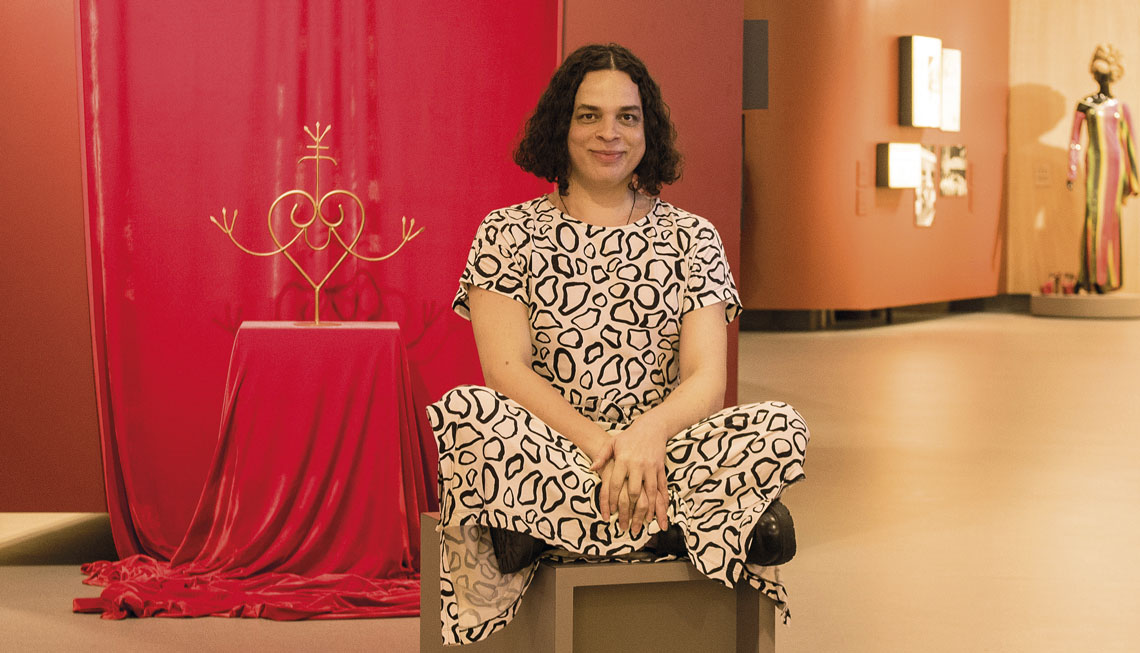
I am a transgender woman who always wanted to be a writer. I have always felt a connection with books. I was born into a middle-class family in Campinas and my mother says that I learned to read at the age of four. I lived as a man for 29 years, growing up isolated and friendless because I could not be my true self. I found a safe haven in books, and maybe that is why I decided to study languages and literature, a path that offered me the chance to create worlds where I could make sense of myself.
In 2005, I started my undergraduate degree at the Institute of Language Studies at UNICAMP [University of Campinas]. In the very first class of the literature course, I was introduced to the 1934 book ABC of Reading by American poet and literary critic Ezra Pound [1885–1972], which presents an overview of the most avant-garde and sophisticated works in international literature. I fell in love with the book and the way it reveals that what we see as avant-garde has always been a part of literature, even though we often lack awareness of this more experimental side of other times and cultures.
The class was taught by Trajano Vieira, a professor of Greek language and literature at UNICAMP who had a great influence on my academic career. During my undergraduate studies, I took the opportunity to attend some of his lectures, and I used to show him the poems I translated as an exercise in poetic learning—an invaluable suggestion from Pound. The name I later chose to adopt was inspired by an expression I saw in his translation of the classic poem The Odyssey, written by Homer in around the eighth century BC. The Moirai were the seers who controlled the fate of Ulysses, and “amara” is a more erudite way of saying “bitter.” Together, “amara moira” can be read as “bitter destiny,” a combination of words that I chose not only for their meaning, but also for the way they sound.
Through Trajano and Pound, I found a way of understanding my own voice. I began exploring the translation of experimental poetry and studying erotic poetry on my own. My interest in eroticism worried my parents: they thought the topic would harm my academic career. But their fears proved unfounded. In 2006, Professor Eliane Robert Moraes, who at the time worked at PUC-SP [Pontifical Catholic University of São Paulo] and is now a professor of Brazilian literature at USP [University of São Paulo], hired me as an assistant for five months to help her with the Antologia da poesia erótica brasileira [Anthology of Brazilian erotic poetry; Ateliê Editorial, 2015]. This opportunity showed me that there was a purpose and value to the research I was doing.
Two years later, I was awarded a scholarship to study medieval literature at the University of Porto, Portugal, where I learned paleography—the study of ancient documents. This experience was fundamental to my undergraduate dissertation in 2010, in which I addressed the jeering and disdainful songs of medieval troubadours who spoke of “sodomy,” the word used at the time for sexual and gender nonconformity.
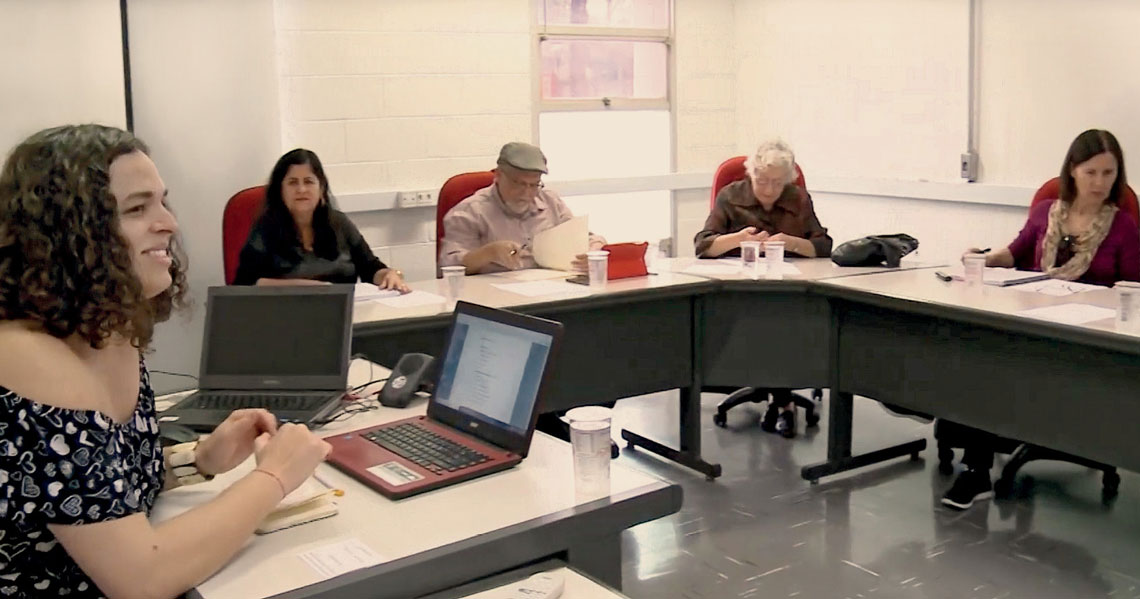
Reproduction of YouTube video by TV UnicampAmara Moira defending her doctoral dissertation at UNICAMP in 2018Reproduction of YouTube video by TV Unicamp
Until then, I had been planning to pursue an academic career as a medievalist. I already had a master’s topic in mind to propose to UNICAMP as soon as I graduated. However, in the last semester of my undergraduate degree, a professor taught an entire course dedicated to the book Ulysses, by James Joyce [1882–1941]. The experience led me to change my line of research. I was completely enamored by the novel and by the way Joyce experiments with and reinvents language right through to the ultimate consequence. I started my master’s degree at UNICAMP in 2011. My research project was to translate Dubliners, a book of short stories by Joyce, with funding from FAPESP. I still intend to publish my translation.
In 2013, I started my PhD at UNICAMP and continued my research on Joyce, this time with a grant from CAPES [Brazilian Federal Agency for Support and Evaluation of Graduate Education]. My focus was Ulysses. In the book, Joyce tackles the indeterminacy of meaning through resources such as onomatopoeia and indecipherable words, as if he wanted to leave readers in doubt about how much they really understand. In my research, I analyzed how these moments in which the novel flirts with unintelligibility were translated.
In the first year of my doctorate, I began my gender transition. I was 29 years old and I was unable to work as a full-time researcher during the process. It was a turbulent time. I left home because my parents had great difficulty accepting my decision. I didn’t feel accepted at university either. I felt judged, watched, observed by my colleagues and professors. For two years, I worked as a prostitute, an environment in which I felt accepted. Many of the people I shared the sidewalks with were transgender and had gone through the same experience I was going through at that moment. I do not want to romanticize my time as a prostitute, but it helped me develop a more positive relationship with my body, to experience sexuality in a less normative way, and to interact with people who I learned to admire a little more every day. However, I also had to deal with the police, as well as verbal and physical aggression on the streets of Campinas.
In the midst of all this turmoil, I continued my PhD, despite many questions, including whether it made sense to continue my research given what I was going through. UNICAMP never abandoned me, it continued to support me, which was a crucial factor in me not giving up on my studies. I defended my doctoral thesis in 2018, which was even covered in the newspaper—not because of the quality of my work, but because I was the first transgender person to obtain a doctorate from UNICAMP under their new chosen name.
There were other transgender researchers at UNICAMP at the time, however, such as Beatriz Pagliarini Bagagli, who works in the field of literature, and Jéssica Milaré, in mathematics. But we were, and still are, few and far between. As I said when defending my thesis, I finished my PhD primarily because I know how important it is for transgender people to be in academia, producing knowledge and challenging the knowledge produced by others, rather than merely as an object of study.
Academic research was no longer the main purpose of my life; other issues started to feel just as important, such as activism and writing. Today, at 39 years old, I have published two books. I live in São Paulo and I manage exhibitions, cultural programs, and the educational center at the São Paulo State Museum of Sexual Diversity. My life is very busy, but I don’t intend to stop studying. I plan to do a postdoctoral fellowship soon. About six years ago, I started surveying literary works written by transgender authors in Brazil, and so far I have gathered more than 100 titles, most of them autobiographies. Who knows, maybe this will lead to an academic study.
The story above was published with the title “Between words and identity” in issue 344 of October/2024.
Republish