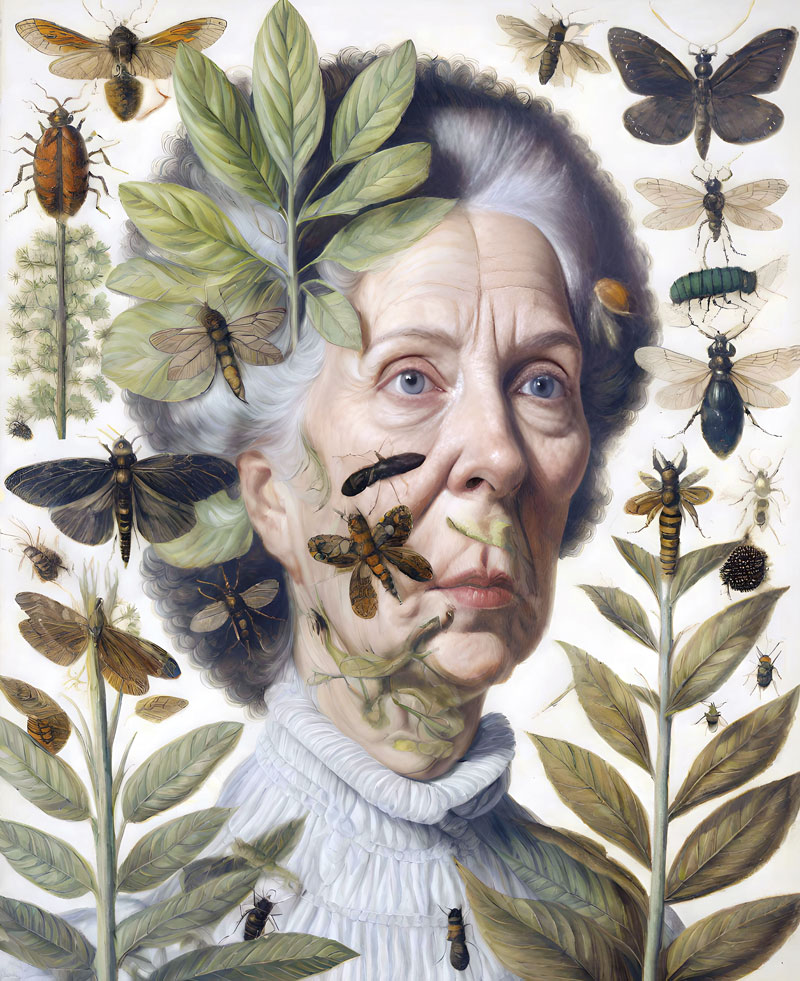
Giselle Beiguelman / Courtesy of the ArtistMaria Sibylla Merian, 70, in a portrait created by Giselle Beiguelman using artificial intelligenceGiselle Beiguelman / Courtesy of the Artist
At the age of 52, German naturalist and scientific illustrator Maria Sibylla Merian (1647–1717) embarked on a scientific expedition to Suriname. She financed the trip by selling her own prints. In 1705, faced with financial difficulties due to the costs of traveling to South America, she published an illustrated book about the insects of Suriname, as well as other titles. Twelve years later, impoverished and with her eyesight failing, she died in Amsterdam, Netherlands. She began to earn recognition for the artistic value of her work only after it was rediscovered by feminist researchers. In 2011, an edition of her 1675 book New Book of Flowers, sold for £570,000 at an auction in the United Kingdom.
Sibylla Merian is one of the women portrayed by visual artist Giselle Beiguelman in her exhibition Venenosas, nocivas e suspeitas (Poisonous, harmful, and suspicious), on display at the FIESP Cultural Center in São Paulo until April 20. “They are naturalists, illustrators, or both, who were born between the seventeenth and nineteenth centuries and erased from the history of art and science,” says Beiguelman, a professor at the School of Architecture, Urbanism, and Design of the University of São Paulo (FAU-USP). Among the seven portraits, there are two Brazilian women. One is Maria do Carmo Vaughan Bandeira (1902–1992), considered the first botanist at the Rio de Janeiro Botanical Garden. The other is illustrator Constança Eufrosina Borba Paca (1844–1920), who joined scientific expeditions led by her husband, botanist João Barbosa Rodrigues (1842–1909), at the beginning of the twentieth century.
“The portraits were created with generative artificial intelligence [AI] and are speculative, since they are based only on very rare images of these women when they were young. The technology uses text-to-image and image-to-image processing to create their faces at the age at which they died, blending them with the plants and ecosystems they covered in their work, aesthetically and scientifically,” explains the artist.
In addition to the portraits, the exhibition includes seven videos in which Beiguelman uses AI to reinterpret plants such as the mandrake and the belladonna. She also combines them to create hybrid species. “These plants have been banned or demonized at various times for a variety of reasons, ranging from their use in ritual practices to their aphrodisiac or hallucinogenic powers,” says Beiguelman. “As I researched the illustrations, I realized some of them had been drawn by women I had never heard of, and that’s how I got the idea for the exhibition.”
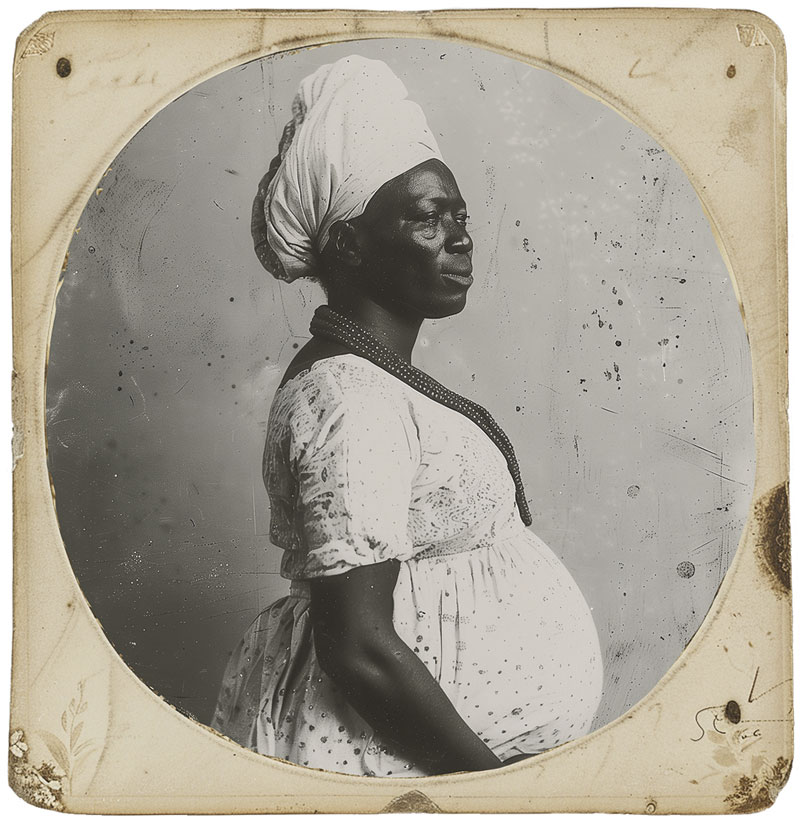
Mayara Ferrão / Courtesy of the artistImage from Álbum de desesquecimentos (Album of unforgetting; 2024), by Mayara FerrãoMayara Ferrão / Courtesy of the artist
According to the artist, her homage to these women, whose importance was not recognized in their times, was only possible thanks to the use of technology. “Because there are very few images of them, I was able to produce these portraits by passing textual information I collected during my research through the machine,” says Beiguelman.
Visual artist Mayara Ferrão, from Bahia, used the same strategy to shine a spotlight on Black and Indigenous women from the colonial period. In her collection Álbum de desesquecimentos (Album of unforgetting; 2024), she imagined scenes of motherhood and homosexuality through AI-generated images.
Visual artists using technology in their work is not new. One of the pioneers when it comes to AI, a field that emerged in the 1950s, was the British painter Harold Cohen (1928–2016). “He painted in oil and was well-known in Europe before moving to the USA in the 1960s to do a postdoctoral fellowship at Stanford University. There he met a group of researchers who were studying AI,” says Brazilian artist Fabrizio Poltronieri of the University of Nottingham, UK. In the late 1960s, the painter created Aaron, a program designed to create art, which he worked on until his death in 2016. “At first, the software reproduced Cohen’s paintings,” explains Poltronieri. “But towards the end of his life, Cohen began working together with the program, which suggested new forms in a co-creative process.”
Lúcia Santaella, from the Pontifical Catholic University of São Paulo (PUC-SP), notes that AI has evolved through progressive learning algorithms over the last 20 years. However, the emergence of generative AI in 2018 was a major turning point. Now, by being given prompts, AI machines can write, speak, and produce images on a similar level to humans. “Creativity has been reimagined, challenging the hegemony that has belonged to humanity throughout history,” says the researcher. “This has raised a series of questions about the role of the artist and the risk of machines replacing humans in artistic creation.”
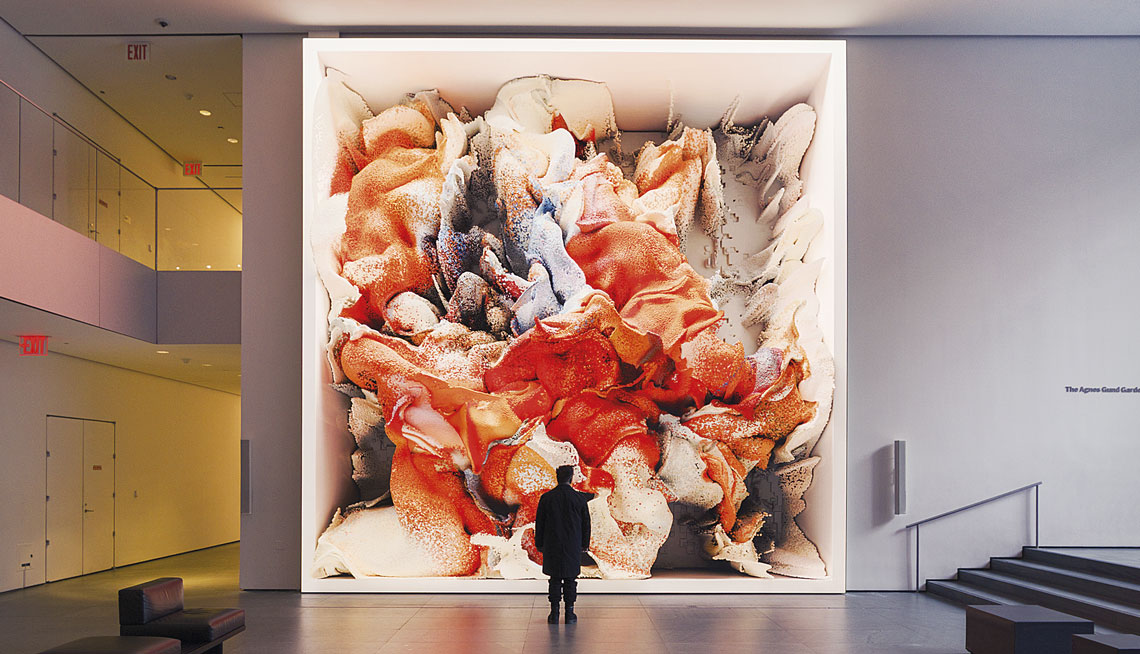
©Refik Anadol Studio / Courtesy of the artistUnsupervised (2021), by Refik Anadol©Refik Anadol Studio / Courtesy of the artist
Other questions have also arisen since then. The 2018 project Anatomy of an AI System by artists Kate Crawford, from Australia, and Vladan Joler, from Serbia, shows the gears of this structure in a diagram. “It shows the step-by-step process of an AI system being developed by a large technology company in the USA, making it clear that this production process has an environmental and social impact,” explains multimedia artist Cesar Baio of the Institute of Arts at the University of Campinas (UNICAMP).
One of the aspects highlighted in the diagram is the use of precarious labor. “When generative AI emerged in 2018, big tech companies gathered a huge volume of data from the internet to train their models and teach machines what an apple or a cat was, for example. In those early days, images had to be manually identified as ‘apple’ or ‘cat.’ This exhausting and poorly paid work was mostly done—and sometimes still is—by masses of workers from developing countries,” says Bruno Moreschi, a Brazilian visual artist from Leuphana University Lüneburg, Germany, who investigated the topic during a postdoctoral fellowship at FAU-USP in 2020.
According to Moreschi, most current generative AI uses pretrained models, starting with a set of data organized in that first phase. “But AI still uses precarious human labor to correct and calibrate tools or even create new databases. These are issues that artists need to consider if they want to avoid being naive about the use of AI resources,” says the researcher.
Art historian Nara Cristina Santos, a retired professor at the Federal University of Santa Maria (UFSM), Rio Grande do Sul, highlights another controversial point: the issue of copyright. “Some artists using AI in their work have been accused of plagiarism. At the same time, there are artists suing technology companies because they believe their work was used to train AI systems,” says Santos, founder of the Laboratory for Research in Contemporary Art, Technology, and Digital Media at UFSM (LABART-UFSM).
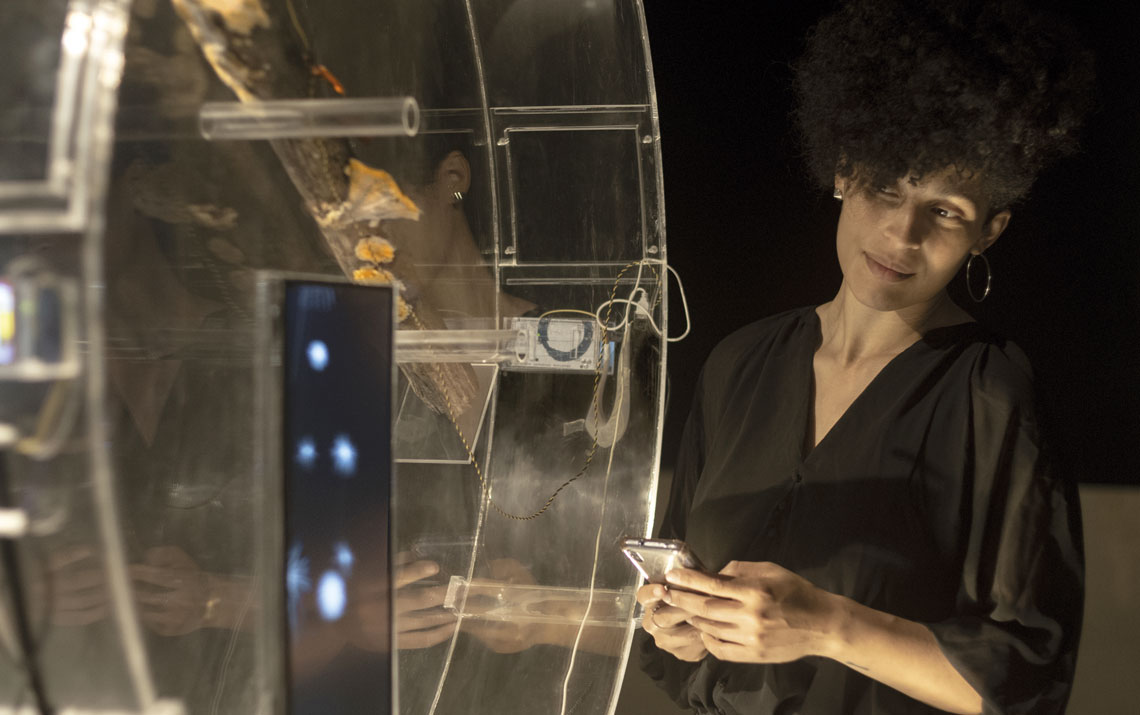
Publicity / Beto Mohr_Tuane EggersMycorrhizal Insurrection (2022), by Cesar Baio and Lucy SolomonPublicity / Beto Mohr_Tuane Eggers
Last year, LABART-UFSM hosted the 19th Contemporary Art Symposium, with AI as the main theme. The idea arose from discussions outlined in the 2020 book AI Ethics, by Belgian philosopher Mark Coeckelbergh. There is much to discuss. “We are reviewing a series of issues in our field,” says Santos. “In addition to the person creating it, a work of art made with AI involves enormous databases and algorithm programmers. It is not simply a case of ‘shared authorship,’ which has been argued in legal circles, but more like an ‘incorporated authorship’ based on the artist’s intentionality.”
Of the possibilities AI has opened in the field of art, Moreschi highlights its potential for analyzing image patterns. “For example, it is capable of creating connections between the visual content of a piece of art or between different pieces, or searching a museum collection to identify the incidence of common themes,” he explains.
The study of museum collections can lead to entirely new works of art, such as Turkish artist Refik Anadol’s Unsupervised, which was on display at the Museum of Modern Art (MoMA), New York, between 2021 and 2023. Anadol trained a machine-learning model to interpret data from the MoMA’s collection, looking at 380,000 high-resolution images of more than 180,000 pieces.
One of the challenges faced by Beiguelman in creating her exhibition Venenosas, nocivas e suspeitas was portraying the women in old age. “The system took a while to understand this, at first only producing images of young women,” she recalls. “These models are based on huge data sets that reflect hegemonic white, male, ageist thinking. They find it difficult to understand prompts that deviate from these standards,” continues the researcher, who is leading a FAPESP thematic project on digital archives.
A group of 17 Indigenous visual artists from Brazil, Argentina, Bolivia, and Chile dealt with a similar challenge. In 2023, they participated in the project “INDIGENIA: Generative AI for Indigenous futures and ‘digital good living,’” led by Thea Pitman of the University of Leeds, UK, and Andreas Rauh of the University of Dublin, Ireland. “The idea was for Indigenous people to generate images using generative AI,” says Potiguara researcher Alexsandro Cosmo de Mesquita, who followed the study and wrote an article for a dossier on AI and creative processes published by SESC São Paulo last year. “The software was used to produce futuristic images, but they were full of stereotypes. The depicted Indigenous people had characteristics described by colonizers in the past.”
The artists then wrote a manifesto on how to use digital technologies, in which they advocated for “codes of ethics […] and forms of regulation to enforce compliance with these codes, including representation of Indigenous peoples.” In Brazil, AI is yet to be formally regulated. Bill No. 2,338/23, designed to do just that, was approved by the Federal Senate in December, but still needs to be debated in the Chamber of Deputies, which is set to take place this year.
In addition to regulation, UNICAMP’s Baio is also concerned about environmental issues. Since 2018, he has been creating a series of artworks in partnership with American artist Lucy Solomon of California State University, San Marcos. One is Mycorrhizal Insurrection, an installation presented at the 13th Mercosul Biennial in 2022. “For this piece, we trained an AI system with natural language models that recognizes text about topics related to climate change, such as deforestation,” says Baio. “The AI also processes electrochemical signals emitted by mushroom cells to communicate with each other, transforming them into messages that combine text and graphics. This content can then be sent to the viewer’s cell phone by a messaging app.”
Baio and Solomon are now working on a new experiment, with funding from FAPESP, that uses generative AI to enhance interaction between humans, machines, and microorganisms, such as fungi and protozoa. “We will generate images from a database that we are assembling. It contains two-dimensional microscopic images and data generated by the microorganisms themselves,” says the researcher. “Our aim is to create an interspecies AI.”
The story above was published with the title “Creativity reimagined” in issue in issue 348 of february/2025.
Projects
1. Digital collections and research: Art, architecture, design, and technology (nº 22/05946-9); Grant Mechanism Thematic Project; Principal Investigator Giselle Beiguelman (USP); Investment R$908,513.91.
2. Interspecies poetics: Intelligent biointerfaces for non-human networks (nº 23/10966-1); Grant Mechanism Regular Research Grant; Principal Investigator Cesar Augusto Baio Santos (UNICAMP); Investment R$132,050.00.
3. Post-anthropocentric aesthetics: Towards bio-hybrid systems (nº 18/24452-1); Grant Mechanism Regular Research Grant; Principal Investigator Cesar Augusto Baio Santos (UNICAMP); Investment R$99,148.81.
Scientific articles
BRAGA, A & SANTAELLA, L. A inteligência artificial generativa e os desconcertos no contexto artístico. Revista Geminis. 2023.
BEIGUELMAN, G. Inteligência artificial como phármakon: A arte algorítmica entre o remédio e o veneno. Rapsódia. 2023.
BEIGUELMAN, G. Eugenia maquínica do olhar: Visão computacional, etarismo e gênero. Virus. 2024.
MORESCHI, B. Five experimentations in computer vision: Seeing (through) images from large scale vision datasets. BJHS Themes. 2023.
MORESCHI, B. et al. Trabalhadores brasileiros no Amazon Mechanical Turk: Sonhos e realidades de “trabalhadores fantasmas”. Revista Contracampo. 2020.
SANTAELLA, L. A IA generativa e a emergência de novas questões estéticas. Semeiosis. 2023.
Books
BEIGUELMAN, G. et al. Boundary images. Minnesota University Press, 2023.
POLTRONIERI, F. & VEAR, C. (Ed.). The language of creative AI – Practices, aesthetics and structures. Springer: 2022.