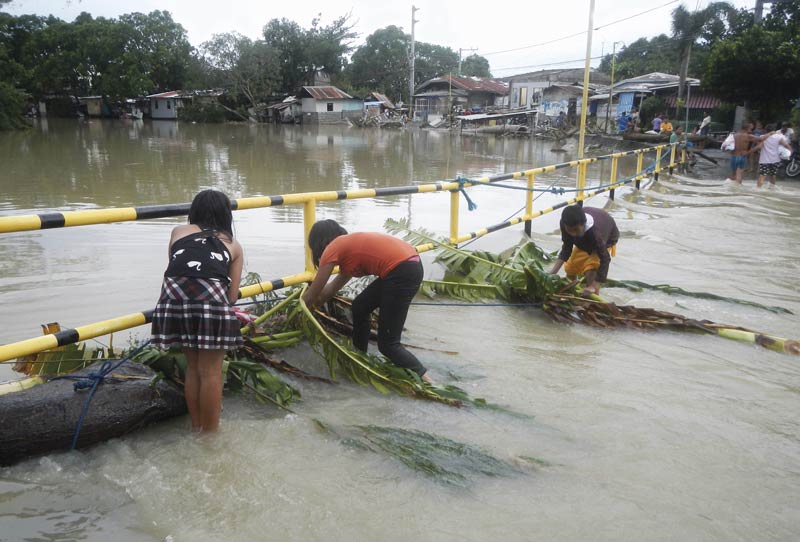
judgefloro / Wikimedia CommonsFlooding in the municipality of San Rafael, in the province of Bulacan, caused by a typhoon in November 2020judgefloro / Wikimedia Commons
At least five cities in the Metropolitan Region of Manila, the capital of the Philippines, are experiencing subsidence (sinking of the ground). Researchers from the University of the Philippines analyzed surface deformation images taken by the Sentinel-1 satellite and found that from 2014 to 2020, Davao sank by 38 millimeters per year (mm/y), Legazpi by 29 mm/y, Cebu by 11 mm/y, and Iloilo by 9 mm/y. The city suffering the most from subsidence was Bulacan, which sank by 109 mm/y, as observed in a previous study. Subsidence results from overextraction of groundwater, rapid urbanization, and natural sediment compaction. The affected areas—in this study, mainly industrial and commercial complexes—are at greater risk of flooding, damage to buildings, and storm surges. The location in the worst situation is the village of Pariahan, in Bulacan, where an international airport is being built on recovered areas of the Manila Bay that have been permanently flooded since the early 2000s (International Journal of Applied Earth Observation and Geoinformation, September).
Republish