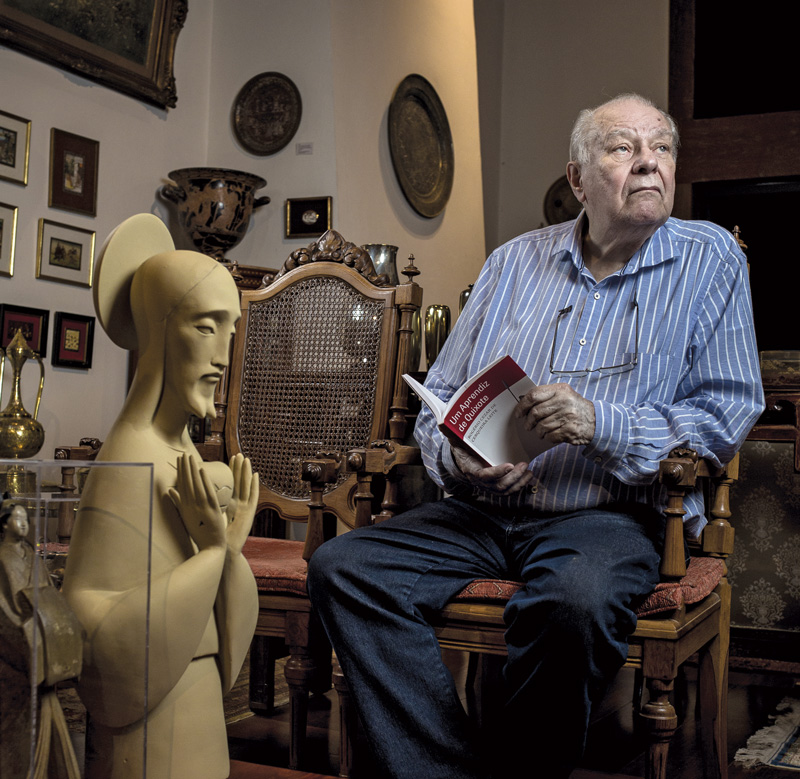
Keiny Andrade/FolhapressPhysicist Cerqueira Leite at his home in Campinas, 2017Keiny Andrade/Folhapress
Until a few weeks before his death on December 1, physicist and electronic engineer Rogério Cezar de Cerqueira Leite, 93, was actively working as Chairman of the Board of Directors of the Brazilian Center for Research in Energy and Materials (CNPEM) in Campinas. The institution, which he helped to design and create, is home to Brazil’s new synchrotron light source: the Sirius accelerator, the largest and most complex laboratory in the country. Cerqueira Leite was one of the most influential Brazilian scientists, both for his research—he published 80 scientific articles, cited more than 3,000 times—and for his work establishing science institutes.
As the author of 15 books, the physicist was a prolific writer. He shared his opinions on important political and scientific issues, especially in columns in the newspaper Folha de S.Paulo, where he was a member of the editorial board between 1978 and 2021. He advocated for the participation of scientists in debates on what he called “key national issues,” such as defense, violence, and economic and social reforms. He used his own political involvement as an example of the combative action that, in his opinion, the scientific community should take.
His education and academic work overseas, first in France and then in the USA, gave Cerqueira Leite a vision of economic development linked to science, something that he endeavored to adapt to the unique circumstances of Brazil. “He believed that Brazil could be competitive on the global scientific scene and pushed for the creation of pioneering institutions by looking to appoint the right people to the right places,” says physicist Antônio José Roque da Silva, general director of CNPEM. “For him, the right people were nonconformists, questioners, people who do not easily accept established knowledge.”
Born in Santo Anastácio, São Paulo State, in 1931, Cerqueira Leite lost his mother at the age of four and his father 10 years later. He always liked mathematics and wanted to study at the Polytechnic School of the University of São Paulo (Poli-USP). Through an uncle who was an Air Force captain, he found out about the Technological Institute of Aeronautics (ITA), where he studied and graduated in electronic engineering in 1958. He did a PhD in physics at the University of Paris (Sorbonne), which he completed in 1962, and that same year was invited by physicist Sérgio Porto (1926–1979), who had been his professor at ITA, to carry out research at Bell Laboratories in New Jersey, USA.
The eight years he spent as a researcher at Bell Labs were his most productive period. “I published like a beast,” he said, smiling, in a recent interview with the FAPESP Memory Center. Most of the research he did there was in solid state physics. At the time, understanding semiconductor materials was the key to developing microprocessors. Cerqueira Leite helped develop applications of Raman spectroscopy, a laser technique used to analyze the molecular structure of many of these materials.
In 1968, toward the end of his time in the USA, Cerqueira Leite began thinking about returning to Brazil to lead research into the physics of solid materials. He was able to do just that in 1970, when Zeferino Vaz (1908–1981), dean of UNICAMP at the time, invited him to head what is now known as the Department of Condensed Matter Physics at the Gleb Wataghin Institute of Physics (IFGW). Over the course of the 1970s, together with Porto and physicist José Ellis Ripper Filho, Cerqueira Leite turned the IFGW into a groundbreaking institution. He was supported by a network of international connections and financial contributions from public agencies such as the Brazilian Development Bank (BNDES) and the Brazilian Funding Authority for Studies and Projects (FINEP).
According to physicist Carlos Henrique de Brito Cruz, former scientific director of FAPESP and senior vice president of research networks at Elsevier, Cerqueira Leite’s experience at Bell Labs gave him essential insight into how to organize research and bring together companies and universities. “He saw that companies play an important role in research, but also that universities continue to be fundamental for basic research,” says Brito Cruz, who was also dean of UNICAMP between 2002 and 2005. He shared his ideas with Porto and Ripper, resulting in the creation of such institutions as the Research Center for Development and Telecommunications (CPqD) at the telecommunications company Telebrás, located near UNICAMP, in 1974. The first Brazilian optical fiber was developed there in 1976.
Around the same time, Leite founded the Technological Development Company (CODETEC), also in Campinas, as an incubator for small businesses and to facilitate interactions between the university and the private sector. Brito Cruz says this was a pioneering initiative in adapting the model that was so successful in Silicon Valley, California, where Stanford University functioned as a hub for technology companies. In 1979, continuing these efforts, Leite founded the Campinas High Technology Development Center (CIATEC).
He was inspired by a nationalist vision that Brazil needed to be more autonomous in technology, science, and energy. In the 1970s, he was one of the critics of an agreement between Brazil and Germany to build the Angra 2 nuclear power plant, in which he saw the technology transfer process as insufficient. He argued for investment in the National Alcohol Program (Proálcool) as a means of taking advantage of the country’s energy potential in biofuel. In the 1990s, he opposed the Amazon Surveillance System (SIVAM) project, managed by the armed forces, which he believed was an example of “voluntary servitude” to foreign interests.
Cerqueira Leite considered the lack of focus and funding for large research projects to be a problem in Brazilian science policy. He was against over-dispersion of resources, which he labeled as “pseudodemocracy.” He preferred investments to be concentrated in large projects and hubs. In the 1980s, in addition to serving as vice president of São Paulo Power and Light Company (CPFL) from 1983 to 1987, the physicist also put his vision into practice. He played a decisive role in the development of a large particle accelerator in Brazil, which eventually became the Brazilian Synchrotron Light Laboratory (LNLS). Opened near UNICAMP in 1997 and replaced by Sirius in 2020, the LNLS was the first of the four laboratories that currently comprise the CNPEM.
This center is also home to its latest intellectual offspring: ILUM, a higher education institution opened in Campinas in 2022, which offers an interdisciplinary bachelor’s degree in science, technology, and innovation. According to physicist Adalberto Fazzio, director of ILUM, Cerqueira Leite wanted to equip young researchers with broad knowledge, without them being dependent on the figure of a supervisor. “Researchers start their careers very late, which is detrimental to creativity,” notes Fazzio.
At UNICAMP, as well as having led the IFGW, he was also one of the people responsible for establishing its music department in 1970, which went on to become the current Institute of Arts. His appreciation for the world of arts was notorious. As a teenager, he sneaked into theaters, he owned thousands of classical music records, and he had a vast collection of Chinese, pre-Columbian, and African art. “Until the end, he continued studying and learning about his collections,” says José Roque.
Republish