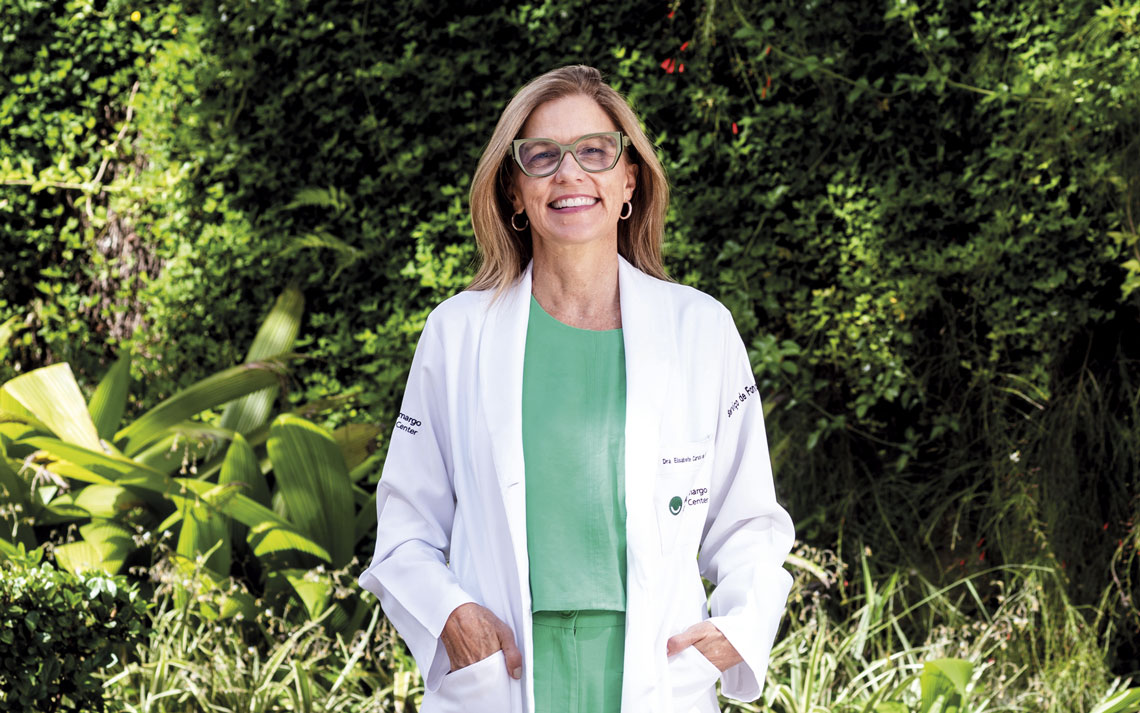
I started working at the A.C.Camargo Cancer Center, São Paulo, almost 30 years ago, in 1996. But my first memory of the hospital, as well as my interest in voice rehabilitation for cancer patients, is from much earlier.
I was born in the city of São Paulo and grew up in the Campo Belo neighborhood. My mother enrolled all four of her children in guitar lessons, but I was the only one who continued studying the instrument. I even completed a free classical guitar course. When I was nine years old, I visited A.C.Camargo for the first time to play guitar in a Christmas performance for children at the hospital. I like to think that this was the embryo of a project that I would create years later: the Sua Voz choir.
The choir was formed in 2011, at around Christmas time. I played guitar at the first performance and never stopped. The choir is composed of A.C.Camargo patients undergoing rehabilitation. Now featuring 23 singers of various styles and ages, we try to act as a support group for patients and spread the idea of voice diversity. The choir also serves as a channel for talking about cancer prevention, especially laryngeal cancer.
Tumors in the head and neck can affect functions such as breathing, eating, and speaking. In some cases, treatment requires partial or total removal of the larynx (which includes removal of the vocal cords) and tongue. With speech therapy, these people are often able to communicate again, albeit with a slightly different voice—usually deeper. As a result, many choose to isolate themselves socially. This was the starting point for the creation of the choir. Music allows you to practice melody and pauses in breathing, both of which are important to cancer patients in the process of relearning speech.
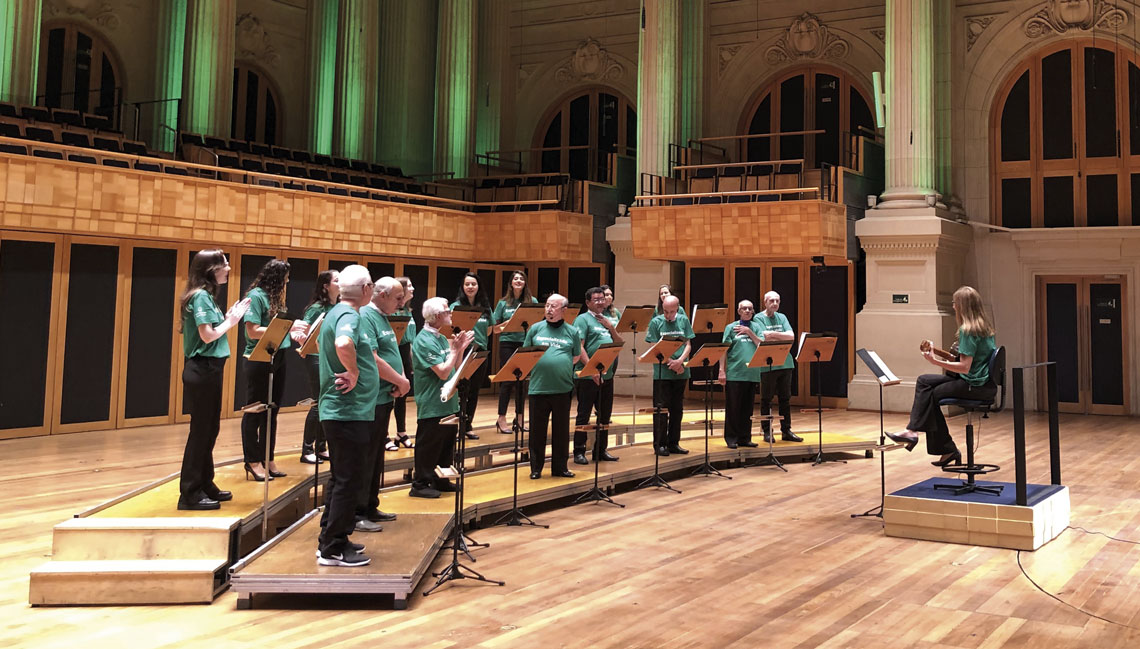
Personal archive Carrara-Angelis (on guitar) with the Sua Voz choir at Sala São Paulo, 2021Personal archive
This is a topic that I have been interested in since I did my undergraduate degree in speech therapy. I studied at the Paulista School of Medicine of the Federal University of São Paulo [UNIFESP] and before finishing the course in 1988, I did an internship with head and neck cancer patients undergoing rehabilitation. That was what I intended to study for my master’s degree, but at the time, postgraduate programs in oncology only accepted doctors. So I continued studying voice disorders, but in the field of neurology. During my master’s degree and PhD, which I completed in 1994 and 2000 respectively (both at UNIFESP), I analyzed voice and swallowing disorders in people with Parkinson’s disease. It was around that time that my first son, Eduardo, was born.
Soon after I finished my PhD, I was invited to join the A.C.Camargo Postgraduate Committee. Since then I have also worked as a teacher and research supervisor on the medical center’s master’s and doctorate programs.
A little later, in 2004, my daughter Gabriela was born with Down syndrome. My experience in research helped me deal with her verbal apraxia, enabling me to intervene and pass on what I learned. Most clinicians at the time believed apraxia of speech only affected adults. In children with Down syndrome, difficulties articulating sounds were commonly associated with some type of intellectual disability. As I followed my daughter’s development, I began to question this paradigm. I often say that if I was not a speech therapist and a scientist, Gabriela would never have spoken.
Today the concept of childhood apraxia of speech is well established. In 2007, the American Speech-Language-Hearing Association [ASHA] adopted the term CAS [Childhood Apraxia of Speech], which encompasses all apraxias that manifest in childhood as a neurological disorder in which the precision and consistency of speech-related movements are impaired. Because the disorder is linked to a motor speech issue, speech therapy is used to teach patients how to produce the sounds of the letters in a process similar to that used for individuals who have had their larynx or tongue removed. That is what we did with Gabriela and we achieved great results.
To help other families facing similar issues, I created the Fala Down project at the Darcy Vargas Children’s Hospital, a public institution linked to the São Paulo State Health Department, in 2010. For almost 10 years, we have been treating children with apraxia of speech and providing guidance to their caretakers. The project was halted shortly before the pandemic in 2019.
That same year, Eduardo, who was then 20 years old, was diagnosed with a brain tumor. Within a few months, he fell into a coma. But in order to receive the most effective treatment, he needed to be conscious. So I started studying neuromodulation techniques. I proposed to the medical team at A.C.Camargo, where he was hospitalized, that they use the approach to help my son’s recovery process. Their response was really positive and over the course of his treatment, I realized the potential of neuromodulation in speech therapy.
Eduardo died in November 2019. After taking some time off work and research, my passion for the voice prevailed. In 2021, after completing a course at the Center for Assistance and Research in Neuromodulation [Rede Napen] in São Paulo, I started using transcranial direct-current stimulation [tDCS], a method of neuromodulation, in the rehabilitation of cancer patients and in children with Down syndrome and autism spectrum disorder.
The procedure, which lasts 20 minutes, involves placing two electrodes on the patient’s head. The stimulation caused by a low-intensity electrical current creates synapses that help individuals without a tongue or vocal cords relearn how to speak using the esophagus, an organ in the digestive system. It is like the body reinvents itself. We recently completed a research project on this at A.C.Camargo. We tested the use of neuromodulation in patients whose tongues had been removed during cancer treatment. One of the cases was described in an article published last year.
I am now finishing a master’s degree project on neuromodulation and Down syndrome in partnership with the Postgraduate Program in Neuroscience and Cognition at the Federal University of ABC [UFABC]. I am also working on a project with Rede Napen to make this treatment available via the public health system. Neuromodulation has been used since the 1960s in fields such as mental health and physiotherapy, but in speech therapy it is something new. There are many challenges, but also many excellent prospects.
The story above was published with the title “The choir of life” in issue in issue 350 of april/2025.
Republish