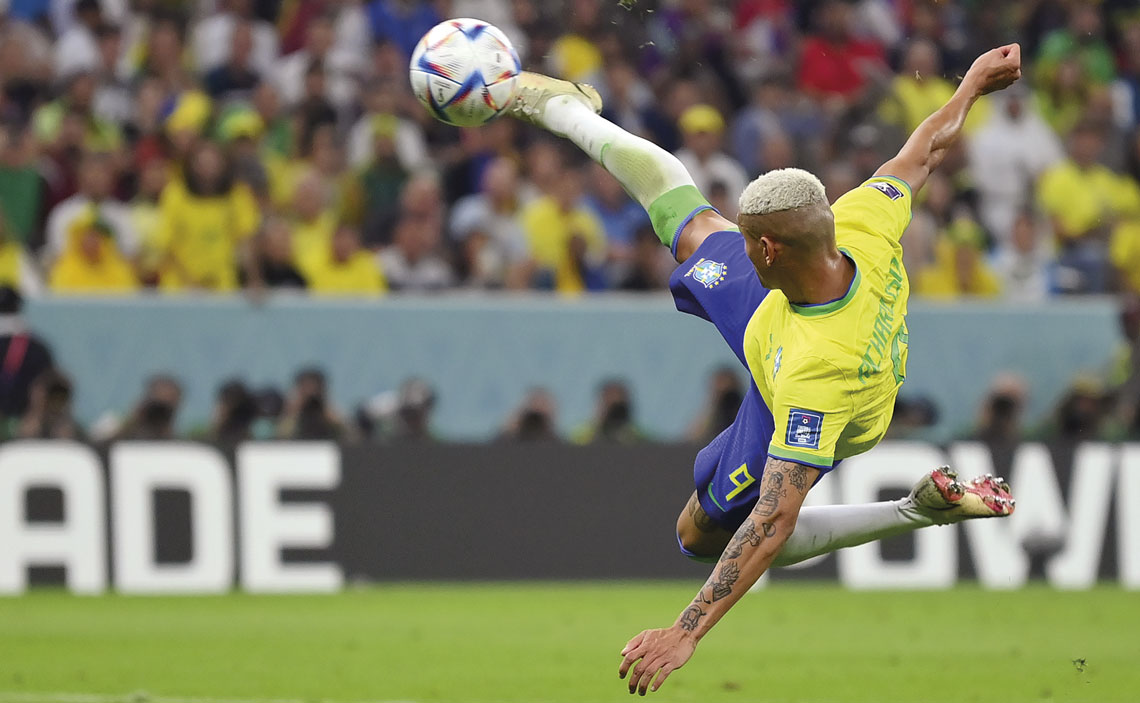
On Thursday, November 24, 2022, Brazilians watched attentively as the national team played its opening match against Serbia at the World Cup in Qatar. More than two years later, maybe few remember the game, which ended with a 2 x 0 victory for Brazil, but striker Richarlison’s volleyed goal remains etched in the memories of soccer fans. With his left foot, he cushioned the ball crossed with the outside of the boot by Vinicius Junior and, in a choreographed leap, struck a precise shot with his right foot past the opponent’s goalkeeper. Chosen as the goal of the tournament in a public poll by the International Federation of Association Football (FIFA), the moment illustrates the athlete’s profile on one of his social media accounts.
Moments like this, which captivate even those who do not follow the sport, do not rely solely on luck or extraordinary physical ability. In addition to a deep technical understanding of the game, athletes who pull off such moves demonstrate superior abilities in processing information and making decisions than individuals of the same age and educational level, according to a study published in January in the scientific journal Proceedings of the National Academy of Sciences (PNAS).
In the study, an international group of researchers, including Brazilian Alberto Filgueiras, of Central Queensland University in Australia, investigated the personality traits and cognitive abilities of 153 players from teams in Brazil’s top league, Série A, and 51 players from the top division of Sweden’s national league—the athletes ranged from 17 to 35 years of age. According to the authors, this is the most extensive psychological and cognitive assessment conducted on the largest number of elite players to date. Previous studies included few athletes at the peak of their careers and only some of the tests.
In the study published in PNAS, each player underwent three sets of neuropsychological tests. The first one defined the personality traits of the participant, whereas the other two, one of which was developed by Filgueiras and colleagues and published in 2023 in the journal BMC Psychology, measured their cognitive abilities—characteristics such as creativity, mental flexibility, and short-term memory, as well as the abilities to sustain attention, plan and solve problems, and inhibit inappropriate responses.
In all the cognitive tests, the soccer players achieved higher average scores than the reference values for individuals of the same age group, or than members of the control group, composed of 124 Brazilians from the same age range and educational level who did not play soccer.
The superiority of the soccer players in these cognitive characteristics, important for quick reactions, changing strategies, or creating chances in the heat of the game, was complemented by personality traits that also favored self-confidence and teamwork. The athletes presented higher levels of extraversion, openness to new experiences, and conscientiousness (a trait linked to ambition, self-discipline, focus, and self-control) than the participants from the control group. In turn, the control group scored higher than the athletes in characteristics such as agreeableness and neuroticism, the latter referring to the tendency to experience negative emotions, such as anxiety, anger, frustration, and guilt.
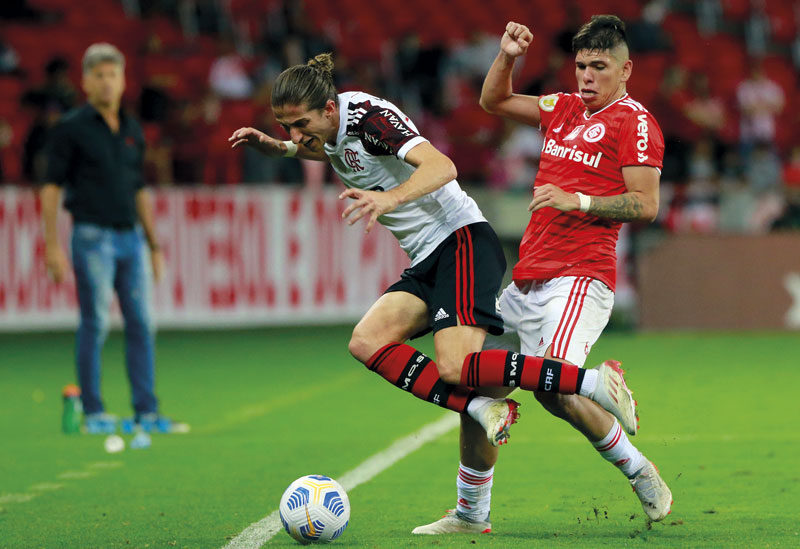
Silvio Avila / Getty ImagesA dispute for the ball between Felipe Luis, of Flamengo, and Carlos Palacios, of Internacional, in a Série A match during the 2021 Brazilian ChampionshipSilvio Avila / Getty Images
These results, according to the researchers, suggest that elite soccer players tend to be more sociable, disciplined, and adaptable than those individuals in the control group used for comparison. In contrast, the non-athletes demonstrated greater emotional instability and a greater tendency to follow social norms without questioning them than the soccer players.
As a continuation of the study, the authors used the personality traits and cognitive performance of all the participants to teach two artificial intelligence programs to distinguish elite soccer players from non-athletes. They also used one of these programs to identify which personality traits and cognitive abilities contributed most towards recognizing who was a top-level soccer player. Afterward, based solely on the personality data and cognitive test results, they asked the program to select which were the elite athletes—the algorithm chose correctly 97% of the time.
For the final stage of the research, to verify whether these characteristics could predict the players’ on-field performance, the researchers compared the psychological profiles and the cognitive abilities of the Brazilian athletes with their actual performances (goals, shots on goal, passes, and dribbles) during the 2021 season of the Brazilian Championship, the Copa Sudamericana, and the Copa Libertadores da América—the Swedish players were excluded from this phase because of a lack of data. The players who scored higher on the scales of conscientiousness and openness to new experiences scored more goals, while those with better memory successfully completed more dribbles.
“Our results show that cognitive abilities, such as planning and mental flexibility, are directly linked to performance in soccer, influencing metrics like goals, dribbles, and assists,” said Italian psychologist and neuroscientist Leonardo Bonetti, a professor at Aarhus University in Denmark and a researcher at the University of Oxford in the UK, and lead author of the study in PNAS, to Pesquisa FAPESP. A graduate in classical guitar and psychology with a PhD in neurosciences, Bonetti researches the brain mechanisms behind memory and cognitive abilities.
“Our article aims to identify a typical cognitive and personality profile of elite athletes,” explains Filgueiras, coauthor of the study. “Until now, we have known that elite athletes have better physical abilities and technical-tactical knowledge than the rest of the population, but we were always met with the stereotype of the unintelligent athlete, who only has physical skills,” he says. The researchers have now shown that their mental characteristics, particularly personality and executive functions, differ from those of the general population. “It would be a sort of sports intelligence, focused on solving problems and making effective decisions on the soccer field.”
One finding that caught the researchers’ attention was the low level of agreeableness among elite athletes; in other words, a tendency to question direct orders. “This makes us reflect on the role of the coaches, who often give a lot of instructions and commands. Interestingly, these athletes do not obey them automatically. They question them and need to be convinced that the instructions make sense before following them,” says Filgueiras. “This is not about impulsiveness, but rather about autonomy and confidence in their own decisions. If a coach says, ‘do it this way,’ the response will likely be, ‘Why? The other way seems better,’” the Brazilian psychologist adds.
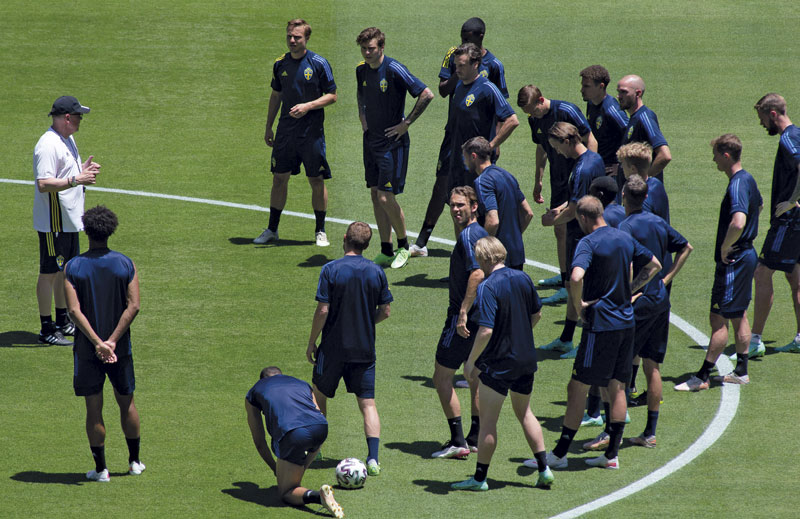
Joaquim Corchero / Europa Press Sports / Getty ImagesCoach Janne Andersson (in white) instructs players from the Swedish national team during a training session held in Spain in 2021Joaquim Corchero / Europa Press Sports / Getty Images
This trait, according to the researchers, could be linked to what is commonly known as “game intelligence,” a skill that involves not only awareness of the environment, but also the ability to adapt to sudden changes and maintain a stable performance. Ricardo Picoli, psychologist at Esporte Clube Bahia and coordinator of the Specialization Program in Exercise and Sport Psychology at the Federal University of São Carlos (UFSCar), states that this ability is particularly relevant in practical situations, such as changes in formation or shifts in game scenarios. “Players with this more developed capacity are able to better assess long-term career opportunities, avoiding choices that may seem attractive initially, but could be harmful in the future,” adds Picoli, who did not participate in the study.
The authors of the study from PNAS argue that the results could be used by clubs and coaching staff to improve training methods by incorporating cognitive and psychological testing into player evaluation and development. “Analyzing these skills allows for a more precise approach to be taken in selecting athletes, defining roles within the team, and refining training strategies,” affirms Bonetti. “Success in soccer depends not only on physical attributes, but also on psychological traits and cognitive abilities, which play an essential role in the performance of high-level players.”
Using psychological assessments to try and understand and improve athletes’ performance is not new. In the last decades, sports psychology has sought to map how psychological factors influence a player’s performance and how they can be applied to enhance training, explains sports psychologist Kátia Rubio, senior associate professor at the School of Physical Education and Sport of the University of São Paulo (EEFE-USP) and coordinator of the Olympics Study Group (GEO-USP), in an earlier study, published in 2007 in Revista Brasileira de Psicologia do Esporte.
In high-performance sports, these factors were identified through psychodiagnosis, which assesses the athletes’ personality traits and emotional state during training and competition in order to find intervention strategies that alleviate symptoms of suffering and improve emotional well-being. “With the result of the diagnosis, conclusions can be made about individual or group characteristics that support the selection of new athletes for a team, adjusting training, individualizing technical-tactical preparation, choosing the strategy and tactics to use in a competition, and optimizing psychological states,” writes the researcher in the article from 2007.
In an interview with Pesquisa FAPESP, Rubio, who did not participate in the study led by Bonetti, says that the search for psychological profiles in sports began between the 1960s and 1970s, when psychology tried to establish itself as a science through psychometrics. “In the context of the Cold War, sports were seen as a way of demonstrating power and there was a lot of interest in making it more predictable, including trying to identify profiles of elite athletes,” recalls the researcher. “However, more than five decades later, there is still not a definitive model that can predict, categorically, who will be a champion. Sporting performance is multifactorial, influenced by psychological, environmental, and social aspects,” he ponders.
This, therefore, is a gap that the authors of the study from PNAS intend to fill, by expanding the research to sports teams’ youth academies. Under the coordination of Filgueiras, they plan to research how cognitive traits develop and whether it is possible to predict which players have a greater chance of reaching elite level. “We’re also seeking to explore the relationship between cognitive abilities, positions on the field, and team balance, since a team doesn’t need players with only one type of cognitive profile to be successful,” says Bonetti.
The story above was published with the title “Good ball skills and reasoning” in issue in issue 350 of april/2025.
Scientific articles
BONETTI, L. et al. Decoding the elite soccer player’s psychological profile. Proceedings of the National Academy of Sciences. Jan. 14, 2025.
FILGUEIRAS, A. et al. Cognition in soccer and futsal: Evidence of validity of a 4-instrument protocol to assess executive functioning among women athletes. BMC Psychology. Dec. 9, 2023.
RUBIO, K. Da psicologia do esporte que temos à psicologia do esporte que queremos. Revista Brasileira de Psicologia do Esporte. Dec. 2007.