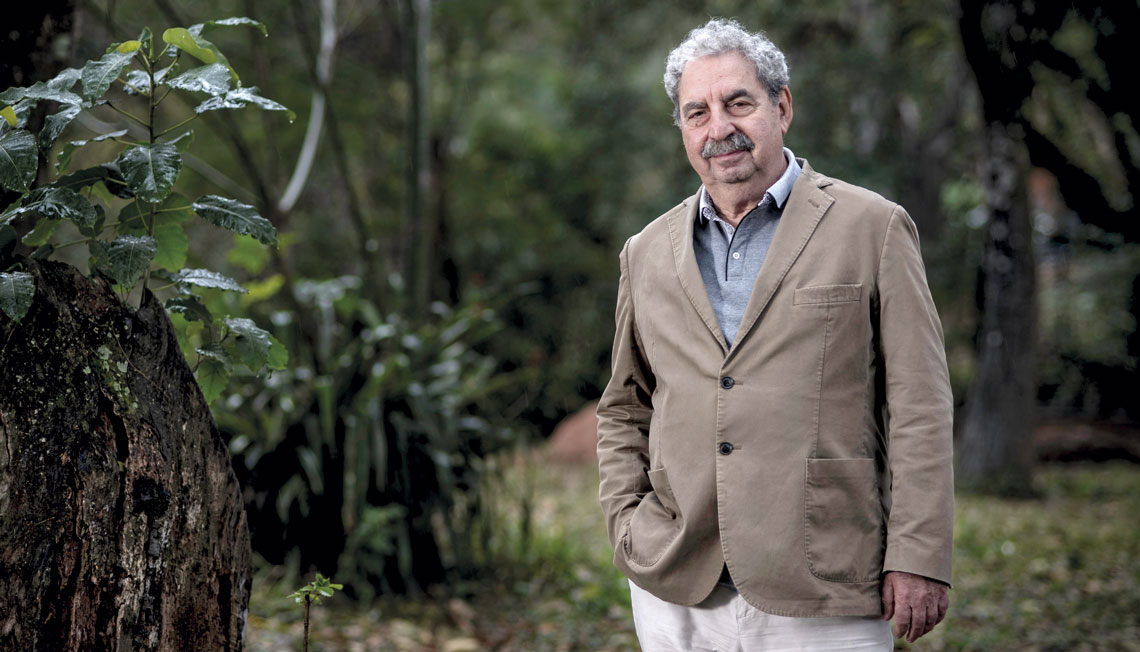
French philosopher Francis Wolff, a professor emeritus at École Normale Supérieure in Paris, has a long-standing connection with Brazil. In the early 1980s, he taught at the School of Philosophy, Languages and Literature, and Humanities at the University of São Paulo (FFLCH-USP), the last person funded by the French government to teach at the institution through an arrangement that began in the 1930s.
Wolff, 74, is considered a leading expert on the work of Aristotle (384–322 BC), although in the last two decades, he has shifted his attention to the contemporary world. In Brazil, he released books such as Nossa humanidade – De Aristóteles às neurociências (Our humanity – From Aristotle to neuroscience; Editora Unesp, 2013), Em defesa do universal – Para fundar o humanismo (In defense of the universal – Founding humanism; Editora Unesp, 2021), and Não existe amor perfeito (There’s no such thing as perfect love; Edições Sesc, 2018).
The FFLCH’s Philosophy Department invited Wolff to take part in an event in August to honor his work and the launch of the book A vingança do bom selvagem e outros ensaios (The revenge of the Noble Savage and other essays; Editora Unesp, 2024), by French philosopher Gérard Lebrun (1930–1999). During his visit, he took some time away from the festivities to speak with Pesquisa FAPESP.
Why did you come to live in Brazil in the 1980s?
My academic career in France was not progressing the way I wanted. I got my agrégation [equivalent to a bachelor’s degree] in philosophy from École Normale Supérieure in 1974 and secured a position as a lecturer at a teacher-training college in northern France. I remember driving down icy roads to visit my philosophy of education and psychopedagogy students who were doing internships as elementary school teachers. But what I really wanted to work with was the history of ancient philosophy. In 1979, I received a phone call from a former college colleague who had been appointed French cultural attaché in Brazil. He recommended that I apply to teach epistemology on the new philosophy course at the University of Campinas [UNICAMP]. He told me to contact Gérard Lebrun, who was already teaching at the institution. Lebrun came to Paris to interview candidates and I met him at a café. Two months later, I was offered the job and I arrived in Brazil in October 1980 with my wife, my son, and a piano. In 1979, Lebrun left the French government–funded philosophy professorship at USP after six years in the role and began teaching at UNICAMP. I applied to take his place at USP. In February 1981, I began teaching the history of ancient philosophy at the university. My aim was to offer students a more classical education in terms of reading texts, as well as to strengthen the graduate course.
How old were you?
I was 30. I was a young professor who wanted to leave France for a while to experience other cultures. As it happens, being young was a characteristic of those who assumed the philosophy professorship, which was created by a French mission at USP in 1934. The first, philosopher Jean Maugüé [1904–1990], was also 30 years old when he arrived in Brazil. Lebrun, who held the position twice [1960–1966 and 1973–1979], was the same age in the 1960s. Many philosophers have held the position, such as Claude Lévi-Strauss [1908–2009], Gilles-Gaston Granger [1920–2016], and Michel Foucault [1926–1984], who was only in the role for one month as a visiting professor.
I arrived in Brazil in 1980, shortly after the amnesty, and people at USP were discussing how the country would emerge from the military dictatorship and transition into democracy
You were the last professor to occupy the position. Why was it ended?
The French Ministry of Foreign Affairs decided to close the professorship very abruptly, without warning anyone. Many professors from USP, such as Marilena Chaui, and even professors from other universities in São Paulo, spoke out against its closure. It even made the television news, but it was in vain. I was supposed to spend six years in the role, but I only stayed for about four years. I returned to France at the end of 1984 and took up a teaching position at Aix-Marseille University. But I did not cut all my ties with USP. Until the mid-1990s, I used to visit regularly to give seminars and teach graduate courses at the Philosophy Department.
Was it difficult to adapt to the Brazilian academic environment?
No. Foucault called the philosophy department at USP a “French overseas department.” Practically all of my colleagues were French speakers who completed their doctorates in France. And two-thirds of the philosophy department’s library was in French, since the French government had shipped over many books over the decades. The exceptions were the philosophers of science who had studied in the US. I learned Portuguese, however, unlike some of my predecessors. José Arthur Giannotti [1930–2021], who was a professor at USP, used to say that Lebrun would start his classes in Portuguese, but students would ask him to continue in French so they could better understand the content. Teaching philosophy in a language other than our own is an experience that is as disconcerting as it is enriching, particularly because we philosophers need clarity in our thoughts. At first, I felt helpless and even a bit stupid, because philosophy requires precise vocabulary and subtle syntax. But the act of translating concepts allowed me to learn better what I wanted to say, what I wanted to think—it helped me to eliminate the word games that could be beautiful in my own language but confusing in another.
In France you were more involved in epistemology, but at USP you converted to the study of political philosophy. What happened?
I arrived in Brazil just after the amnesty. The climate was one of political openness. In the corridors and classrooms of USP, people discussed how the country would emerge from a military dictatorship and transition into democracy. I had no education in political philosophy, which at that time in France was taught by the most reactionary professors, especially classical philosophers, by authors such as Rousseau [1712–1778] and Montesquieu [1689–1755]. Progressives like me were linked to the philosophy of science, epistemology, and the history of knowledge, strongly influenced by Marxism. But the big issue in Brazil at the time was democracy and its institutional, social, legal, cultural, and historical conditions. These were the questions I learned to ask here through the history of philosophy. I began teaching my students about democratic thinkers, such as Protagoras and the sophists, as well as certain aspects of Aristotle’s politics. Alongside my colleagues and with great enthusiasm, I experienced the mass demonstrations of the early 1980s calling for the return of democracy, such as the Diretas Já movement.
What is your view on the expansion of the extreme right around the world today?
It concerns me, but I have not lost hope. Between the 1970s and 1990s there was a move back toward democracy in various places around the world, including countries in Latin America and Greece, Portugal, and Spain. Now we are witnessing a movement in the opposite direction. There is a nationalist and authoritarian trend in countries like England, Germany, and France, but I believe that in the case of Europe, the European Union is capable of protecting the continent from the advance of populist national movements. The European Union is far from perfect, but it represents what I call a kind of “cosmopolitanism” on a regional scale. In Três utopias contemporâneas (Three contemporary utopias; Editora Unesp, 2018], I defended the idea that we need to create a form of internationalism compatible with the diversity of humankind. I hope that the construction of regional spaces can overcome nationalism and self-centered tendencies in other parts of the world, with a rule of law that respects individual freedoms and provides social protection. The concept of a nation is a harmful ideological invention and I believe that the way forward for the world is federalization.
Is philosophy doing well in France?
Yes, although there are some who claim that the golden age of French philosophy was the 1960s and 1970s. I have noticed that teacher training and the range of topics covered today are superior to those of that time. One of the reasons for this is that graduate studies have become mandatory in any university education. Graduate courses are funded by scholarships—the amounts of which need to be improved—but this benefit did not exist in my country before the 1990s. Almost 2,000 philosophy theses are now defended every year in France, which has led to the creation of new disciplines more attuned to contemporary times, such as gender ethics and the philosophy of cognitive sciences. I often tell young people that philosophy requires patience, rigor, and an open mind. It is important to read widely—and not just the classics of our field, but also works from other disciplines, such as the arts. This enriches our philosophical reflection. It is also crucial to participate in philosophical discussions and debates, whether in an academic or informal setting. Philosophy feeds on the exchange of ideas and dialogue. Finally, it is important to keep in mind that philosophy is an approach to life, not just an academic discipline. It helps us question, understand, and navigate our complex world.