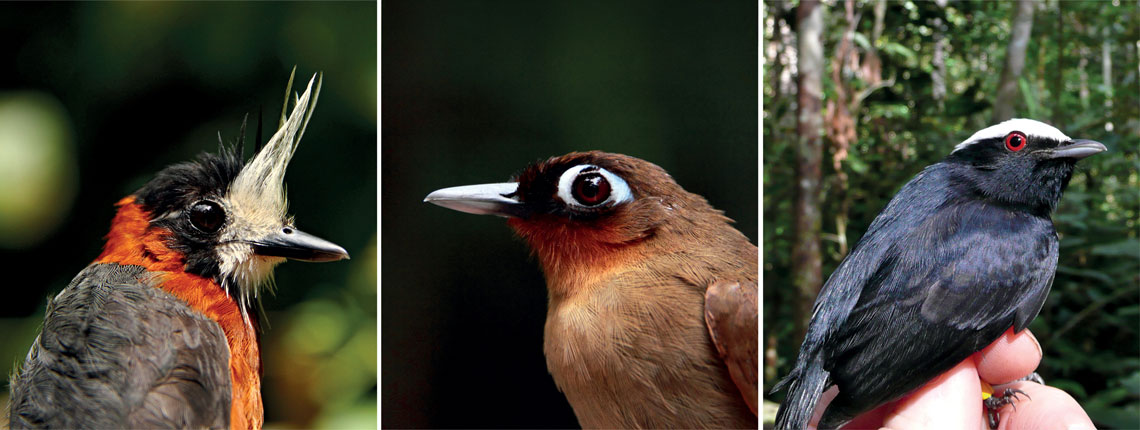
In the Amazon, many birds find refuge in the dense low-growing vegetation beneath the forest canopy. An article published on January 29 in the journal Science Advances suggests that an increase of 1 degree Celsius (ºC) in average temperature during the dry season—from May to October—has reduced the apparent survival rate of birds inhabiting the tropical forest understory by almost two-thirds, even though this area experiences virtually no human interference.
The conclusion of the study is based on statistical modeling that linked temperature and rainfall data with the capture and recapture numbers of 4,264 specimens of 29 bird species previously caught, identified with a ring, and released back into the wild. The animals were caught between 1985 and 2012 in 20 points within the 3,180 hectares of preserved forest of the Biological Dynamics of Forest Fragments Project (PDBFF), located 80 kilometers north of Manaus. Composed of 23 portions of forest, the PDBFF is a federal conservation unit and the research within the area is coordinated by the National Institute of Amazonian Research (INPA) in partnership with the Smithsonian Institute in the USA.
According to the study, the rise in temperature during the dry season reduced the average apparent survival rate of the bird community living in the understory of the PDBFF by 63%. In other words, due to the temperature increase, the probability of a bird surviving from one year to the next dropped to about one-third of what would have been expected if temperatures had remained milder.
“Tropical birds are very sensitive to changes that affect their habitat,” states ornithologist Jared Wolfe, lead author of the study from Michigan Technological University, USA, and collaborator at INPA, to Pesquisa FAPESP. “An increasingly hotter and more arid dry season has a very dramatic impact on the survival of practically all the birds that we analyzed in the Amazon understory.”
Overall, 24 of the 29 species showed signs of being affected by the warming of the region, with a greater impact observed in the group of birds with longer lifespans. Species such as the olive-backed foliage-gleaner (Automolus infuscatus), the spot-throated woodcreeper (Certhiasomus stictolaemus), the Amazonian plain xenops (Xenops minutus), and the rufous-throated antbird (Gymnopithys rufigula) are among the most vulnerable birds identified by the study.
“In our statistical model, temperature data explained about 85% of the variation in the apparent survival rate of the birds,” comments Wolfe. When the year became hotter, the rate fell; when it cooled, it increased. The research also calculated the impact that a 10-millimeter (mm) reduction in rainfall during the dry season would have had on the annual apparent survival rate of the birds. The effect was much lower than in the case of the increased temperature. On average, the decrease in rainfall would have been associated with a 14% reduction in the number of birds in the studied population.
Apparent survival is a concept used to describe the maintenance of life among previously identified animals within a defined area over time. A drop in this rate does not necessarily mean that a member of the sample has died. Three factors, which this definition does not distinguish, can lower the numbers related to apparent survival: the actual death of members of the studied population, migration outside the study area, and even simply failing to recapture animals within the expected time frame.
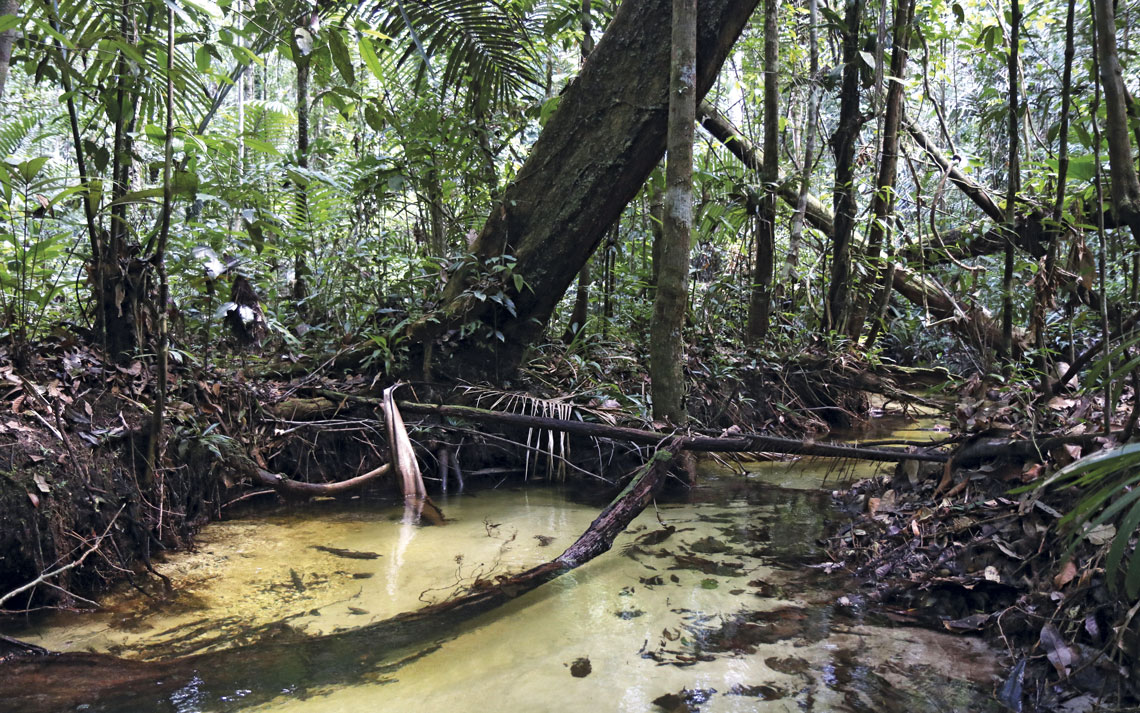
Vitek JirinecAn area of understory within the PDBFF, 80 kilometers from ManausVitek Jirinec
When a bird is not recaptured, it is a sign that it may have died or was simply not caught again. The authors of the article used a statistical model to differentiate between these two probabilities. As a result, they adjusted the apparent survival estimates, which indicate the probability of a bird still being alive the following year.
It is possible that rising temperatures and the observed drop in rainfall may be influencing birds to seek out other territories, which are cooler and have a greater supply of water. However, the recurring failure to recapture the birds year after year is, in Wolfe’s assessment, an indication that the heat and dryness have been increasingly fatal to them.
Rain, water availability, and the diversity of local terrain appear to be important for creating microclimates that help birds stay cool amid rising temperatures. “Do these species have the adaptive capacity to develop evolutionary responses that keep up with the conditions they now face?” asks biologist Philip Stouffer, of Louisiana State University, a coauthor of the study, in an interview with Pesquisa FAPESP. “Under the current conditions, populations are declining, and survival rates are dropping. So far, the results have not been encouraging.”
According to the biologist, the resilience of understory birds depends on preserving large areas of intact forest. This ensures that even with dwindling populations, the species can remain viable. “Lower-lying areas of the forest, such as along streams, are also extremely important for protecting the birds, because they provide refuge niches,” notes Stouffer.
Ornithologist Mario Cohn-Haft, curator of the bird department at INPA, who did not participate in the study published in Science Advances, also stresses that the results of the study highlight the importance of conserving large areas of intact forest. “Climate change is due, in part, to deforestation,” he says. “We need to restore the forest and stop cutting it down. This will help reestablish the climate and preserve the conditions necessary for maintaining biodiversity.”
For evolutionary biologist Ana Paula Assis, from the Institute of Biosciences at the University of São Paulo (IB-USP), the study conducted in the Amazon stands out for having used long-term data—nearly 30 years’ worth. “If they obtained these results while working in areas of virgin forest, imagine how much worse the situation must be in deforested or fragmented areas of forest,” wonders Assis, who also did not participate in the article.
She suggests a possible extension of the research: investigating whether variations in survival rates among birds could be related to hereditary factors. “If any individuals from the more threatened species can easily survive the temperature increase, perhaps they can pass this ability on to their offspring if this resilience is based on a genetic trait,” comments the biologist.
Studies like the one done in the PDBFF have been conducted in Panama and Ecuador. These studies indicate that birds, especially insect-eating species, are disappearing from the lowest and intermediate sections of the forests. Research like that conducted in the Amazon, linking climate change to bird survival, is still rare, and long-term data on this issue remains scarce.
The story above was published with the title “More heat, fewer birds” in issue in issue 349 of march/2025.
Scientific article
WOLFE, J. D. et al. Climate change aggravates bird mortality in pristine tropical forests. Science Advances. Jan. 29, 2025.