


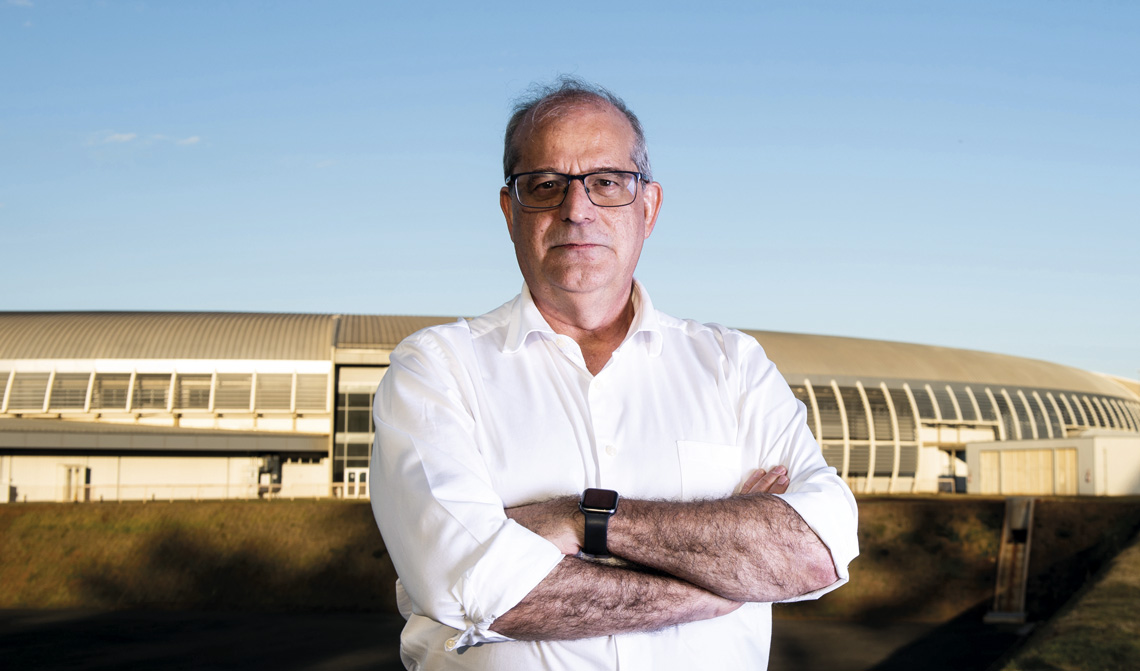
In 2009, Antônio José Roque da Silva, from São Paulo, was appointed director of the Brazilian Synchrotron Light Source Laboratory (LNLS) in Campinas, São Paulo. The circular accelerator of charged particles (electrons) generates radiation (synchrotron light), which allows scientists to investigate the structure of matter on an atomic and molecular scale. It functions like a giant microscope, capable of “seeing” the inside of materials, biological tissues, and pathogens.
José Roque, as he is known, is a scholar of atomic, molecular, and condensed matter physics tasked with giving a new lease of life to the old UVX, the Southern Hemisphere’s first synchrotron light source, and leading the construction of its replacement: Sirius, a new fourth-generation accelerator, the most advanced available. Shortly before the inauguration of Sirius in December 2018, the physicist began directing the Brazilian Center for Research in Energy and Materials (CNPEM). This CNPEM manages the LNLS, the National Biosciences Laboratory (LNBio), National Nanotechnology Laboratory (LNNano), and National Biorenewables Laboratory (LNBR), its own Technology Division (DAT), and the Ilum School of Science, which offers a bachelor’s degree in science and technology. “All these units work together in a coordinated way to carry out the mission of a research center that is unique in this country,” he says.
In April this year, José Roque, 61, won the 2025 Admiral Álavaro Alberto Award in the Exact, Earth, and Engineering Sciences category. The honor is awarded by the Brazilian National Council for Scientific and Technological Development (CNPq), in partnership with the Brazilian Ministry of Science, Technology, and Innovation (MCTI) and the Brazilian Navy, to scientists who have made an important contribution to the country. In this interview, given at his office in Campinas, the physicist talks about the CNPEM, how Sirius works, and the Orion project, which will be the first maximum biosafety level (BSL-4) laboratory in Latin America.
Was the award a recognition of your work as a scientist, or for the management side of things?
It was probably a bit of both, but I think my role as a manager played the greater part. Obviously, Sirius is a highlight in the context of the CNPEM and Brazilian science. But the research center is larger than Sirius alone and is a unique science institution in the country, similar to few abroad. The CNPEM’s institutional mission influences several transversal and multidisciplinary activities at our research units. I was chosen because they understood that I made an important contribution to the management of the CNPEM. It is almost an award for the technical capacity of Brazilian science. It conveys the message that Brazilian science can sometimes do things that other countries cannot. With more challenges and less money than richer countries, having to make smart choices, we have shown that we have competent people and companies. About 85% of Sirius’s components were built in Brazil.
Due to its grandeur and the level of investment, the Sirius project was initially criticized by some people in the scientific community. Has this criticism been completely overcome?
Since the first synchrotron, there has been concern in the scientific community that a project as large as Sirius could receive all the science funding that would otherwise be invested elsewhere. But that was never the case. Sirius is given a certain portion of the Brazilian science budget. We have received around R$2.5 billion over the 13 years since the project began.
Is Sirius now operating at full capacity?
It is always growing and will be for many years to come. It was designed to have up to 38 beamlines [experimental stations for carrying out studies on the structure of materials using specific frequency bands of the electromagnetic spectrum, such as X-rays, ultraviolet, or infrared, obtained from synchrotron light]. No synchrotron light source starts operating at full capacity. You cannot build that many beamlines at once. The first phase of Sirius’s operations, which began in 2020, included the design of 14 beamlines, which would cover most of the important techniques used by the scientific community at the frontier of knowledge. There are currently 10 lines fully open to users from any research institution in Brazil—and not just CNPEM researchers—or abroad. Two are still operating on an experimental basis and two are close to being ready. All 14 lines should be operational by the end of 2026. Despite some difficult moments, we have never had to suspend any research activities. With the current federal government, we negotiated an allocation of R$800 million from the new Growth Acceleration Program (PAC) to implement a second phase at Sirius, which will be used to add 10 more beamlines. Construction has already been started on some. We hope to complete the second phase lines by 2028.
The award recognizes technical and managerial skills in Brazilian science
Is there a typical Sirius user or does each beamline have a different user profile?
I would say that we have the more traditional users who, in previous decades, used the UVX source and now use Sirius. They are mostly from the field of physics, as well as materials sciences and chemistry, especially scientists who work with catalysis. We have made an effort—which has been successful—to expand its use to other areas, such as health, soil sciences, cultural heritage, and porous materials. Last year, 437 studies used a Sirius beamline in some form, of which 309 were carried out by external researchers not from the CNPEM.
Do scientists from CNPEM laboratories have priority?
Back when the UVX was still around, they had a set percentage of time to use them, but not anymore. Competition here is high. Of every three or four requests to use a beamline, only one is approved. Researchers from the CNPEM have to submit their proposals for analysis just like anyone else. They do not receive any special treatment. Recently, there has been an increase in requests to use Sirius from the US and Europe. Previously, international applications primarily came from Argentina and other South American countries. In 2024, 16% of approved proposals were from abroad. In the past, almost no one from outside South America came to use the UVX. But to use Sirius, they come.
What are Sirius’s competitors around the world?
In addition to Sirius, there are currently two other fourth-generation synchrotron light source facilities open to external users in the world. One is MAX IV in Sweden, which started operating before us in 2016. The other is the European Synchrotron Radiation Facility [ESRF] in France, which was upgraded to a fourth-generation synchrotron in 2020. At MAX IV, the electron energy is to the order of 3 gigaelectronvolts [GeV], the same as Sirius. The ESRF is a 6 GeV machine, meaning it has electrons with twice the energy of Sirius. It is in another category and can generate higher energy X-rays with greater brightness. At these higher frequencies, Sirius and Max IV cannot achieve the same brightness. However, Sirius was designed for beamlines with high-energy photons as well. We are very competitive in more intermediate energies, which are important for studies on issues related to health and agriculture, for example. The accelerator electron energy is not an important factor in defining the generation of a synchrotron. A higher energy synchrotron is generally larger than a lower energy one. It is therefore more expensive to build and operate. The choice of accelerator energy is about cost-benefit. Sirius was designed to be competitive across a wide range of photon energies, including high-energy X-rays.
So what does determine the generation of a synchrotron?
What really matters is the brightness of the synchrotron light beams. The brighter the beam, the more photons—which are light particles—can be concentrated into a very small beam, increasing the experimental capability of the synchrotron to see inside materials. An important parameter for increasing brightness is emittance, which determines the size and concentration of the electron beam that circulates through the accelerator. The lower the emittance, the higher the brightness. The next fourth-generation synchrotron to be opened to external users is expected to be the Advanced Photon Source [APS] at Argonne National Laboratory, USA. It is a 6-GeV machine, similar to the one in Europe. The Swiss Light Source [SLS] at the Paul Scherrer Institute in Switzerland is being upgraded to a fourth-generation 2.7-GeV synchrotron, and China is building a 6-GeV synchrotron called the High Energy Photon Source [HEPS]. In the coming years, the number of fourth-generation synchrotrons operating worldwide will increase from three to six.
Against this landscape, will Sirius continue to be competitive?
Depending on the energy used and the problem to be investigated, Sirius can compete with all of them. It is not just the synchrotron capacity that makes a difference. Once you have a machine of a certain level, what really makes the difference is having good ideas for scientific problems to study. One challenge for Brazilian science is to identify problems sophisticated enough to justify the use of Sirius. Only then will it deliver to its full potential. We need challenging scientific problems to do work that was impossible to do here before Sirius.
Does the scientific community know what types of experiments can be done with Sirius?
That is one of our challenges, including from a communication standpoint. Researchers in fields such as condensed matter physics are well aware of Sirius’s capabilities. But scientists in other fields, such as biology and agriculture, often have no idea how Sirius could be useful in their studies. There is no point trying to explain all the technical details about how the synchrotron works to these scientists. They are not experts in the technique, they are users of it. We have to help them understand how synchrotron light can help them solve scientific problems. This is part of our day-to-day work here.
What work would you highlight that has already been done with Sirius?
It is important to highlight that most of the beamlines have only been in regular operation for two years, meaning papers describing these experiments are only now starting to be published. But important studies have already been published in the field of structural molecular biology, an area that the country previously did not have the capacity to study. In materials science, investigations were carried out on solar cells and electrochemistry. We are currently able to do X-ray tomography work on porous materials, soils, and rocks. We hope to increase our capacity soon to include work on biological systems.
We have to help researchers understand how synchrotron light can help them solve scientific problems
The Orion project is building a biosafety level 4 (BSL-4) laboratory attached to Sirius. Why?
During the pandemic, we needed level-three laboratories to deal with the SARS-CoV-2 virus. The MCTI invested heavily in the construction of more BSL-3 labs. We received funding at that time to build one. But some people from the ministry—who are not even scientists—were involved in conversations in the past that they picked back up about the country needing a level-four lab capable of dealing with maximum biosafety pathogens, such as the Sabiá virus, discovered in Brazil, and the Ebola, Junin, Machupo, and Guanarito viruses. They asked us if we could open a BSL-4 lab connected to Sirius. We said yes, but that there would be a series of obstacles to overcome. This kind of connection has never been made anywhere in the world. Orion should be completed by the end of 2027.
Is it more expensive to create a BSL-4 lab coupled to a synchrotron light source than without the connection?
If we had to do everything from scratch, it would be. But the main structure of Sirius already exists. Practically speaking, the decision does not make Orion more expensive. What extra costs will be incurred? Construction of the building that will connect Orion to Sirius—something relatively simple—and obviously the construction of three new synchrotron beamlines dedicated to the biosafety laboratory complex. The latter is more sophisticated. It requires special floors and other things. But this increased the value of the project as a whole, which had a budget of around R$1.5 billion, by 10 to 15%. The project grew in size as it matured and progressed. The biggest cost increase was related to spaces for animal experimentation. It is important to note that the three Orion beamlines will be part of the total of 38 possible at Sirius.
How will the Orion lab work?
It will be open for use to people not from the CNPEM, like Sirius. But its operating model will be different. Special training is required to use this type of laboratory. We had to get in touch with level-four labs around the world to learn how to run this type of facility. The 28,000-square-meter area of the building was based not on its connection to the three beamlines, but on the requirements of the lab itself, such as the need to conduct experiments on animals and develop vaccines.
What else will the building contain, besides the BSL-4 lab?
There will also be a BSL-2 lab and a BSL-3 lab. During visits to level-four laboratories abroad, we were advised to make our BSL-2 lab larger—twice the size of the BSL-4 lab if possible.
Why?
Because BSL-2 is where you prepare almost everything that will be used in the other levels. It is much simpler and cheaper to run. It is not worth using a BSL-4 lab or even a BSL-3, which is the level of safety required to deal with the COVID-19 virus, for low-risk tasks. The vaccine development process, for example, involves testing the vaccine on mice. The animals would be taken care of and inoculated in the level-two laboratory, where staff can work without wearing a special, fully enclosed suit that receives filtered external air, as is needed in level-four labs. The BSL-4 lab would only be used if the vaccinated animal were to be deliberately exposed to a virus to test to see whether the immunization confers any protection, in a type of experiment called a challenge. Cultures can be prepared in a level-three lab and then taken for use in the experiment in the level-four lab.
What is the advantage of the BSL-4 lab and Sirius being connected?
We will be able to carry out studies and analyses of the most dangerous pathogens we know in one location. We analyzed how many synchrotron beamlines it would make sense to have with Orion and came to the conclusion that we would need three. One for tomography scans of individual cells, to see how viruses and other pathogens modify cellular structure. A second to perform a tomography of tissues and organs, not necessarily at the intracellular level, but capable of looking, cell by cell, at how a disease or pathogen spread and caused damage. And finally, a third beamline dedicated to studying disease progression in live animal models. This form of tomography uses a much higher resolution than a benchtop machine.
Switching the subject to your career, could you tell us how your interest in science arose?
I was born in São Paulo, but my parents, who were government employees, moved us to Brasília between 1963 and 1964. I was seven months old and ended up growing up there. My father was a stenographer and my mother was a librarian at the Chamber of Deputies. Then there was the American space program, which took men to the Moon in 1969. Science and technology were special to me. My father liked these things and I heard conversations about them at home. Back then, people would go to newsstands, and I remember getting a science kit that included various physics and chemistry experiments. With help from my father, I carried out the experiments together with my brother [physicist Antônio Carlos Roque da Silva Filho of USP in Ribeirão Preto], who is one year older than me. In 1981, my brother started studying physics at UNICAMP [University of Campinas]. I went with him to take a preparatory course with the idea of studying engineering. But I found physics more interesting and started at UNICAMP in 1983.
What did you study before working at the synchrotron?
I began my scientific career with computer simulations, which I did in close collaboration with Adalberto Fazzio [physicist and now director of the Ilum School of Science at the CNPEM]. We set up a working group and initially did some research in the area of semiconductor materials. But soon after, the field of nanotechnology really took off. Anyone who did not study nanotechnology in the late 1990s and early 2000s was putting their career at risk of stagnation. I built my career at USP and my productivity was high based on my use of computational calculation techniques to study materials at a nanoscale. That was until I was transferred full-time to the LNLS in 2009.
