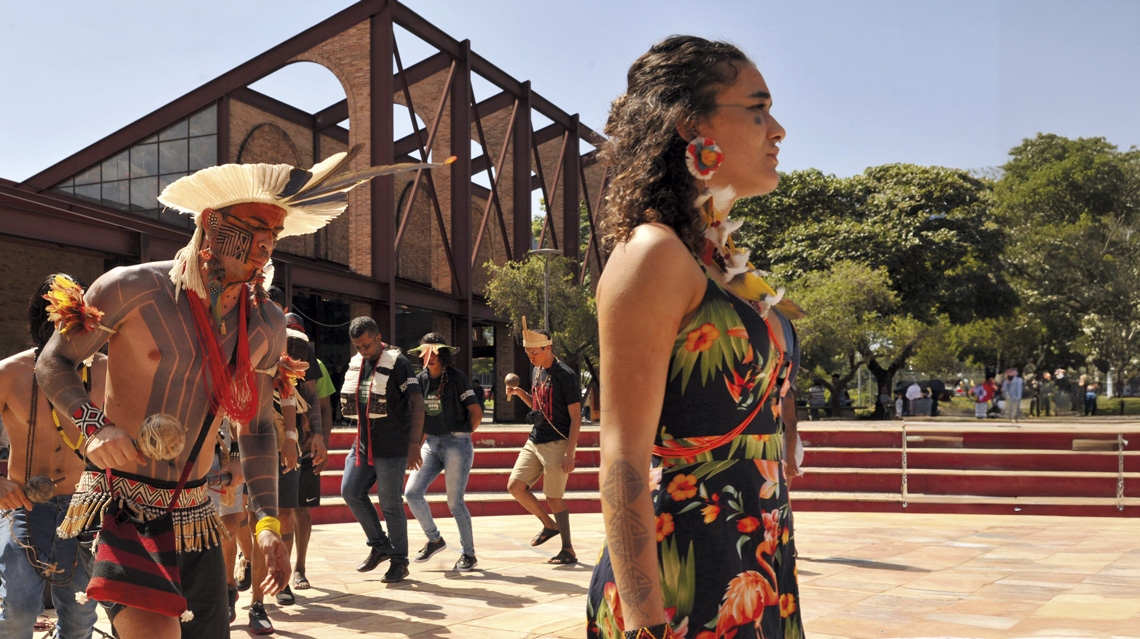
Brazilian universities have never enrolled as many Indigenous students as they do now. According to the Brazilian Ministry of Education’s Higher Education Census, nearly 70,000 Indigenous students, representing hundreds of ethnic groups, were enrolled in college in 2022—up from just 11,400 in 2009. About 29% of these students attend public universities, while the majority, 71%, are enrolled in private institutions. This rapid expansion has prompted universities to introduce new policies and programs to foster inclusion and respond to the needs of this new student population. But it has also brought friction. Like many of their peers, Indigenous students often struggle with financial insecurity, academic difficulties, and social isolation. They also face cultural barriers—ranging from limited proficiency in Portuguese to unfamiliarity with urban living and the rigid structures of academic life, like tight deadlines. Many students report experiencing discrimination and say their cultures are poorly represented in curricula and among faculty.
“In relative terms, Indigenous students are the fastest-growing group in higher education this century,” says Chantal Medaets, an education specialist and anthropologist at the University of Campinas (UNICAMP). “That shows a genuine interest in continuing their education.” Medaets heads the Observatory of Indigenous and Quilombola Students in Higher Education (Obiques), which tracks affirmative action initiatives across Brazil’s public universities.
One of the challenges, she notes, is the group’s sheer diversity. “Some students come from remote communities within Indigenous territories; others grew up and worked in large cities. Some have already attended other universities. Each journey is unique,” Medaets says. UNICAMP now has around 500 Indigenous students and has offered a dedicated entrance exam just for them since 2018, with 130 seats available annually. In 2022, this admission pathway was expanded through a partnership with the Federal University of São Carlos (UFSCar). The exam includes essay prompts on topics drawn from students’ everyday lives and essay questions that feature texts by Indigenous authors.
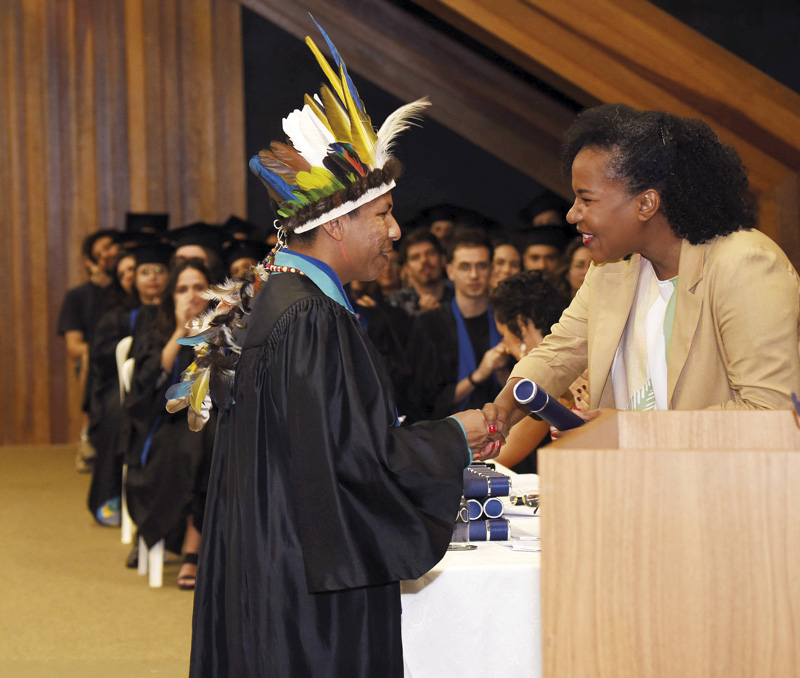
Antonio Scarpinetti / SEC-UNICAMPIn 2023, UNICAMP celebrated its first class of graduates from the Indigenous admissions program (pictured: Jeovane Ferreira Lima)Antonio Scarpinetti / SEC-UNICAMP
The push for Indigenous inclusion gained traction following Brazil’s landmark 2012 affirmative action law, which mandated that public universities reserve admissions slots for applicants self-identifying as Black, Brown, and Indigenous, in proportion to their share of the general population. Some universities had already launched Indigenous-specific admission processes in the early 2000s. Research by Medaets and colleagues, including Indigenous scholars, found that in 2021 and 2022, 28 of Brazil’s 69 federal universities (40%) and 22 of its 41 state universities (53%) were running adapted entrance exams for Indigenous students.
In an article published last year in Novos Estudos by the Brazilian Center for Analysis and Planning (CEBRAP), Medaets and collaborators noted that UNICAMP’s Indigenous exam, like similar efforts at other Brazilian universities, was largely prompted by the mobilization for racial quotas. “But while arguments for Black inclusion often hinge on social justice, calls for Indigenous inclusion have emphasized cultural plurality. The focus is on bringing Indigenous knowledge into academia,” Medaets wrote.
Another significant finding is that most of these initiatives were developed with minimal involvement from Indigenous leaders. Of the 50 universities that launched Indigenous-specific admission processes, only 11 reported drawing input from Indigenous organizations or leadership. The article points to a notable exception: the Federal University of Amazonas (UFAM). While UFAM does not have a separate Indigenous entrance exam, it has a large contingent of Indigenous students. After drawing inputs from local Indigenous communities, UFAM created degree programs tailored to their specific needs—including a teacher-training program offered inside the Alto Rio Negro Indigenous Territory, in the remote municipality of São Gabriel da Cachoeira.
Advancing Indigenous inclusion has required universities to develop support strategies tailored to their needs. “Indigenous students are the least likely to access and complete secondary education, and that takes its toll when they reach college,” says psychologist Everson Meireles of the Diversifica: Inclusão e Diversidade group at the Federal University of Recôncavo da Bahia (UFRB). In a January study published in Educação e Políticas em Debate, Meireles and his team analyzed data on 10,736 Indigenous undergraduates enrolled through 2018 at 65 federal universities across Brazil.
While 87.2% of these students came from families earning less than 1.5 times the national minimum wage per capita, only 56.8% reported receiving basic support services like housing or meal assistance. Participation in academic research (7.46%) and outreach initiatives (6.43%) was also lower compared to other affirmative action students, whose engagement rates were 11.9% and 8.4%, respectively. Women made up a slight majority of the Indigenous student population (52.5%), and 43.5% lived in Indigenous communities and territories. The study also examined enrollment data for 3,000 Indigenous students admitted under Brazil’s affirmative action law, comparing their numbers with the Indigenous population share in each state. It found that in 14 states, Indigenous students were underrepresented.
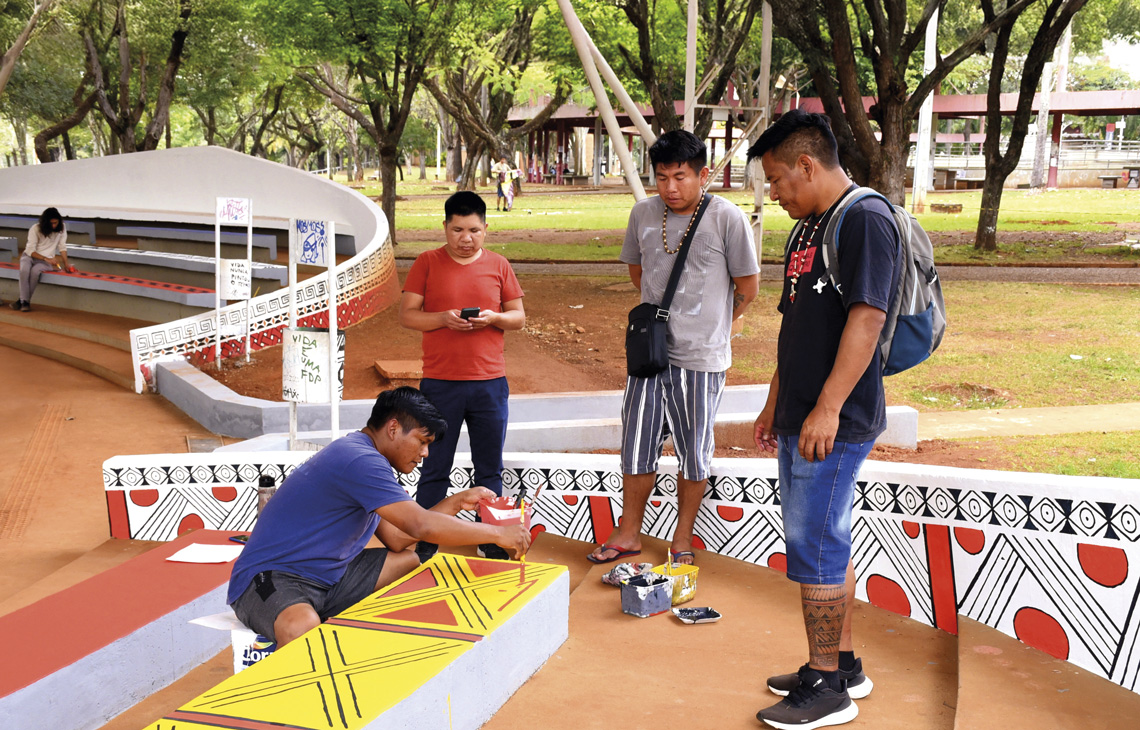
Antoninho Perri / SEC-UNICAMPIndigenous students from several ethnic groups paint the university’s open-air theaterAntoninho Perri / SEC-UNICAMP
Anthropologist José Jorge de Carvalho, a coauthor of the study and professor at the University of Brasília (UnB), adds linguistic and cultural barriers to the list of obstacles. “Many of these students come from areas where Portuguese isn’t the first language or is not spoken regularly at all,” says Carvalho, who leads the National Institute of Science and Technology for Inclusion in Higher Education and Research. Based on qualitative studies, Carvalho notes that university life can be far from welcoming. The environment can be hostile, and cultural discrimination is a reality.”
“I’m usually the last one picked for group work in class, and I’ve had professors publicly ask if I’m able to keep up—like I’m behind just because I’m Indigenous,” says Angelina Ferreira, a 26-year-old Baniwa student. In early 2023, Angelina Ferreira moved from São Gabriel da Cachoeira to study architecture and urban planning at UNICAMP. She brought along her 5-year-old son, her sister (who was accepted into the education program), her 11-year-old niece, and their father, who looks after the children while his daughters attend classes.
“A social worker asked me, ‘Why bring your father?’” Ferreira recalls. “I thought to myself—why not? Family and community mean everything to us.” Her arrival in Campinas came just one month after a devastating loss. Her 19-year-old brother, a business administration student at UNICAMP, had taken his own life. “He was very shy and kept to himself. After I got here, I started to understand what he may have been going through. I ate alone, and felt incredibly lonely in my program. I saw racism—inside and outside the university. He didn’t have the support he needed,” Ferreira says.
Luiz Medina, a Guarani student from Dourados in the state of Mato Grosso do Sul, has faced similar prejudice. “I’ve been told that Indigenous people can’t do science,” he says. “Someone even joked that next the university would start teaching horoscopes because of us.” Medina entered UNICAMP in 2019 through the Indigenous admissions process, encouraged by his mother—then pursuing a PhD in political science at the same institution. He graduated last year with a degree in public administration and is now completing a master’s in interdisciplinary studies on sustainability and social protection at UNICAMP’s School of Applied Sciences, supported by a grant from FAPESP. His research centers on traditional communities in the Vale do Ribeira region of São Paulo.
There are no comprehensive national statistics on Indigenous undergraduate dropout rates, but local surveys suggest the issue is significant. Just as concerning is the high rate of students taking longer than expected to graduate. “We need to expand support systems to ensure students not only stay enrolled but finish their degrees. Their unique backgrounds and pace in completing their degrees need to be recognized—especially when it comes to awarding grants,” says Maria Aparecida Bergamaschi of the Federal University of Rio Grande do Sul (UFRGS), which offers Indigenous admission slots based on agreements with local Indigenous leaders.
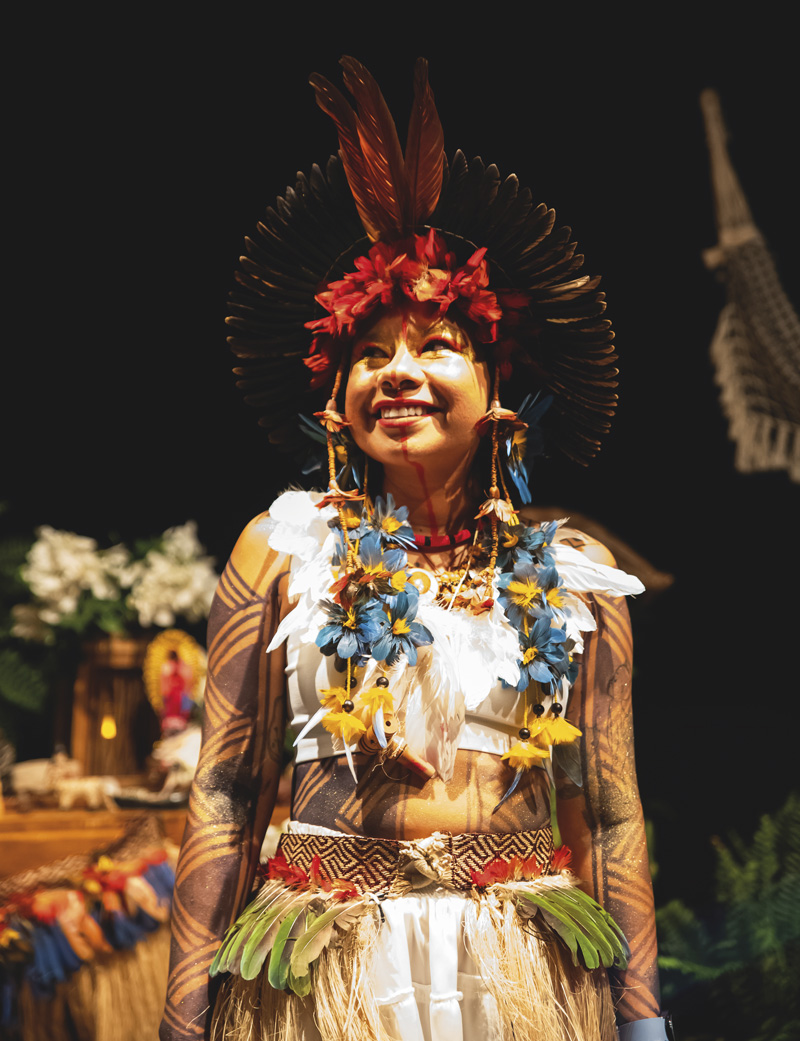
Andresa MorenoMirna Anaquiri, the first Indigenous student to defend a master’s thesis at UFGAndresa Moreno
A study published in November 2023 in the journal Educação by researchers from the Catholic University of Brasília followed the academic trajectories of 108 Indigenous students from 35 ethnic groups who entered UnB between 2004 and 2013. As of mid-2017, just 25.5% had completed their degrees, even though 92.1% had already reached the point where they could have done so. Another 43.5% either dropped out or failed to complete the degree within the maximum allowed time. At the Federal University of Pelotas (UFPel), as of December 2021, the dropout rate among 62 Indigenous and quilombola students was 17.64%, and 80.64% were taking longer than expected to complete their degrees. These data were compiled by Janaina Guerra, a social worker, for her PhD research in social policy and human rights at the Catholic University of Pelotas (UCPel), defended in March this year. “In 2021, there were still Indigenous students enrolled who had started back in 2013,” says Guerra, now part of UFPel’s newly established Office for Affirmative Action and Equity.
At UNICAMP, a 2023 report by the university’s Permanent Admissions Commission analyzed student performance from 2019 to 2023 across different admissions pathways. Students admitted via the Indigenous entrance exam had the highest dropout rates among all groups. They also progressed more slowly than their peers, completing just 40% of the coursework typically expected over that time frame. To address these disparities, UNICAMP rolled out a curricular reform. All Indigenous students now begin their studies with a first-year core curriculum covering essential topics across disciplines before starting their degree-specific coursework. “This change is meant to make the academic journey less overwhelming,” says anthropologist Artionka Capiberibe, one of the program’s coordinators. The initiative, known as the Intercultural Preparatory Program for Indigenous Admissions, was developed through broad consultation with university departments and Indigenous student groups.
At the Federal University of Pará (UFPA), faculty offer supplementary courses in Portuguese, math, and computer skills to help reduce dropout and improve retention rates. According to a January 2025 study published in the journal Educação e Políticas em Debate, 41% of the 105 Indigenous students who enrolled at UFPA between 2010 and 2014 ended up canceling their enrollment before completing their degrees. “Many Indigenous students struggle with being away from their families and communities,” explains Denise Machado Cardoso, one of the coauthors of the paper.
In 2024, the Federal University of São Paulo (UNIFESP) launched an intercultural education degree program for Indigenous teachers. The first 80 seats—split between 2024 and 2025—were fully taken. The program blends coursework on campus with community-based learning in Indigenous territories, and was developed through collaboration between faculty from São Paulo’s public universities and the National Indigenous Foundation (FUNAI), in response to a call from the state’s Indigenous Teachers’ Forum. “We chose the Baixada Santista campus because of its proximity to coastal Indigenous communities and because the campus’s interdisciplinary and territorial-based educational approach aligns with the program’s philosophy,” says UNIFESP’s dean, Raiane Assumpção.
Carvalho of UnB believes the entire admissions model needs rethinking. He proposes a flexible system that would allow Indigenous students to choose their university based on family support and location. Carvalho and Bergamaschi also stress the need to integrate more Indigenous knowledge into university curricula—from coursework and research to community outreach—with subjects that reflect Indigenous worldviews and languages.
Artist and educator Mirna Anaquiri became the first Indigenous woman to defend a master’s thesis at the Federal University of Goiás (UFG), in 2017. She later completed a PhD in visual arts and, in December 2024, joined the faculty at the Federal University of Southern Bahia (UFSB) in Teixeira de Freitas. After her graduation, Anaquiri received messages from Indigenous women across Brazil, inspired to follow her path into academia. She argues that the adaptation process must go both ways. “People talk about giving Indigenous students more time to adjust to university life—but what about professors?” she asks. “Will they study and incorporate Indigenous knowledge into their teaching? If the answer is no, then the relationship remains unequal.”
The story above was published with the title “Bridging campus and village” in issue 351 of May/2025.
Scientific articles
MEDAETS, C. et al. Cotas para negros, encontro de saberes para indígenas: Gramáticas da inclusão étnico-racial no ensino superior. Novos Estudos Cebrap. Vol. 43, no. 2. May 2024.
MEIRELES, E. et al. Condições de ingresso e permanência de indígenas nas instituições federais de ensino superior entre 2013 e 2019. Revista Educação e Políticas em Debate. Vol. 14, no. 1, pp. 1–24. Jan. 2025.
BRAGA, G. S. et al. 10 anos do Processo Seletivo Especial na UFPA: Conquistas e desafios da inserção do movimento indígena no ensino superior paraense. Revista Educação e Políticas em Debate. Vol. 14, no. 1, pp. 1–20. Jan. 2025.
RENAULT, C. R. N. dos S. & ALBUQUERQUE, A. R. de. Perfil e trajetória acadêmica de estudantes indígenas da Universidade de Brasília. Educação. Vol. 48. 2023.
BERGAMASCHI, M. A. et al. Estudantes indígenas em universidades brasileiras: Um estudo das políticas de acesso e permanência. Revista Brasileira de Estudos Pedagógicos. Vol. 99, no. 251, pp. 37–53. Jan. 2018.