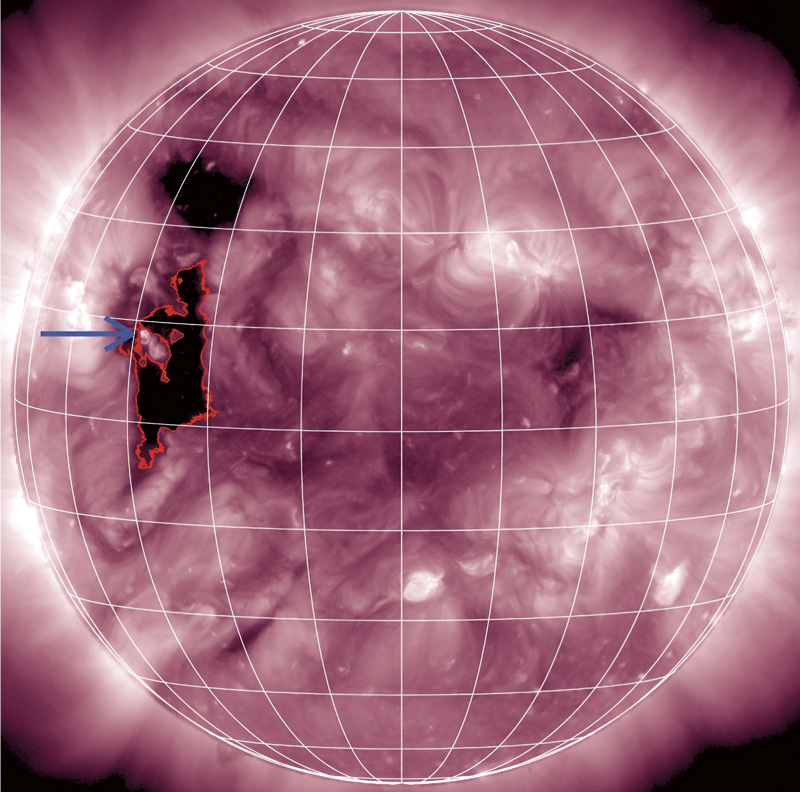
NASA / SDO / AIA In this ultraviolet image, the blue arrow indicates the hole in the solar atmosphere (outlined in red) from which a record concentration of helium-3 was ejectedNASA / SDO / AIA
The Solar Orbiter, a joint venture by the European and North American space agencies (ESA and NASA), recorded the highest ever observed concentration of a rare isotope (a variation of a certain chemical element) of helium, known as helium-3 (3He), coming from the Sun. On October 24 and 25, 2023, helium-3, composed of two protons and one neutron, was ejected from the Sun at concentrations 200,000 times greater than its normal concentration in the solar atmosphere, at speeds higher than most heavier particles. In recent days, NASA’s Solar Dynamics Observatory (SDO) recorded jets, at relatively low temperatures of close to 1.6 million degrees Celsius, emerging from a huge hole in the Sun’s atmosphere formed by a region where its magnetic field is weaker, indicating a possible origin. In the last 25 years, there have been only 19 similar events. Normally, 3He makes up 0.002% of the solar atmosphere. Solar jets can increase its concentration by a factor of about 10,000. The Solar Orbiter is halfway between Earth and the Sun (Astrophysical Journal, March 7).
Republish