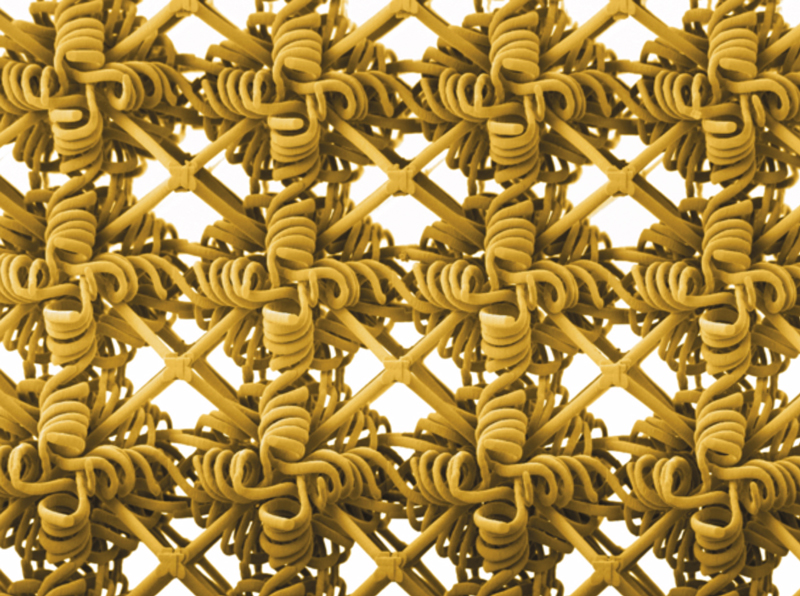
MITMaterial acts like strands of spaghetti tangled in a latticeMIT
A new synthetic metamaterial created at the Massachusetts Institute of Technology (MIT) reconciles two properties that are incompatible in conventional materials: strength and elasticity—typically, the stronger a material, the less stretchy it is. The new metamaterial combines rigid microscopic structures in the form of grids or lattices with a softer woven architecture in the form of spirals that intertwine around each lattice. The two networks are made from a polymer similar to plexiglass (a type of transparent plastic derived from petroleum) and printed at the same time using high-precision laser 3D printing. The double network can stretch to three times its original length without completely breaking, which is 10 times further than the same plastic in a lattice pattern. Strategically placed holes in the material make it even more resistant to breakage. The material could be used to make stretchy ceramics, glasses, or metals, tear-resistant fabrics, flexible semiconductors, electronic chip packaging, and scaffolds on which cells are grown for tissue repair (Nature Materials, April 23).
Republish