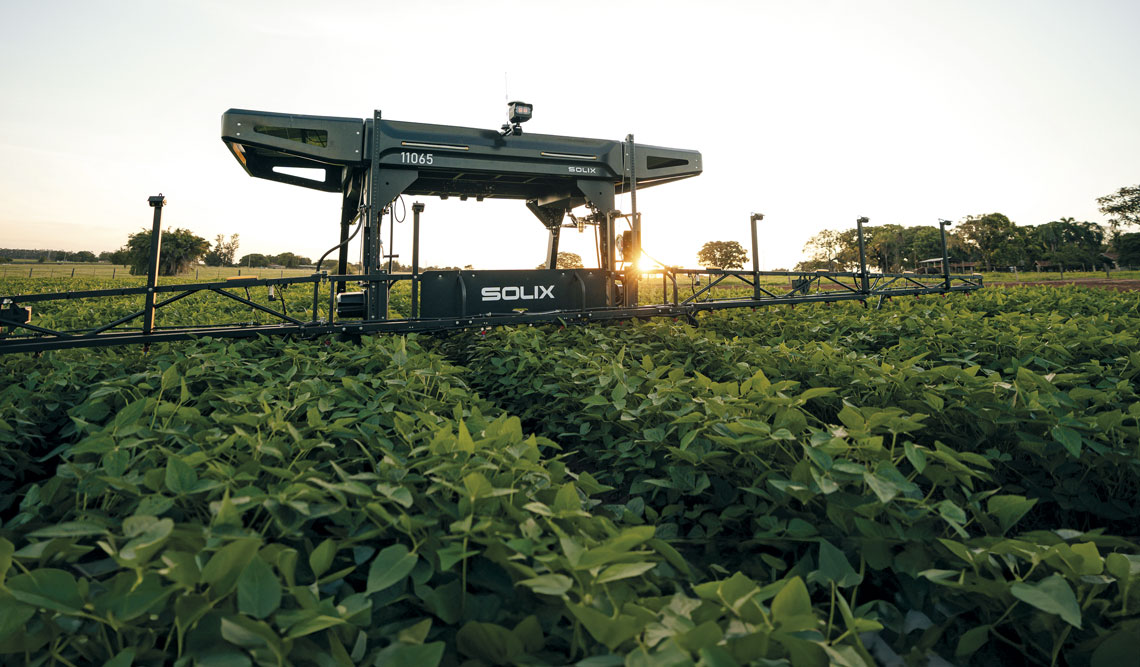
The sugar-energy plant Cruz Alta, in the western São Paulo State municipality of Olímpia, now has an ally in controlling invasive plants that reduce the output of their cane plantations. Since April 2024, the unit, owned by French group Tereos, is experimenting with two autonomous robotic platforms, each 2.5 meters (m) in height, 2 m deep and 12 m wide, to spray herbicide on the crops. Thanks to its artificial intelligence (AI) system, computer vision, sensors, and other technological resources, the robot Solix AG Robotics can differentiate actual food crops from weed species and apply the pesticide selectively.
“The results from the first pilot project tests are promising. We saw a reduction of around 50% in the use of pesticides,” says agricultural engineer José Olavo Bueno Vendramini, Tereos’s superintendent of Agronomic Excellence and Agricultural Business. “We foresee that this innovation will bring a positive impact in agricultural output over the medium and long terms with the reduction of weeds, and with healthy sugarcane growth.” Tereos pioneered the use of Solix with sugarcane; studies demonstrate that invasive plant infestation can reduce the output of this crop by up to 40%.
The Solix AG Robotics device was developed by Solinftec, a Brazilian corporation founded in 2007 by seven Cuban engineers who migrated to the country to create automation solutions for the sugar-ethanol sector. Headquartered in Araçatuba (São Paulo), the manufacturer, a leader in robotics- and AI-based innovations, has technology centers in the United States and China, along with commercial offices in Canada and Colombia.
Tereos is one of Solinftec’s twenty clients worldwide using the Solix. To the end of 2024, some forty robots were operating in Brazil—in the states of São Paulo, Goiás, Bahia, Mato Grosso, and Mato Grosso do Sul—with another fifty functioning in the US and Canada. In addition to sugarcane crops, the equipment, launched in the market in 2023 at a price of around R$350,000, is used in pastures as well as cotton and grain crops. One of the key soy clients is the Baumgart Group. In September, 10 Solix units began operating on a 13,000-hectare farm in Goiás State. In the US Midwest, the robots are deployed to corn and soy crops.
Night hunter
Development of Solix began in 2019. “Our Brazilian research and development teams participated in the project, with around 50 technicians and researchers working with a 20-strong team from the US. Our unit there is in Lafayette, Indiana, and has a partnership with Purdue University,” says agricultural engineer Bruno Pavão de Assis, head of robotic operations at Solinftec.
Pavão explains that the platform was designed to reduce the use of pesticides and promote sustainability in the field. Fitted with solar panels and batteries, it comprises three modules: Scouting, Sprayer, and Hunter. “The aim of Scouting is to gather data from the crop and its monitoring system. For example, as the robot moves along the crop lines, it informs the plant population per hectare, their growth rate, and if there is any pest and weed infestation,” he goes on.
The Sprayer is responsible for spreading herbicides, while the Hunter, developed entirely in Brazil—the Scouting and Sprayer were a joint project with the Lafayette unit—is a nocturnal robot focusing on the elimination of pest insects in the adult phase. “Using specific light wavelengths, it attracts the insects and eliminates them by electric shock,” says Pavão. “As far as we know, there is no other robotic solution in the world with these three characteristics of Solix.”
As it moves within the crops at night, the Hunter deals with insects before they reach the oviposition phase, in other words the female laying the egg. The aim is to control populations of moths, beetles, locusts, and other insects that harm agriculture.
Creation of this module was supported by the Agricultural Integrated Pest Management Research Group (AGRIMIP) of São Paulo State University (UNESP) in Botucatu. “We have participated from conception of the idea to testing for technological effectiveness,” says agricultural engineer Regiane Cristina de Oliveira, coordinator of AGRIMIP.

SolinftecA version of the robot designed to control pest insects in nocturnal habitatsSolinftec
“In the laboratory we released target insects and investigated whether the device was capable of attracting them. We also tested the light frequencies to come up with the most suitable. One of our concerns was to know whether the technology had the potential for attracting pollinators, such as bees,” says Oliveira, emphasizing that the outcomes have been shared at scientific conferences and events in the area.
Agricultural engineer Raul Guedes, of the Department of Entomology at the Federal University of Viçosa (UFV) in Minas Gerais State, says that positive phototropism (attraction toward light) is a known and documented phenomenon in nocturnal insects—indeed, it is the principal by which light traps are employed. Guedes also stresses that insect elimination by electric shock is common, observed in the popular household electric rackets used against mosquitos.
“The curious thing here is a robot emitting a light beam and attracting winged pest insects,” continues Guedes, who did not participate in the development of Solix. “But care needs to be taken: attraction of insects by light is known not to be very selective, and may potentially cause the elimination of several insect species, including some that are beneficial, such as wasps and nocturnal parasitoid insects.”
Thanks to the technology embedded in the Solix AG Robotics, its operation can be conducted remotely. In order to move without trampling crop lines, Solix uses high-precision GPS, thereby reducing positioning errors to a few centimeters, and computer-vision cameras. The platform’s AI, based on convolutional neural networks (deep-learning algorithms that recognize images), also assists in controlling the robot and identifying the invasive plants. Infrared sensors are used for night navigation.
“The robot spends 24 hours a day among the crops,” says Pavão. In addition to the potential reduction in the use of pesticides—given that the robot only sprays where weeds are detected—the engineer states that the device is drift-proof, preventing deviation of the pesticide droplet trajectory outside the crop area.
This occurs for three reasons: the Solix Sprayer operates at a slower speed than conventional spraying machines, using quick-activating electrical valves in the spray nozzles to reduce wind interference in the formation of droplets; there is also a system that indicates wind direction and recommends the best times for spraying.
The story above was published with the title “Robots in the field” in issue 347 of january/2025.
Republish