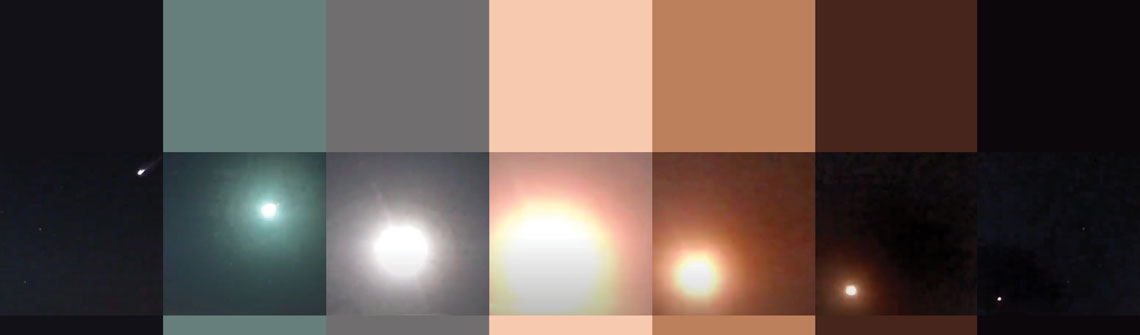
In August 2020, Maria Elizabeth Zucolotto, an astronomer from the National Museum in Rio de Janeiro, received a phone call from Brazilian meteorite collector André Moutinho, who informed her that a shower of space rocks had fallen in the municipality of Santa Filomena, Pernambuco. Despite the restrictions in place because of the COVID-19 pandemic, the researcher, who is curator of the museum’s meteorite collection, was able to travel to the city. There, she witnessed a hunt for the space rocks that even involved local residents, who went out looking for fragments to sell to meteorite traders from Brazil and abroad who had traveled to the site.
The owner of a bar in the city told her that he had kept a meteorite that had damaged the roof of his house. Zucolotto wanted to buy it from him, but he refused to sell. She later learned that American meteorite hunter Michael Farmer had purchased the nearly 2.5-kilogram (kg) rock. The astronomer thus sought out Farmer. “He ended up agreeing to resell it for the same price he bought it for. So we had to find R$18,000 in cash,” she recalls.
The object was sent to the National Museum as the first acquisition for the meteorite collection since the 2018 fire and is set to be exhibited when the institution reopens its doors. According to an analysis published in the journal Meteoritics and Planetary Science by Zucolotto and colleagues in April 2023, it is a chondrite, a type of meteorite estimated to be 4.56 billion years old, probably originating from the asteroid belt between the orbits of Mars and Jupiter.
What happened in Santa Filomena exemplifies the difficult nature of ensuring that scientists have access to meteorites that fall in Brazil. With no regulation on the topic, anyone is free to buy or sell them without scientists having a chance to examine them. To address the issue, the Chamber of Deputies is currently discussing Bill No. 4,471/2020, which would regulate the ownership of rocks from space with the aim of ensuring that samples are also sent to Brazilian scientific institutions.
Plans in Brasília
The bill is based partly on suggestions from scientists in the field who worked together to modify the initial text. Another bill, also from September 2020, ended up being rejected. “When they first emerged, the two bills proposed opposing paths—one was aiming to define meteorites as private property and the other as state property,” explains Rodrigo Vesule, a member of the space law and policy research group at the Catholic University of Santos.
“Both were composed of simple text that did not properly address the complexity of the topic and failed to guarantee that meteorite samples would be analyzed within Brazil,” he adds. Vesule was invited to join a working group led by the Brazilian Geology Society (SBG)—of which Zucolotto is also a member—that brought together researchers to discuss which points should be included in a bill of this nature.
“We created the working group to ensure that scientific interests were taken into account,” says SBG president Elisa Rocha Barbosa, a geologist from the Federal University of Goiás (UFG). The team was composed of people from public universities, research institutes, and amateur astronomers. Barbosa went to Brasília three times, together with Zucolotto, to talk to politicians about the bill.
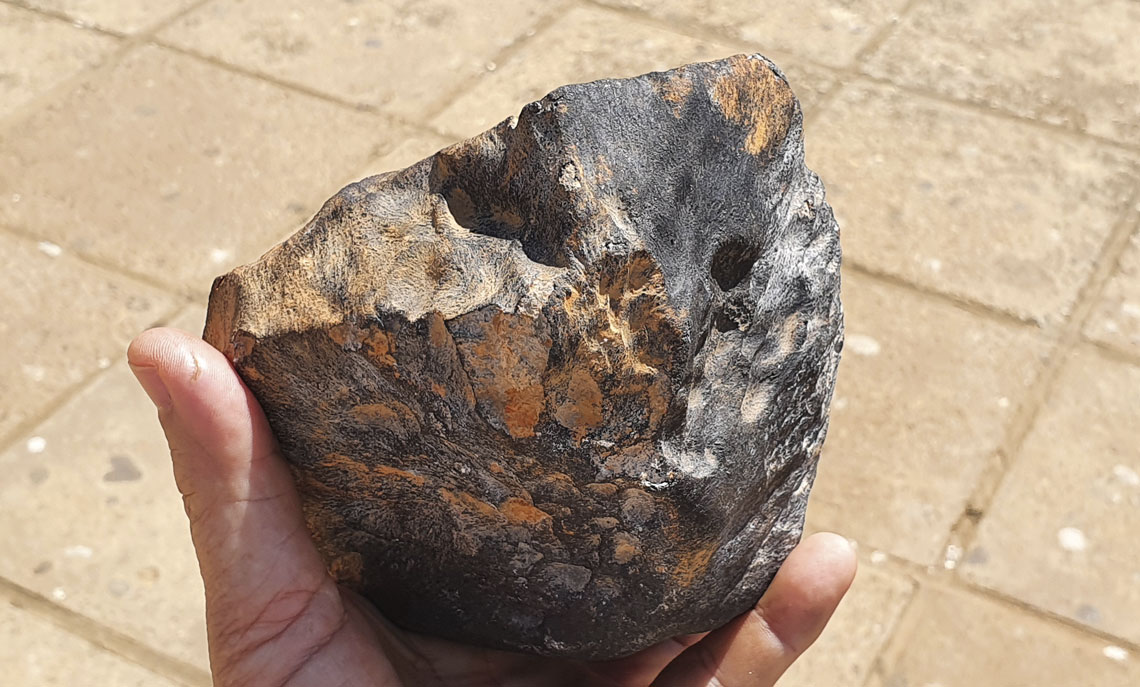
Maria Elizabeth Zucolotto / National MuseumSanta Filomena meteorite, weighing 2.5 kg, which now belongs to Brazil’s National MuseumMaria Elizabeth Zucolotto / National Museum
The scientists’ suggestions were presented at a public hearing held by the Mines and Energy Committee in 2022. “One of the aims was to define what meteorites are and to highlight why they cannot be considered a common rock. If they were, they would belong to the federal government according to the Brazilian Mining Code,” explains Vesule. The new bill provides for a national meteorite registration certificate. If it is approved, every meteorite found in the national territory will have to be registered in the country, by law. “This ensures ownership for the finder of the object, who may sell it, but guarantees a sample for the scientific institution that analyzes it,” explains the specialist.
To this end, the bill establishes the need for institutions certified to register meteorites, which must be Brazilian research organizations, and proposes that anyone who finds a meteorite will have 180 days to register it, free of charge. In return, approximately 20% of the rock must be transferred to the institution. The text also defines that meteorites can only be removed from the country after being registered.
“The current situation is a no man’s land. If someone finds a meteorite, puts it in their pocket, and leaves the country, we have no means of control or benefit for science,” says geologist Alvaro Crósta of the University of Campinas (UNICAMP), who is also a member of the working group.
This appears to be what happened with a meteorite from Mars weighing almost 4.5 kg that was collected in the town of Socorro, Pernambuco, and was only discovered by Brazilian researchers when it appeared in October 2021 in the database of the international organization The Meteoritical Society, a global reference for meteorite records. The rock was reportedly taken to Miami, USA, and sold to a collector who chose to remain anonymous.
“Given its size, rarity, and the market value of this type of meteorite, it is estimated that it could have been sold for hundreds of thousands of dollars,” explains Crósta, a member of The Meteoritical Society’s board of directors. Zucolotto managed to obtain a sample of the rock weighing almost 3 grams (g) for the museum’s collection. Since it is so small, it has not been possible to carry out an in-depth study of the material—ideally, fragments for study should weigh at least 30 g. Brazil currently has 88 officially catalogued meteorites. “This is a very small number considering the size of the country. Worldwide, there are more than 76,000 records,” adds Crósta.
At the beginning of November, the bill was submitted to the Committee for the Constitution, Justice, and Citizenship (CCJC), which will analyze whether it is constitutional. If approved, it will go to the plenary of the Chamber of Deputies. Barbosa believes the regulation could prevent traders from buying valuable meteorites from people for the prices of common rocks.
“It is the public that finds meteorites, not scientists,” notes Zucolotto, who receives an average of five messages per day from people across the country asking her to evaluate rocks they believe to be meteorites. She has been traveling around the country with the “Meteorites on the Road” project, which promotes science and seeks to spark an interest in meteorites among the public, showing them that they could one day find them. “By investigating the composition and characteristics of meteorites, we can understand the formation and evolution of the Solar System,” she concludes.
The story above was published with the title “The luck of the meteorites” in issue 346 of December/2024.
Scientific article
TOSI, A. et al. The Santa Filomena meteorite shower: Trajectory, classification, and opaque phases as indicators of metamorphic conditions. Meteoritics and Planetary Science, Vol. 58, pp. 621–42. Apr. 2023.