Jayson Ricamara / Kaust
Suzana Pereira Nunes is a woman in a man’s world, both in her field of research—chemical engineering—and in the country where she has chosen to live and work for the last 15 years: Saudi Arabia. She does not see gender as a personal limitation in her context, however, and says she faces the same struggles as any woman in any country or professional field. But she has worked hard to include young female researchers at the King Abdullah University of Science and Technology (KAUST), which helped earn her the 2023 L’Oréal UNESCO International Award for Women in Science, a highly respected distinction.
Nunes uses cutting-edge chemistry to develop ultraspecific membranes that function as filters. In line with the urgent need for sustainability and the fight against global warming, she is working on processes that do not involve the production of carbon dioxide (CO₂).
Membrane chemistry
Institution
King Abdullah University of Science and Technology (KAUST), Saudi Arabia
Education
Bachelor’s degree (1980), master’s degree (1983) and PhD (1985) in chemistry from the University of Campinas (UNICAMP)
The researcher grew up in Campinas, in the interior of São Paulo State, where she also completed her education and began her scientific career. During research fellowships in Germany, she met German scientist Klaus Peinemann, who she later married, leading her to leave her teaching position at the University of Campinas (UNICAMP) to move to the European country. The greatest opportunities in the field, however, were at the university created by Saudi King Abdullah in 2009, whose vision was to foster talent in science and technology and overcome the limits imposed by the rules of Saudi society, such as the separation between men and women. Nunes, Peinemann (also a professor of membrane chemistry), and their son, now in his early teens, moved there together.
Elected to The World Academy of Sciences (TWAS) in 2024 and a member of the São Paulo State Academy of Sciences (ACIESP), the 66-year-old chemist now wants to help foster the recognition and international exchange of Brazilian science.
You study the composition and production of membranes used as superspecific filters. What are the objectives of this research?
My motivation is primarily related to industry, where 50% of energy consumption is used in separation processes. In the pharmaceutical industry, for example, a series of steps is needed to purify and separate drugs. It never starts from pure substances. These processes, such as distillation, are difficult to implement, require a lot of energy, and produce CO2. The aim is to obtain a pure product without degradation using more efficient processes with lower energy costs. The same goes for the chemical and petrochemical industries.
As well as efficiency, is sustainability also an appeal?
When we talk about sustainability in this field, we mean continuing to do more or less what we have been doing for decades: adding CO2 capture at the end of the process. Instead of rethinking the whole process, just add a step. However, with more efficient separation processes, it is possible that while some CO2 will still be produced, it will be much less. In economic terms, it has great benefits. More efficient filtration also allows for results that are not feasible via thermal processes. One example is the purification of vitamins. What I have been doing for a long time is developing membranes with much greater selectivity than those currently available on the market. And I try to improve the process in some way.
With more efficient separation processes that use less energy, much less CO2 will be produced
Are the filters made of compounds that you create?
Recently we have been using cyclic monomers, which are molecules in the form of a pore. This pore polymerizes and forms a filter that has pores smaller than one nanometer, capable of separating small molecules, such as pharmaceuticals. Our work ranges from preparation of the monomer itself, although many of them are commercial products, to polymerization and deposition on a porous material, the aim of which is to obtain a highly selective structure.
In addition to chemical methods, you also use tools such as electron microscopy and synchrotron radiation sources. How important are these resources?
A membrane has several layers: one has larger pores, another is the selective part. We need to develop the design of these layers. We perform a chemical characterization of the material and the fractions that will pass through this membrane. I use electron microscopy a lot, and the microscopy equipment we have here is fantastic: transmission, scanning, whatever you want. We do a detailed characterization using microscopy, with methods that are being developed as we use them, to see the membranes. Transmission microscopy offers a high resolution, almost atomic, but it only allows you to observe a very small area of the material—less than one micrometer. With an electron microscope, you normally have to work in a vacuum, which changes the morphology of the membrane. With the synchrotron, we can analyze the structure of membranes in water or in other conditions in which they operate. I have been collaborating for a long time with the LNLS [Brazilian Synchrotron Light Laboratory] in Campinas, having practically witnessed its inception. At the Sirius lab, they now have a beamline that generates three-dimensional images, which works at high resolution without the need for a vacuum. We can also see a much larger area, up to 30 micrometers. At this scale, I can go deep until I see the small pores, building the entire image in 3D.
Can the membranes you develop reach a commercial scale?
In the lab we work on a small, research scale; although we also have machines that can make 40-centimeter rolls and even a roll several meters long. This is a technical or semitechnical scale, but not industrial scale. My husband is also a membrane chemist. He founded a company in Germany to manufacture products that we developed while we were there, so we have that possibility in the future. Here, we operate in the intermediary phase, working with industries that are interested. We are currently working on a filter for desalination, with some companies interested in purchasing and further developing our product.
Desalination must be a particularly important application in the Middle East?
Very important. I think this is the application in which membranes have been most successful, and it is difficult to compete with existing commercial products, to create something better than what is already on the market. We have a membrane that we hope will be competitive: not only in terms of cost, but also in some situations where existing membranes do not work well. For example, when there are contaminants in the water in addition to salt, which can pass through the filter. They are very small molecules that are difficult to retain when treating water. Another type of application on the rise is the separation of ions with similar characteristics to salts—more selective membranes are needed for this. Separating lithium and magnesium from sodium, for example.
Have you been able to do this?
Yes, in the lab we have membranes that have proven successful at separating ions. They are based on the cyclic monomers I mentioned.
Is it true that your interest in science started with a toy chemistry set?
Yes it is true. For my seventh birthday, I got a chemistry set. I loved it. I played with it a lot and it made me really curious. Then I went to COTICAP, the Technical School for Chemistry in Campinas, [Colégio Técnico Industrial Conselheiro Antonio Prado, which later became Escola Técnica Estadual]. The school was founded by the chemical industry together with the French consulate, with the aim of educating technicians to work at companies. It was very good, most of my classmates ended up with good careers as a result. Chemistry was part of my life from an early age.

Personal archiveIn her spare time, the chemist likes to travel in her jeepPersonal archive
Did you have a favorite experiment?
Yes, in Brazil we call it devil’s blood. Simply mix water with phenolphthalein and a little ammonia, and the liquid turns red. If you pour this liquid onto white clothing, it leaves a bright red stain. But as the ammonia quickly evaporates, it turns white again.
Did your parents work in education?
No. My mother was a housewife and my father was an economist.
Is the issue of gender something that concerns you?
Yes, it is a concern—I work in Saudi Arabia, after all. I moved here 15 years ago, and the country was completely different then than it is now. It was much stricter, with far fewer freedoms for women, especially for studying chemical engineering. I came for other reasons, but the potential to have an impact on education for women was important. KAUST was the only university that offered mixed education, with men and women in the same labs. When I arrived, I noticed a major limitation: there was no chemical engineering for women at other universities in the country.
You were the only woman in the field?
Yes, I was the only female professor on the chemical engineering program. There are only postgraduate courses at KAUST. I was hired by the chemical engineering program, and according to university rules, PhD candidates needed to have studied chemical engineering to pursue a PhD in that field. I realized that it was highly unlikely that any of my students would be Saudi women, because there were no educational opportunities for them. Only women who had studied abroad could join the KAUST program. There are now degrees in almost every field available to women, but I believe that in most universities, men and women are still separated in some way, such as in different rooms or buildings. But changes in Saudi Arabia are accelerating and the opportunities are growing every day.
In this pioneering role, what was it like teaching men? And how did the students treat each other? Did you need to cover your hair?
In classes, I had no problems at all. There was always complete respect; I was treated very well by the men. The university was founded by the monarch at the time, King Abdullah, with rules that were very different from the rest of society. There was no segregation or hijab requirement. Inside the university it was not necessary, but if I went to a shopping mall, I wore an abaya, which is like a long dress. Now, even this is not mandatory. In terms of gender issues, female students may have faced the same kinds of problems as anywhere else: being involved in a discussion and not being listened to as much as men, for example.
You were previously in Germany, also in a position of leadership. How did you make the decision to move?
It was a complete surprise to me too, actually. In Germany, I was in a really good position at the Helmholtz research center, which is famous, and I was working on fuel cells, an important area of applied research. I led European projects and I liked what I did. But there was no opportunity for growth at the institute, the only chance for that would be to work at a university at least part time. I started looking for alternatives in Germany or elsewhere in Europe, but two colleagues of mine, one from Europe and the other from the US, said to me: “If I were you, I would not look in Europe, but in Saudi Arabia.”
Fifteen years ago, Saudi Arabia offered far fewer options for women, especially when it came to studying engineering
Did it seem like a strange option?
Of course! My first reaction was: “No way.” But they were colleagues that I respect a lot, and they both told me the same thing. The university was just being founded and I started to see what it had to offer—especially in terms of microscopy, which I had always been interested in and to which I had limited access in Germany. I interacted with other people, especially when I did the interview at Imperial College, London. I knew a lot of people from my field there, and several of them told me it was an interesting place. It was also important that I was not going alone. My husband was a professor at KAUST—he is retired now. We were hired at the same time through different hiring processes.
You were a professor at UNICAMP, a researcher at the Helmholtz research center, and now you are a professor at KAUST. Can you compare the three professional experiences in three very different countries and institutions?
All of them had pros and cons. I really enjoyed working at UNICAMP and I think that if I had continued, it would have been a good career. I left for family reasons: I had been to Germany several times, on postdoctoral fellowships and sabbaticals, and that was how I met my husband, who is German. When my son was born, I decided maintaining a long-distance relationship was not sustainable, so I moved. In Germany, I had a lab with PhD students and postdoctoral researchers, but because it was not a university, I had limited contact with students. I also did not teach, which has advantages and disadvantages. Helmholtz is focused on applied research and the structure tends to be very hierarchical. At KAUST I had the freedom to choose and expand my research topics. The access to cutting-edge equipment is also incredible. And I now have closer contact with students again—and not just those in my lab—which gives me a greater chance to have an impact on their overall education.
Do you still have connections at UNICAMP and in Germany?
At UNICAMP, indirectly, through my work at Sirius. And I have collaborations across Europe in general. I chair the board of a large membrane project in England involving several universities and I have recently published articles with colleagues from various countries.
What was it like to win the L’Oréal UNESCO International Award for Women in Science, which reflects your efforts to introduce women to chemical engineering in Saudi Arabia?
It was amazing—there is a really emotional side to it. Every year, five women from around the world receive the award: one from each continent, in different fields of knowledge. I did not expect to win, because I grew up and worked in Brazil, then in Germany, and now here. My career was divided into three. The awards panel usually prefers someone who was born in a place and continues to work there, but I won as the representative of Africa and the Middle East. It was unexpected. It is a very special kind of recognition.
What stands out in your career, in the eyes of the judging panel for this type of award?
I think there are two sides to it. I was chosen for my contribution to chemistry, but it helped that I work on something that can have an impact in terms of reducing CO2, making industry more sustainable. I think it was also important that I am dedicated to educating women in a place where this was once heavily restricted. Most of the people who work with me are women, from all over the world. I end up becoming an inspiration in some way and thus receiving more female candidates, now also from women in Saudi Arabia. One of them, an excellent researcher, defended her thesis in March.
Last year you were elected to the TWAS. What does it mean to you to be a member of this international academy?
It is very special. It is a form of recognition, mainly in terms of science, but also in terms of education, of having contributed in different countries. I have just been elected, so I am not involved in discussions yet. I see it as an opportunity to continue contributing to education and inspiring science in various countries, especially for women. I have also been a member of the São Paulo State Academy of Sciences [ACIESP] for a long time, and I am very proud of that. Now I am also a member of the World Academy.
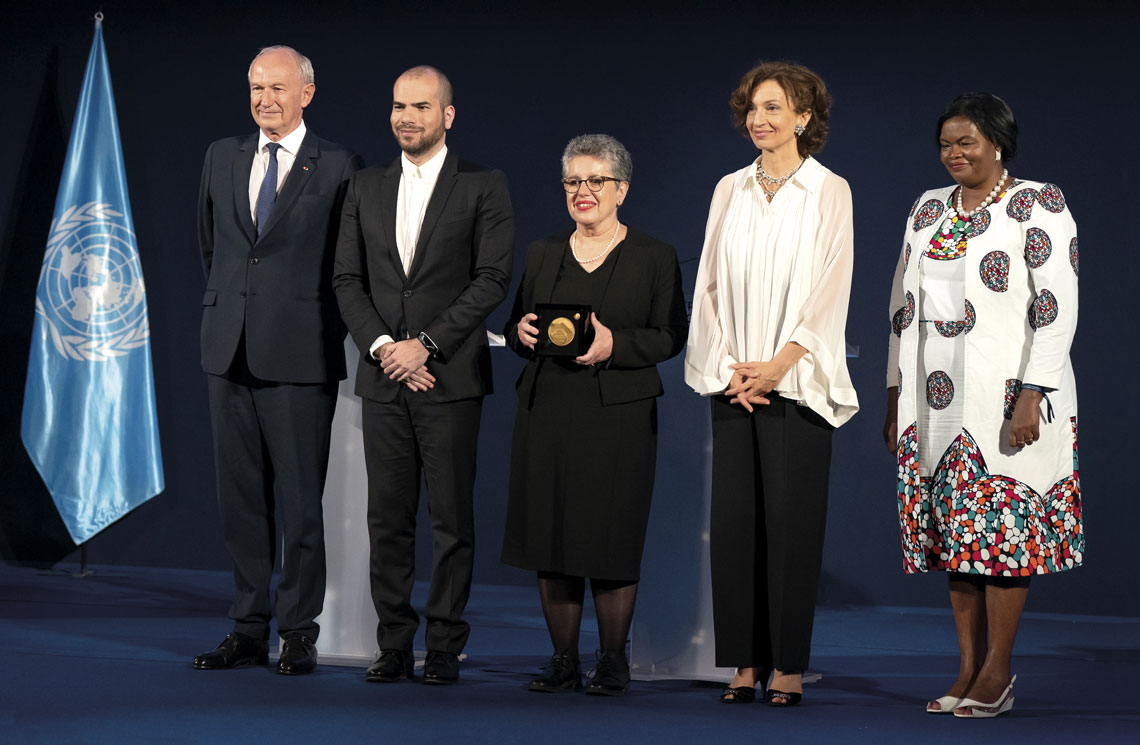
Personal archiveIn 2023, at the L’Oréal UNESCO International Award for Women in Science ceremonyPersonal archive
And what about the management side? Until 2024 you were vice provost. How was the experience, what were the challenges?
Whatever country you are in, administrative positions like this involve dealing with things that are not always visible. If you do it well, people do not notice. If you do not do it well, you will receive a lot of criticism. Before being vice provost, I had already spent five years as an associate dean, responsible for managing one of the university’s three divisions, similar to the administrative structure at many universities in the USA. It is an interesting role, but it takes a lot of energy, the kind I would rather devote to science.
Did you have to stop doing research?
I did not stop, but it is impossible to be in the lab every day, so my contribution was more limited. The university is like a city and the president is like the mayor and the dean at the same time. The provost is the part of the dean’s office that focuses on education. We had no provost for a year and a half, so I basically took on that role. At that time, many changes were being made at the university, with strategic decisions that needed to be implemented. In situation like that, you cannot always make friends…
Is KAUST big?
It is a postgraduate-only university. There are approximately 200 professors, 1,700 master’s and doctoral students, and more or less the same number of postdoctoral researchers, in addition to the administrative staff. More than 90% of the professors are from abroad. I am not the only professor from Brazil. About 60% of the students come from abroad, with 40% from Saudi Arabia. That was the plan from the start. In Germany, I had several Brazilian students and postdoctoral researchers. My first PhD student here in Saudi Arabia was Brazilian—she had already enrolled and ended up working with me.
How does funding work?
Every professor at the university has a basic budget to support a group of eight to ten people, including trips to conferences and everything else. On top of that, we can apply for funding for additional projects. Saudi Arabia is implementing a new grant system a bit like FAPESP’s, but most of our funding comes directly from the university. In this sense, KAUST is special. It was King Abdullah’s vision and I think it was very well thought out. He wanted to create a legacy and sought out famous universities around the world to help establish the different disciplines. Imperial College created the chemical engineering department, and other areas were created by renowned institutions such as the University of Chicago, the University of California, Berkeley, and the University of Oxford. Despite not offering undergraduate degrees, the university also created a program to identify and invest in talented students at other institutions, including schools. This may include selecting the most suitable university for a person to develop their skills. This should be done in other places, encouraging young people to pursue scientific careers.
Now you are back in the lab?
Yes. My time in management was very intense, but since October I have been doing research almost exclusively. My group currently has 12 people, including students and postdoctoral researchers. It is not very big, but we are very productive. For the first two years after I moved here, I spent a lot of my time working with microscopy. But after that, with teaching and administrative duties, there was not much time to spend in the lab.
What brings you the most joy in your work today?
Seeing students grow not only in terms of knowledge, but also in the way they are and how they work. That brings me great joy. I feel a sense of accomplishment in seeing them defend their doctorate and move on to a new phase. Three of my PhD students are now university professors in Brazil.
Seeing students grow, not only in terms of knowledge, but also in the way they act and how they work, brings me great joy
Is the little girl fascinated by the chemistry set still in there?
She is. Every time a student comes to discuss something with me, or when there are surprising results to find. In physical chemistry, which is the area that attracts me the most, as well as microscopy, I continue to feel the same enthusiasm.
What is it like, living in Saudi Arabia? Do you live on the university campus?
Yes. The campus is like a small town, with a supermarket, hospital, school, and restaurant. It is located about 80 kilometers from Jeddah, Saudi Arabia’s second city in terms of size and importance. The advantage is that it is very international and very safe. The children grow up in contact with people from all over the world, as was the case with my son. The university has 16 research programs in the exact sciences, biology, and engineering, so we only live alongside people interested in these fields.
How old was your son when you arrived?
He had just turned 13. He studied here and then went to UCLA [University of California, Los Angeles] to get his degree in biology. Now he has returned to do a PhD in marine biology here at KAUST. He did really well in Los Angeles, he could have gone wherever he wanted after that, but he chose to come back. The university is located on the shores of the Red Sea and oceanography is a very strong discipline here. There is a lot to be explored.
Do you participate in Saudi society in any way?
Very little—only through contact with students or colleagues. The lingua franca is English and I do not speak Arabic. I go out and I talk to people, and I have traveled to various places in the Middle East over the years. I really like driving, so when I have time, I go out in my jeep.
Are there not limitations on driving, being a woman?
No, not anymore. But it was different when I first arrived. Until 2018 I was not allowed to drive outside the university campus. I could take a taxi or bus, but I could not drive myself.
What is your plan? Do you plan to stay after you retire?
I would really like to live in Brazil, but I will most likely return to Europe when I retire, for family reasons.
Do you visit Brazil much?
Not in recent years. But I will visit for the TWAS conference, which will be held in Rio de Janeiro in September. I have good friends in Brazil, I maintained collaborations when I worked in Germany and I still interact with my old colleagues, through Sirius for example. This makes me happy and I would like this contact to be more frequent. I hope that Brazil will become even more international, with more opportunities for student exchanges. I know FAPESP has always played an important role in this: if I can contribute in any way, it would be a pleasure.
The story above was published with the title “Suzana Nunes: Chemistry without borders” in issue in issue 350 of april/2025.
Republish