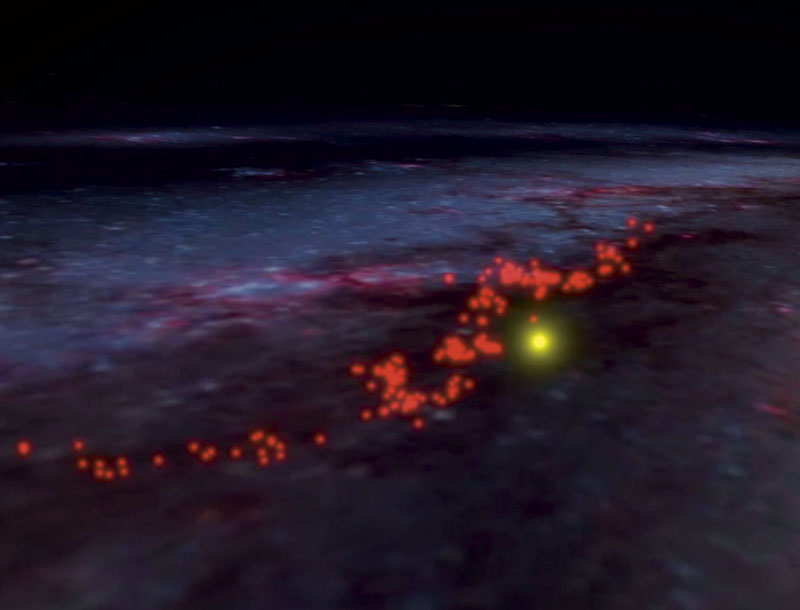
esaRadcliffe Wave (red dots), the largest gaseous structure in the Milky Wayesa
Our Solar System, formed by the Sun, eight planets, asteroids, and other celestial bodies, is moving at a speed of 720,000 kilometers per hour (km/h) in the center of our galaxy, the Milky Way, which comprises more than 200 billion stars. Using data from the European Space Agency’s (ESA) Gaia mission, an international research team led by the University of Vienna, Austria, discovered that between 14.8 million and 12.4 million years ago, the Solar System passed through the constellation of Orion, which is part of the Radcliffe Wave, a wave-shaped gaseous structure in the Milky Way containing stellar nurseries, with a diameter of about 9,000 light-years and located just 500 light-years from the Sun. It then returned to its original orbit. This passage through such a dense region of space may have compressed the heliosphere, a bubble created by solar wind, increasing the influx of interstellar dust and influencing Earth’s climate. The period when the Sun and its companions visited Orion coincides with the so-called Middle Miocene Climatic Transition on Earth, marked by a shift from a warm climate to a cold one, resulting in the expansion of ice cover across most of the planet (Astronomy & Astrophysics, February 11).
Republish