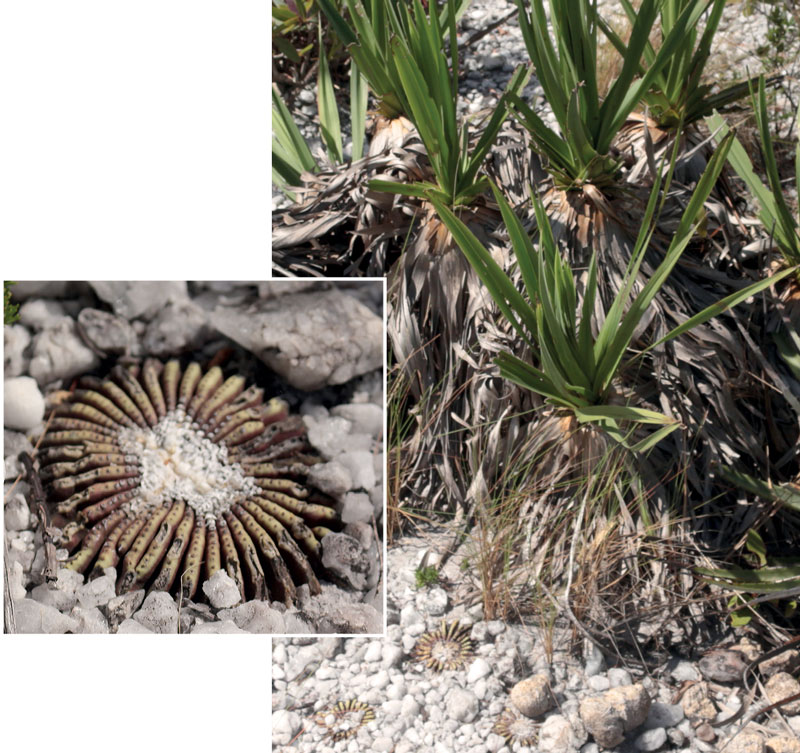
Fabiane Costa / UFVJM Find the cactus: Uebelmannia nuda (above) is difficult to see among the quartzFabiane Costa / UFVJM
A crown emerging from the quartz and sand, topped with a yellow flower, is reminiscent of a child’s drawing of the Sun, its circular center surrounded by radial lines. This subterranean, thornless cactus, named Uebelmannia nuda, fits in the palm of your hand and is found exclusively in Sempre-Vivas National Park, part of the Espinhaço Mountain Range in Minas Gerais. There are four species in the genus Uebelmannia, one of which coexists with U. nuda, and they are all very thorny and have visible stems above the ground, making this newly discovered species all the more surprising. “This remarkable species is so distinct that our group was able to quickly describe it, allowing ICMBio [the Chico Mendes Institute for Biodiversity Conservation] to develop monitoring plans and conservation measures,” says Daniela Zappi, a botanist from the University of Brasília (UnB). The park, located near Diamantina in the north of Minas Gerais, is difficult to access: the expedition that found the new species had to travel by helicopter. Despite this fact, the habitat of the new species is threatened by the extraction of quartz and semiprecious stones by illegal miners. The situation is putting U. nuda at risk of extinction—less than 100 specimens were found in an area of roughly four square kilometers (Taxon, May 29).
Republish