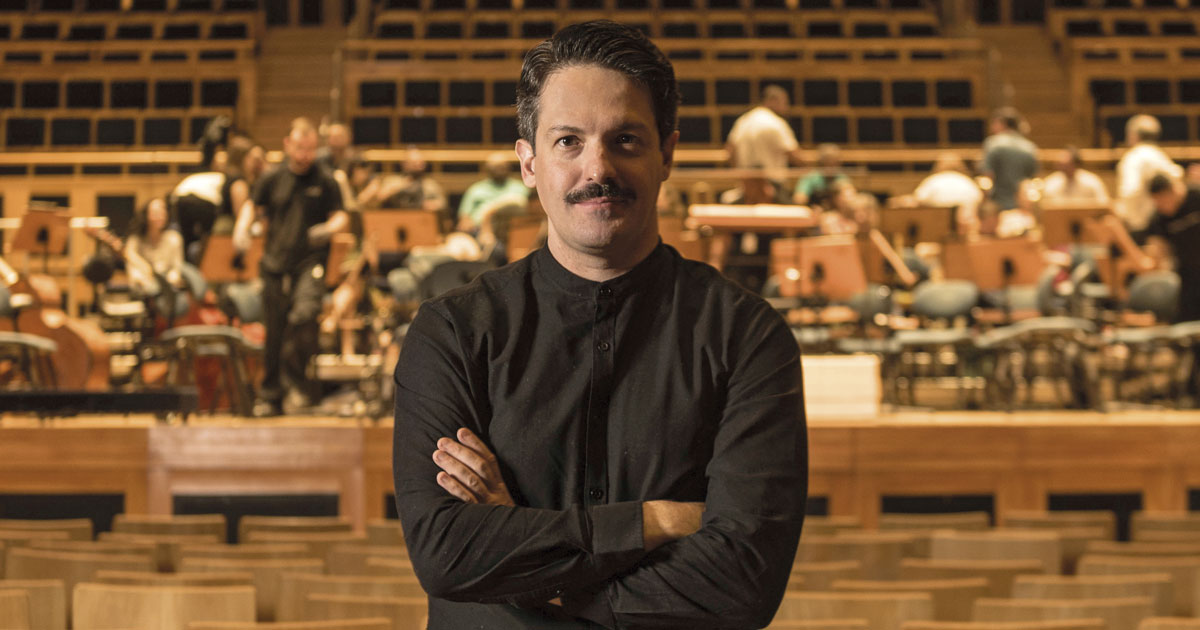
I come from a humble family. I was born in Vila Matilde, in the east of São Paulo. My father worked in advertising and my mother is a teacher. I have two sisters, who are now also teachers. In the early 1990s, we moved to my mother’s hometown of Cunha, São Paulo State. When I was 10 years old, my uncle gave me a recorder and I remember spending hours in my room playing music by ear. A short time later, I joined the school choir. The teacher, noticing my inclination, asked me to coach the male voices in the choir. I often joke that my first experience in music was as a conductor. Even without knowing how to read sheet music, I found it easy to decipher musical notation. However, my parents did not have the financial means to enroll me in a music school or hire a private teacher.
I only started taking music lessons later, when I began learning the violin with a social project in Cunha led by Carlos Kaminski, a conductor and professor at UNESP’s Institute of Arts, São Paulo campus, who has now retired. I was already 15 years old, which is considered late to start learning music, especially the violin. The project started in 1998 and the following year I became one of the teaching assistants. Around that time, I decided to form “my” choir, a madrigal with eight voices, comprising people from the violin course, some amateur musicians, and even my mother. That is when I understood that this was what I wanted to do—to be a conductor.
But my dream had to wait. Since I did not have enough training to pass the specific skills test, which is a prerequisite for the music course entrance exam, I instead chose to study biological sciences, a subject I enjoyed. In 2001, I started my undergraduate degree at the Federal University of Alfenas [UNIFAL] in Minas Gerais, where I grew interested in two areas, the study of reptiles and plant physiology. In my first year, I did an internship at the snake center at UNIFENAS [Professor Edson Antônio Velano University] and an undergraduate research project at UNIFAL on the allelopathic effects of the fruits of four plants: tomatoes, eggplants, lobeira (named so because it features heavily in the diet of the maned wolf), and the tropical soda apple, a shrub native to South America.
Allelopathy is a phenomenon by which some plants emit substances into the surrounding environment, such as the soil and air, to prevent or harm the growth of other plants around them. In my research, I showed that the fruits of these plants have an allelopathic effect on the cultivation of lettuce, which had smaller roots and fewer leaves when grown nearby as a direct result. But I never gave up on music. To support myself financially, I was giving violin and viola lessons, in addition to being the conductor of the UNIFAL choir and another choir in Paraguaçu, which neighbors Alfenas.
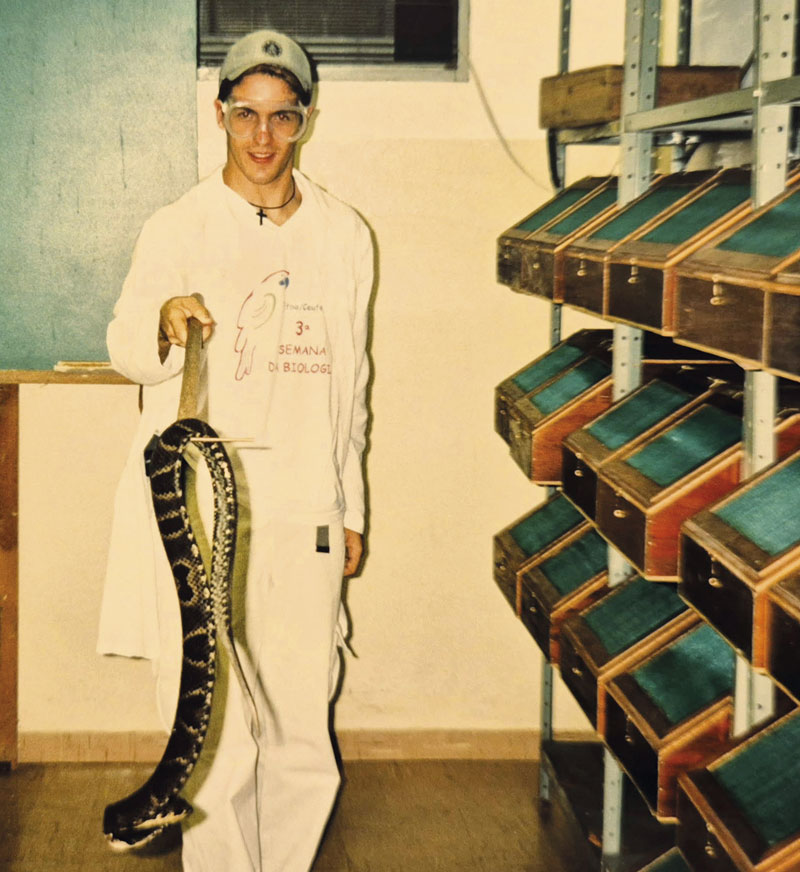
Personal archiveCoelho in the 2000s, when he was an intern at the snake center of a university in Alfenas, Minas GeraisPersonal archive
After graduating in 2005, I moved to São Paulo, where I spent the next four years dividing my time between being a science teacher at Colégio Objetivo and a professional musician. I was the conductor of the Caixa Econômica Federal choir and pedagogical coordinator of a social project run by the Presbyterian Church of São Paulo, which included an orchestra, as well as director of the recently created conservatory at Alfenas. In 2009, I had the opportunity to study a course in symphonic band conducting in Canada, after which I returned to Brazil determined to go further into this field. Finally, in 2010, I enrolled on a bachelor’s degree in conducting at the School of Communications and Arts of the University of São Paulo [ECA-USP], where I graduated in 2016.
During my master’s degree at ECA-USP, which I also completed in 2016, I studied the Congada de São Benedito, based in Cunha. Congada is an Afro-Brazilian tradition that involves music, dancing, and singing, combined with Catholic beliefs and rural folklore. In addition to the history and general organization of the festival, I analyzed the musical transcriptions and rhythmic patterns of the main instruments used in the congada. My master’s dissertation was published by Casa Cultura in 2023, and earlier this year, public schools in Cunha started using the book in the classroom.
When I was still an undergraduate, Professor Monica Isabel Lucas invited me to join the USP Early Music Ensemble, where I am now the principal conductor. In our concerts, we try to reproduce musical works as they were originally created, especially in the seventeenth and eighteenth centuries, both through the use of replica period instruments and the study of original musical treatises and manuscripts from the era. Working with this group helped me discover other perspectives on making music, beyond the approach established in the nineteenth century—the so-called Romantic period—which sparked my interest in musicology.
It was based on these themes that I chose the topic of my PhD, completed in 2022, in which I analyzed the symphonic work of Beethoven [1770–1827], who is celebrated as a precursor of the romantic musical language of the nineteenth century. In my thesis, however, I argued that the composer was more aligned with the traditions of the eighteenth century, known as the classical period, because he was heavily influenced by his predecessors, such as Haydn [1732–1809] and Mozart [1756–1791]. In 2022, my research won the Award for an Outstanding Thesis from the Postgraduate Program in Music at ECA-USP, which led to the publication a free, digital book by Editora CRV last year.
I have been leading the OSESP [São Paulo State Symphony Orchestra] Choir for five years. In 2024 we celebrated the 70th anniversary of OSESP, the 30th anniversary of the choir, and the 25th anniversary of Sala São Paulo. To celebrate these dates, I added some particular works to the choir’s program, including by Italian composer Antonio Lotti [1667–1740], Brazilian composer and pianist Juliana Ripke, Heitor Villa-Lobos [1887–1959], Gilberto Gil, and Dorival Caymmi [1914–2008].
Music education in Brazil is focused on European composers, which ends up being reflected in concert programs. I therefore try to give the public a more varied and inclusive repertoire, with composers from different origins and musical genres. I have an emotional relationship with popular music. At home, we listened to a lot of MPB [Brazilian popular music], but also a lot of country music. For me, there is no hierarchy between popular and classical music—a term that I do not like, and which is the subject of much discussion in academia. There is well-written and poorly written music in every style, whether concert or popular.
On a personal level, I also have reason to celebrate. I have just been accepted to study choral conducting and music education at the Music Department of ECA-USP. I am very happy to be able to continue my career as a researcher, but I do not plan to abandon the concert halls. After all, as Gilberto Gil sang in “Quanta” [1997], art is the sister of science.
The story above was published with the title “Art: the sister of science” in issue 345 of November/2024.
Republish