American geographer Antoinette WinklerPrins, professor of environmental science and policy at Johns Hopkins University and deputy division director of the Behavioral and Cognitive Sciences Division at the US National Science Foundation (NSF), spent August in São Paulo, evaluating new opportunities for collaboration between FAPESP and the American agency. A range of topics, from cognitive sciences to the Amazon, were on the agenda.
Her interest in Brazil is not new. WinklerPrins’s father was a diplomat and they lived in Rio de Janeiro between 1970 and 1975, when she was aged 8 to almost 13. It was during this period that she began paying attention to the Amazon, after seeing the headlines of the biweekly news magazine Manchete about exploration in the region. Later, in the 1990s, she visited Santarém, in the state of Pará, for her PhD at the University of Wisconsin-Madison. She explored rural areas of the municipality to collect soil samples and interview locals living on the riverbanks for her studies on land use and the importance of traditional soil knowledge.
Despite her focus on administrative work at the NSF, she is still publishing scientific articles. The most recent, which described the transformation of pre-European Amazonian landscapes, was published in the Annals of the American Association of Geographers in January 2021 in partnership with Brazilian biologist Carolina Levis, who is currently on a postdoctoral fellowship at the Federal University of Santa Catarina (UFSC).
Early in the conversation with Pesquisa FAPESP, WinklerPrins stressed that she would be sharing her personal views and was not speaking on behalf of the NSF. The geographer was in Brazil to participate in the Embassy Science Fellowship Program, run by the US Embassy and Consulates in Brazil in partnership with FAPESP.
What was the main topic you discussed here in Brazil?
We discussed possibilities for collaboration in the science of learning and cognitive neuroscience, my main focus now at NSF. We started talking about this in 2022, and we are picking back up on the discussions now. There is a lot of interest right now in the science of learning, cognitive development, and broadening the sampling populations for those sciences.
Was the Amazon region on the agenda of these conversations?
Yes. The NSF and FAPESP have a substantial collaboration. In March 2023, a new memorandum of understanding was signed by the two institutions. We have several initiatives relating to the mobility of researchers to the Amazon, but there is room for more. Amazonia+10, for example, is a special program and it is transversal. There is potential there, but there are other initiatives that will probably move forward more quickly because the two agencies’ programs are already aligned.
We need to think about coproduced knowledge. The questions should be coming primarily from the local population
What is the aim of Amazonia+10, in your view?
To mobilize and improve resources and institutions in the Amazon and develop human capacity so that researchers from the area can conduct research in their own region, because it has been a bit of a colonial space in the past. Thirty years ago, there were very few Amazonians working in the Amazon. Everyone came from outside to study it and tell them what to do. Things are changing, but there is still a lot of work to be done. We need to think about coproduced knowledge and about what questions need to be asked. The questions should be coming primarily from the local population. There is so much to discover about the Amazonian biota, fauna, and flora. No one group of researchers or one country can do all of it. So finding ways to cooperate is great, but in a different way than it was 30 or 40 years ago.
Are you also going to address the bioeconomy in the Amazon?
Yes, I suggested workshops on the bioeconomy, which is a big part of what Amazonia+10 wants to do. There are many different definitions of bioeconomy, and it is often related to biotechnology, but the bioeconomy in the Amazon is much more about working with standing forests and developing communities using the resources that result from this policy. It would be wonderful to support more basic research on the bioeconomy as Amazonia+10 envisions it.
What is your view on the dilemma of conservation versus socioeconomic development?
There is always tension between these two elements. In the Western world, the history of conservation was based on the idea that the only way to conserve the environment is by taking people out of it. That is based on certain ideologies—romantic notions of pristine nature. The Amazon is the postcard of this image, a vision of untouched nature. People do not realize that the forest is the way it is partly because of how it has been used by people. That framing gets in the way of having a different sense of conservation and moving beyond the national park model.
How can we unite local communities in this process?
Brazil was ahead of its time with sustainable development reserves. Some of them have been very successful, like Mamirauá [Sustainable Development Reserve, Amazonas]. There needs to be more of that, because we know that the best way to protect the standing forest is to use it. Indigenous territories are also a huge protection against industrial incursion. Of course, to conserve the forest, different approaches are needed for cattle and soy. Value chains must be changed to stop further deforestation. The basic idea of sustainable development reserves is to use the bioeconomy to take products from the forest and add value to them, to give economic security to people living in the forest environment.
What work did you do in the Amazon?
I went to Santarém with an NSF grant in the 1990s. I studied soil use and traditional Amazonian knowledge in the várzea [seasonal floodplain forest] region for my PhD at the University of Wisconsin-Madison. I conducted interviews, collected soil samples, and worked on the Várzea Project, which is now IPAM [Amazon Environmental Research Institute]. A lot of jute was grown in that part of the Amazon in the past. It was used to make sacks for the coffee industry in São Paulo. But then production subsidies were stopped and the market collapsed in the region. Many smallholder families were left trying to figure out a way to make a living. They tried to intensify their agriculture, which is hard when you can only grow things half the year. And everyone was planting the same things: watermelon, cassava, various types of squash. They transported the fruit in canoes, and they had no coolers. It was very difficult.
What alternatives did the riverside communities consider?
There was great potential for increasing and intensifying fishing, which was a common practice among the residents. But little was known about the species and how they reproduced. The Várzea Project worked closely with the fisher’s association, which was trying to unite people to make local agreements. But outsiders would come to the várzea lakes with large boats full of ice, scoop up all the fish, and then leave. And ice was new there. The local fishermen were lost. My thesis was titled “Between the Floods,” because after jute we did not know what would come next in terms of sustaining people. Then urbanization took place, and much of the várzea came to be used for cattle farming.
What did you discover?
That there was significant traditional knowledge of the soils, and the way agriculture was practiced there was based on a very nuanced understanding of the landscape, of where the moisture was, because the dry seasons are very dry up there. Certain crops could be planted at certain elevations. There was a desperate need for cold storage and market information, as well as support to develop and intensify agriculture, perhaps with different crops. It was at the beginning of what we called engaged research, now known as coproduced research, to recognize that local people have knowledge. You cannot just come in and impose it from the top. It is not going to be successful if you are not engaging.
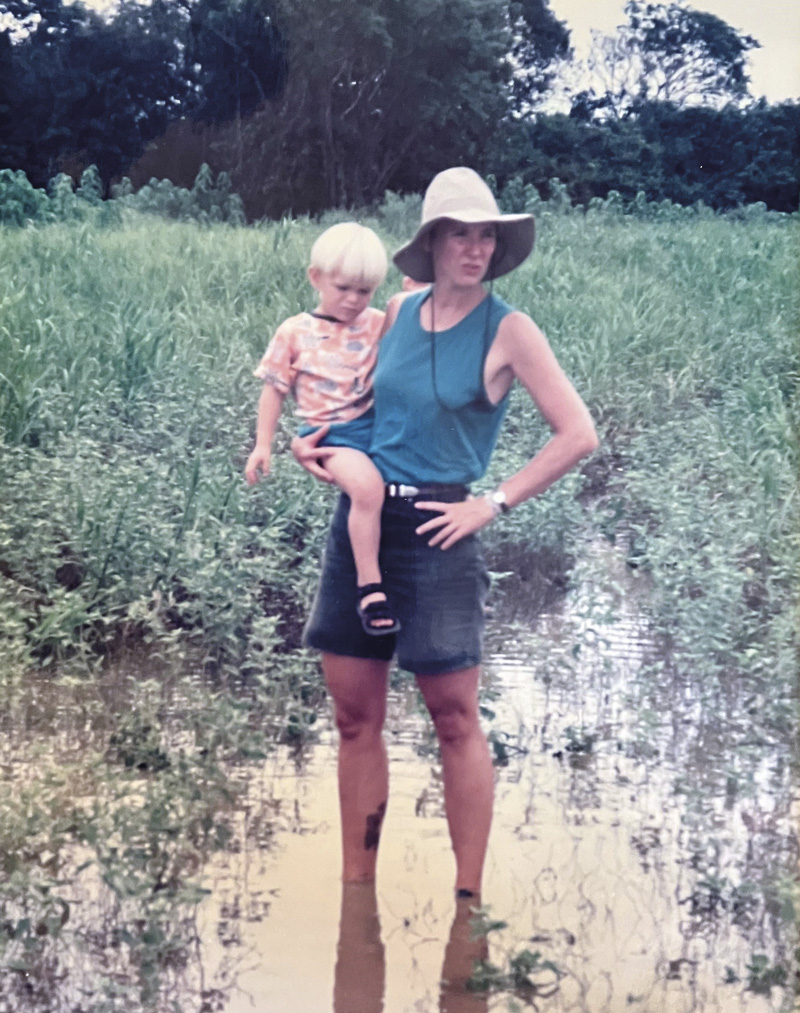
Personal archiveWinklerPrins in 1996, doing fieldwork in Santarém, with her son Lukas, who was 2 years old at the timePersonal archive
Are things different today?
In the narrative, yes. In practice, perhaps not so much, but it has come a long way in the last 30 years. It is very hard to do collaborative research and development work that is respectful of the local communities, in a way that benefits them the way they want to be benefited.
You also studied home gardens in Santarém. Can you tell us about that?
Yes. During my doctorate, I noticed the connection with Santarém and the urban area. People would have a household on the island, in the várzea, but also one in the city sometimes so that the children could go to school. I went to the city to follow the same people whose agricultural practices and traditional knowledge system I had studied. I spent a year observing 25 households, together with an assistant who was from the várzea, to understand the circulation of plants and products. These people needed money to buy, from this circulation of products that was going on within the city, but also between rural areas in what was a very informal economy. I wrote a chapter on home gardens in a book on globalization and new geographies of conservation, published in 2006. I also edited a book on global urban agriculture, published in 2017.
What challenges have you faced in your research?
The first was doing the fieldwork. In the várzea region, at lunchtime, my field assistant and I—the two women on board—were the ones who had to cook at the back of the boat. There was sexism. I had my son with me, who was 2 years old at the time, and my husband. We lived in a small house that we rented in Santarém. My husband is a doctor and he worked as a volunteer at an NGO called Fundação Esperança. Little Lukas went to preschool while I did my research. When my husband returned to his practice in the US, Lukas stayed with me. I was doing soils research, walking around with an auger [a tool for drilling and taking soil samples], which was not associated with women. But when I did the interviews, I took my son with me—I was totally a mother, fitting the mold of what it means to be female. It opened doors for me.
And the second challenge?
It was the tension between development and science. I wanted to know how people used the environment and they asked me: “Where is the money for the new well?”, “Where is the money for this banana disease?” I was asking theoretical questions and they wanted practical answers. It is a reminder that people have immediate needs, they do not care what you write in your scientific paper.