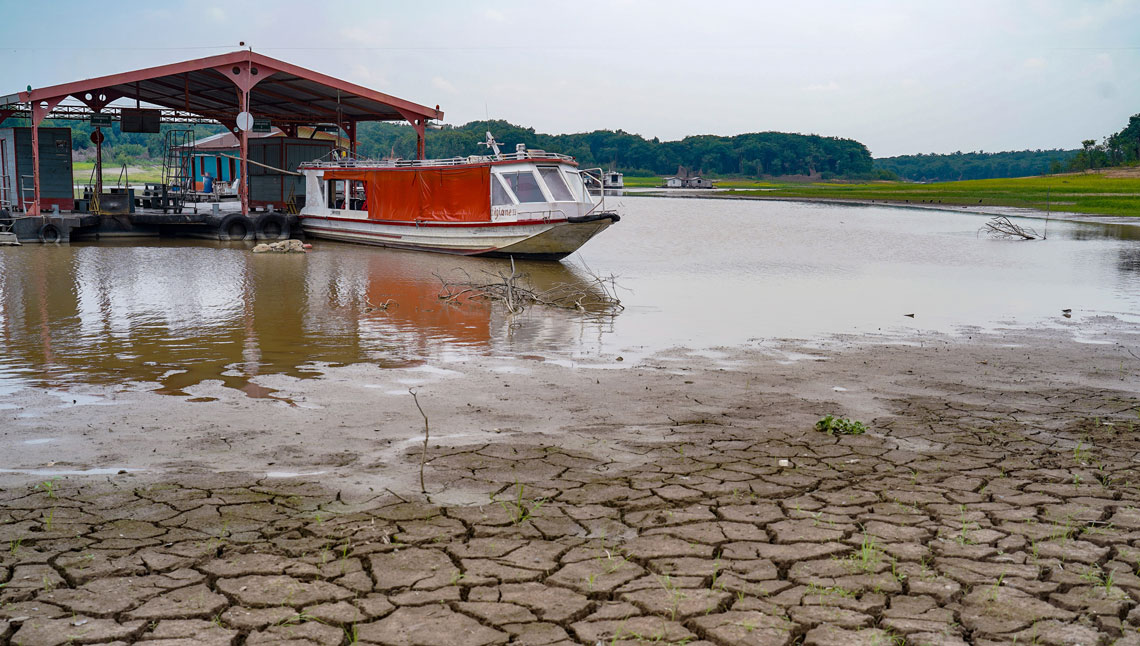
In the Amazon, groundwater acts as a reservoir that sustains trees during dry periods. When a drought is prolonged, however, the water levels of underground aquifers drop, exacerbating the drought and leaving forests more vulnerable to fires, especially in years in which the El Niño climate phenomenon occurs.
These conclusions are part of a study carried out at the University of São Paulo (USP) and published in the journal Science of the Total Environment in December, which warned of the need to manage groundwater accumulated between and within rocks.
“When the forest has no water to draw from, the smallest spark can start a fire, which then also spreads more easily,” says USP geographer Bruno Conicelli, one of the authors of the article. Using satellite data, he calculated the level of Amazon aquifers between 2004 and 2016 and compared it with data on forest fires. The largest fires occurred in regions where the aquifers were driest.
“Because aquifers store enormous volumes of water—around 97% of the planet’s fresh water in liquid form—it takes longer for them to replenish, while rivers, which account for 1% of global freshwater reserves, are refilled almost instantly after heavy rain,” explains USP geologist Ricardo Hirata, coauthor of the study.
This phenomenon is most visible in seasonal rivers in arid and semiarid regions, which dry up during the dry season and start flowing again as soon as the rains return. In these places, aquifers are generally deeper than the river surface and even deeper than the riverbeds.
“In the Amazon, aquifers take months to recover after the rains return,” notes Conicelli. He explains that when there are droughts year after year, as has been the case recently, aquifers are unable to recover. Plants with shallower roots are the first to suffer from a shortage of water.
Variations in the areas affected by fire can be explained both by reduced aquifer levels and exploitation of the forest. There were many fires along the agricultural frontier of Mato Grosso, for example, despite the fact aquifers in the region were not as low. However, there were also intense fires in regions of the Amazon that were drier, such as in the north near the border with Venezuela, in the central region, and at the mouth of the Amazon River. Near the Andes, where it rains more, there were fewer fires.
Losing water
Groundwater surfacing in springs helps maintain perennial rivers that flow all year round, even during dry periods. Some rivers may lose water, however, as it infiltrates the riverbed and returns to aquifers.
The majority of Brazilian rivers are losing water (55%), according to a November study published in Nature Communications. In areas of extensively irrigated agriculture, such as the São Francisco River basin, more than 61% of rivers supply water to aquifers.
“This loss does not mean that most rivers are drying up, but it could become significant in terms of flow if the aquifer level decreases,” explains Edson Wendland, a civil engineer from USP’s São Carlos School of Engineering (EESC) who is supervising the research.
A similar study published in the journal Water in 2020 indicated that the main reason behind the reduced flow rates of rivers in the São Francisco basin was a drop in the water level of aquifers supplying the rivers. Water extraction for irrigation was identified as the likely main cause of the problem.
“Rivers and aquifers must be managed in conjunction with one another,” argues EESC civil engineer José Gescilam Uchôa, lead author of the Nature Communications article. According to Uchôa, it is important to monitor water resources, especially in areas of irrigated agriculture.
The story above was published with the title “The invisible drought” in issue 347 of january/2025.
Projects
1. SACRE: Integrated solutions for resilient cities (nº 20/15434-0); Grant Mechanism Thematic Project; Principal Investigator Ricardo César Aoki Hirata (USP); Investment R$6,494,953.26.
2. Impact of land use and occupation and climate change on hydrological flows between groundwater and surface water in the outcrops of the Guarani Aquifer system (nº 23/13160-8); Grant Mechanism Doctoral Fellowship; Supervisor Edson Cezar Wendland (USP); Beneficiary José Gescilam Sousa Mota Uchôa; Investment R$365,185.44.
3. Extreme precipitation and temperature events in Brazil in the context of climate change: Statistical properties and future changes (nº 22/06017-1); Grant Mechanism Doctoral Fellowship; Supervisor Edson Cezar Wendland (USP); Beneficiary André Simões Ballarin; Investment R$158,795.17.
Scientific articles
LUCAS, M. C. et al. Significant baseflow reduction in the Sao Francisco river basin. Water. vol. 13, no. 2. dec. 22, 2020.
TOLEDO, N. et al. Dynamics of meteorological and hydrological drought: The impact of groundwater and El Niño events on forest fires in the Amazon. Science of the Total Environment. vol. 954, no. 176612. dec. 2024.
UCHÔA, J. G. S. M. et al. Widespread potential for streamflow leakage across Brazil. Nature Communications. vol. 15, no. 10211. nov. 25, 2024.