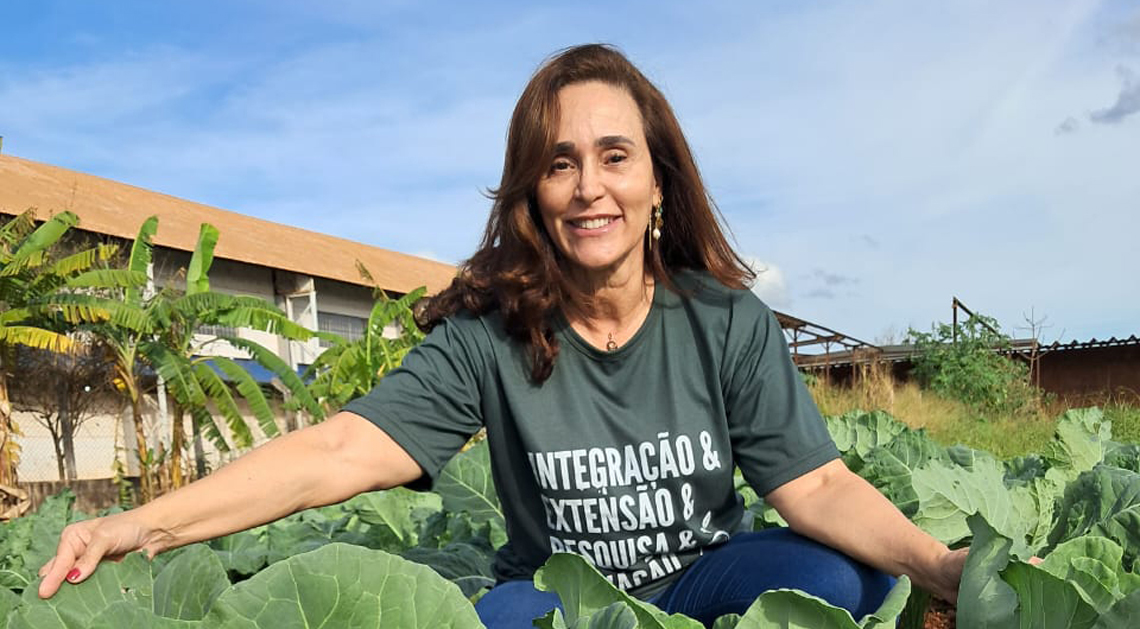
My love of plants came from the women in my family. I was born and raised in Rio de Janeiro. My grandmother was Indigenous and both she and my mother had a vast knowledge of plant cultivation and the use of medicinal herbs.
When the time came to choose what to study in higher education, biology was the natural choice. I enrolled in the biological sciences course at Gama Filho University in 1982, but faced with difficulties covering the costs of private higher education, I transferred to the Federal University of Viçosa, in Minas Gerais, later that year.
It was there that I realized how studying biological processes in plants can optimize agriculture—and I fell in love with applied botany. For my final year project, I analyzed the biology of pollination in Crotalaria anagyroides H. B. K., a species of rattlepod known locally as xique-xique. Like other species of the genus, it is toxic, but it can be used as a green fertilizer and to control nematodes [worms] and weeds.
In 1989, three years after I graduated, I moved to Dourados, Mato Grosso do Sul, in search of professional opportunities. I really wanted to help my family in Rio, who were finding things difficult after my father’s death in 1983.
My boyfriend, who I met during my undergraduate studies in Viçosa, was living in Ponta Porã, a town near Dourados. He is an agronomist. We got married soon after I moved to Mato Grosso do Sul and we are still together today. In the early years, I worked as a biology teacher at an elementary school, but my dream was to work at a university.
During my master’s degree in agronomy, I began researching the relationship between insects and plants. In my dissertation, which I defended at the Federal University of Mato Grosso do Sul [UFMS] in 1997, I analyzed the interaction between insects and the flowers of Brassica napus L., commonly known as canola.
In 2000, despite having two young children aged 7 and 9, I began my PhD in biological sciences at UNESP [São Paulo State University] in Botucatu. I characterized the morphology and anatomy of the vegetative organs (the roots, stems, and leaves) of Pfaffia glomerata, also known as Brazilian ginseng. It is a plant with a long history of use by Indigenous peoples and in traditional medicine, and its pharmaceutical potential has already been proven. In 2003, a year before I completed my PhD, my third child was born.
My dream of becoming a university professor became a reality in 2006, when I secured a position at the School of Biological and Environmental Sciences of the Federal University of Grande Dourados [FCBA-UFGD]. My research and partnerships at the university opened up new avenues for knowledge exchanges and learning. One of them took me to the Itamarati settlement, which was created in 2002 and is now considered one of the largest in Latin America.
Covering approximately 50,000 hectares, Itamarati is located in Ponta Porã, on the border with Paraguay. In 2017, I saw an agreement signed between the community, the city government, and the university as an opportunity to put my knowledge of botany applied to agriculture into practice.
A number of meetings and discussions with groups of farmers from the settlement and municipal managers led to the creation of an outreach project called the Rural Development Center: Sustainable Solutions Network. The initiative involves collaborations with researchers from UFGD and is aligned with the United Nations [UN] Sustainable Development Goals [SDGs] for 2030.
Itamarati is home to 2,800 families—almost 17,000 people—who produce many foods, from vegetables and beans to corn and soy. They do this both for subsistence and to sell any surplus.

Personal archiveRural Development Center: Sustainable Solutions NetworkPersonal archive
When we started the project, there was already a desire in the community to restrict the use of chemical pesticides. That is when I proposed the adoption of bioinsecticides. In 2019, we began visiting farmers and schools in the region with the objective of understanding local needs. Only then did we introduce these people to specific technologies, teaching them how to manufacture and apply bioinsecticides.
The research I have been conducting over the years shows that several plants, especially from the Cerrado (wooded savanna), have potential as bioinsecticides. These studies have resulted in a database of botanical species with proven effects for controlling insects that impact agricultural production.
We developed a bioinsecticide from barbatimão [Stryphnodendron adstringens] that can be used against the diamondback moth [Plutella xylostella], a pest that affects crops such as cabbage and kale. Because there are a considerable number of people growing crops in the settlement, this type of pest control is essential.
The adoption of bioinsecticides is a long-term project in which education is a fundamental component. Many believe, for example, that because they are made from plants, bioinsecticides do not require the use of personal protective equipment, which is not true. Although these compounds are generally less toxic, they can still cause skin irritation and even respiratory problems.
In addition to visiting farmers, we work at the community’s three schools, where we set up vegetable gardens to support educational activities. This includes cultivation techniques, soil and water care, the manufacture and use of bioinsecticides, and the provision of food for school meals.
Our audience is made up of elementary, high school, and EJA [Youth and Adult Education] students. One of the outcomes of our work is that we help these young people stay in the countryside.
In another area of education, we have a partnership with the municipal government through which we offer workshops and training courses to women on topics of their own choice. The aim is for them to be able to generate income from work they do in the settlement.
The support from the university and the Ponta Porã government is the anchor of the CDR. However, over the years, we have expanded our activities in the settlement through specific educational projects with the state government. Another important point is the scholarships granted to UFGD students via the CNPq [Brazilian National Council for Scientific and Technological Development] and the Mato Grosso do Sul State Funding Agency for Education, Science, and Technology [FUNDECT].
In 2025, we obtained funding from Itaipu Binacional, through a public call for proposals, to acquire machinery for the Itamarati Family Farmers’ Cooperative. This equipment will be used to process agricultural products with the aim of increasing their market value.
My dream now is to build a factory to produce bioinsecticides on a large scale, capable of serving communities inside and outside Itamarati. In addition to financial resources, there is a technological challenge in working with natural active compounds, which can vary depending on factors such as climate, soil, and altitude. Unlike conventional, synthetic chemical pesticides, some bioinsecticides are sensitive to light, temperature, and humidity, which can make storage and application difficult.
When I dreamed of becoming a university professor, I had no idea where that choice would take me. Today, at 62 years old, traveling the dirt roads of the settlement, I know I am on the right path.
The story above was published with the title “Natural choice” in issue 353 of July/2025.
Republish