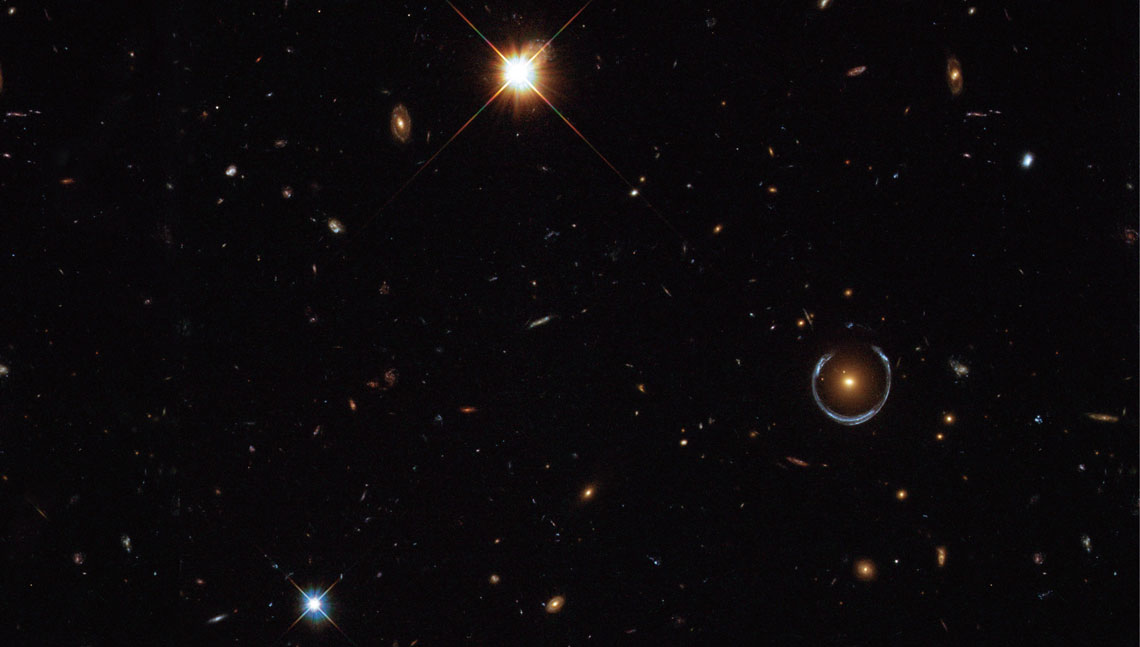
Astronomers have discovered a black hole with the mass of 36 billion suns at the heart of the Cosmic Horseshoe—a stunning trio of galaxies in the constellation Leo. The discovery, ranking among the most massive black holes ever observed, was reported in the Monthly Notices of the Royal Astronomical Society (MNRAS) this August. “Finding such an enormous black hole wasn’t part of the plan,” says lead author Carlos Melo-Carneiro, a Brazilian physicist who recently earned his PhD from the Federal University of Rio Grande do Sul (UFRGS). “For three months, I was convinced I’d done something wrong.”
The research began last year while Melo-Carneiro was conducting part of his PhD at the University of Portsmouth in the UK, supported by an exchange fellowship from the Brazilian Federal Agency for Support and Evaluation of Graduate Education (CAPES). His original goal was to study the evolutionary history and dark matter content—which makes up roughly a quarter of the universe’s total mass—of the Cosmic Horseshoe. As part of his research, he estimated the mass of the black hole believed to sit at the center of one of its galaxies—and the result turned out to be surprising. “We already knew the system hosted a black hole, but our first models capped its mass at around 10 billion suns,” says Thomas Collett, a British astrophysicist at the University of Portsmouth and a coauthor of the study, who also co-supervised Melo-Carneiro’s doctoral research, speaking to Pesquisa FAPESP.
Thanks to a unique feature of the Cosmic Horseshoe, the team could measure the black hole’s mass in two independent ways. One method used stellar velocity measurements—since the faster the stars move near the center, the more massive the black hole must be. The other relied on gravitational lensing, a cosmic optical illusion that warps and magnifies the light of background galaxies. “Our simulations showed that only a black hole about 36 billion solar masses could simultaneously account for the gravitational lensing pattern and the stellar movement we observed,” Melo-Carneiro explains. The team estimates a margin of error of roughly 15 percent.
“It’s a fascinating paper, particularly because of how it combines two methods—stellar dynamics and gravitational lensing—to determine the black hole’s mass,” says Rodrigo Nemmen, an astrophysicist at the Institute of Astronomy, Geophysics, and Atmospheric Sciences at the University of São Paulo (IAG-USP), who was not part of the research team.
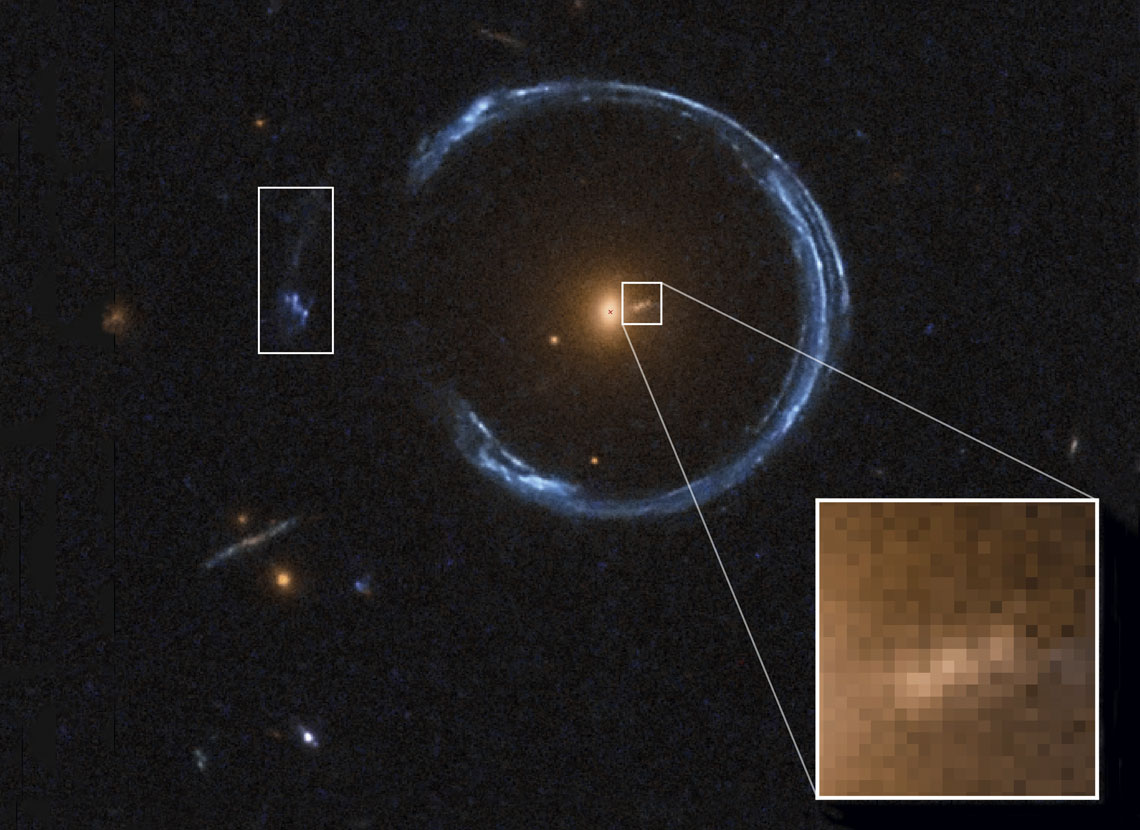
NASAIn the image, a reddish-orange galaxy appears encircled by a broken blue ring and several blurred structures marked in boxes. The black hole lies at the center of the reddish-orange object—one of three galaxies that make up the systemNASA
Discovered in 2007 as part of the Sloan Digital Sky Survey, the Cosmic Horseshoe ranks among the best-known galactic systems whose visible-light images are warped and magnified by gravitational lensing. Predicted by Albert Einstein (1879–1955) in his 1915 general theory of relativity, the lensing phenomenon is caused by gravity—a massive object bending and distorting the fabric of spacetime. That curvature warps the light traversing the perimeter of the object, much like a lens.
Because of this gravitational lensing effect, the system takes on its distinctive horseshoe shape. Without the lensing, an observer on Earth would see only a single round, reddish-orange galaxy in Leo—not the partially closed blue arc that gives the system its name. That glowing, fire-colored object is a luminous red galaxy, and it’s the closest of the trio—lying about 5 billion light-years from Earth. “The black hole we measured sits precisely at the center of that galaxy,” explains Cristina Furlanetto, a physicist at the Federal University of Rio Grande do Sul (UFRGS) who is a coauthor of the study and Melo-Carneiro’s PhD advisor.
With a mass tens of times greater than that of the Milky Way, the galaxy itself behaves as a gravitational lens. It bends and amplifies the light from two much more distant galaxies sitting behind it—one located about 10.4 billion light-years away, and the other roughly 11 billion light-years from us. The system’s blue horseshoe is known in technical jargon as an Einstein ring. The middle galaxy’s light is lensed too, though it doesn’t produce the elegant circular arc that makes the system so striking. Instead, it forms a faint, blurred patch near the bright red galaxy and a bluish streak above the horseshoe—features visible in the smaller inset image highlighting details of the system.
Black holes are cosmic objects so dense that, beyond a certain boundary, nothing—not even light—can escape their overwhelming gravity. Astrophysicists now believe that nearly every galaxy, and possibly all of them, harbor a supermassive black hole at their core. Our own Milky Way hosts a black hole of roughly 4.3 million solar masses, known as Sagittarius A*. The galaxy M87, one of the largest known, contains an even bigger one—about 6.5 billion times the mass of the Sun. The Cosmic Horseshoe’s black hole, by contrast, is dormant. In other words, it consumes almost none of the visible matter swirling nearby. For the most part, it lies silent. This very stillness makes such a cosmic heavyweight especially difficult to study.
One key question astronomers hope to answer is how the luminous red galaxy and its colossal black hole evolved. Did they grow together or independently? Did they emerge in tandem, or in distinct eras? These are among the mysteries the UFRGS research team now plans to explore in future research.
The story above was published with the title “A galactic heavyweight” in issue 356 of October/2025.
Scientific article
MELO-CARNEIRO, C. R. et al. Unveiling a 36 billion solar mass black hole at the centre of the Cosmic Horseshoe gravitational lens. Monthly Notices of the Royal Astronomical Society. Aug. 4, 2025.