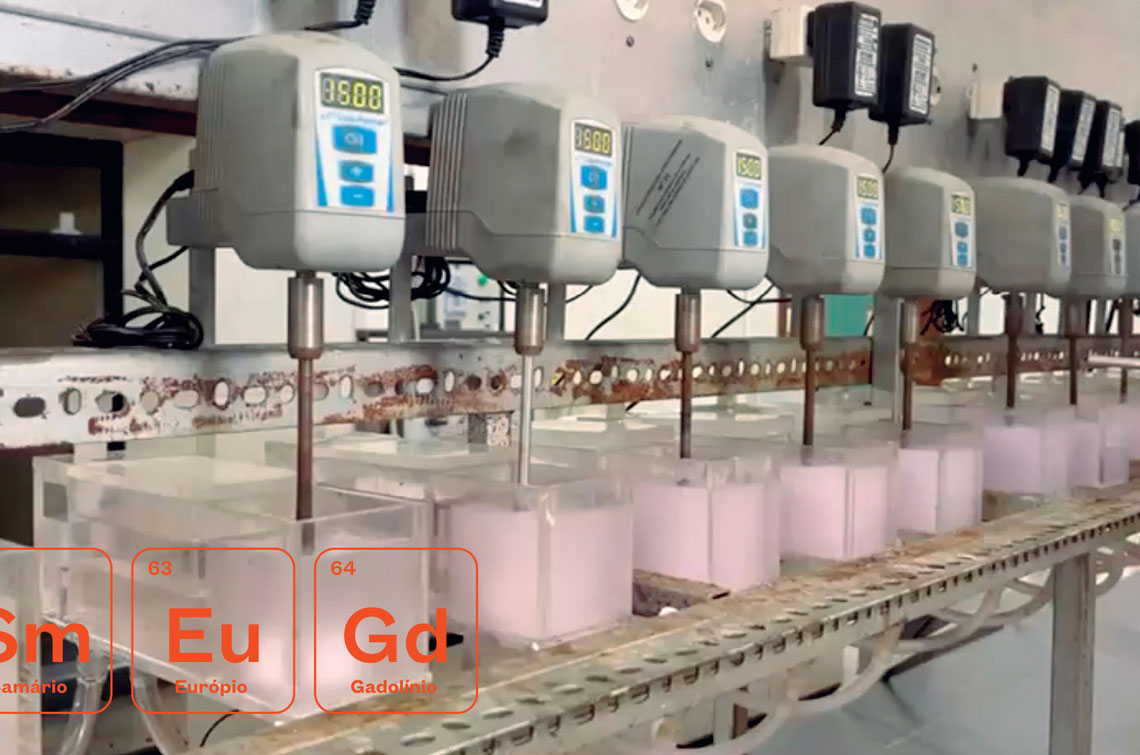
A three-story, glass-fronted building in Lagoa Santa, a town 35 kilometers (km) from Minas Gerais state capital Belo Horizonte, houses a fabrication and laboratory facility that may help Brazil to master the full cycle of permanent rare earth magnet production. Also known as super magnets due to their considerable strength and resistance to demagnetization, these components are used in applications for defense, clean energy, and electric mobility, most notably in electric cars and wind turbines. The primary chemical element used in their fabrication, neodymium (Nd), is one of the 17 rare earth elements (REE) in the periodic table, considered paramount for the energy transition. Known for their special properties such as intense magnetism, luminescence, and conductivity, this group of chemical elements is widely used in high-tech products and processes. In addition to their use in super magnets, they are employed in the manufacture of catalysts for the oil & gas industry, optical fibers, computer screens, cell phones, military jets, missiles, and luminescent markers for biomedical analysis (see infographic). In recent times, rare earths have been the focus of global geopolitical dispute.
Lagoa Santa is home to the southern hemisphere’s first neodymium laboratory-factory. Production of these magnetic components is currently monopolized by China, which holds more than 90% of global availability. Known as the Innovation & Technology Center of the National Service for Industrial Training’s Institute of Rare Earth Magnets (CIT SENAI ITR), the unit commenced operations in 2024 at two sites—one with laboratories and a small-scale pilot plant for the research and development of technologies associated to rare earth metal alloys and super magnets, and the other with a semi-industrial production line for the manufacture of sizeable batches of super magnets. Formerly known as LabFabITR, the laboratory-factory was set up eight years ago by the Minas Gerais Development Agency (CODEMGE), a unit of the MG state government. The Minas Gerais State Federation of Industries acquired the facility in 2023, and CIT SENAI then assumed responsibility for managing the Rare Earth Institute (ITR).
“On a pilot scale, we have already mastered the technological production cycle for permanent magnets made from neodymium [Nd], iron [Fe], and boron [B], the most common metal alloy used in the manufacture of these materials. On an industrial level we have mastered between 60% and 70% of the process,” says chemist and materials engineering master André Pimenta de Faria, who runs the CIT SENAI ITR. “We need to conclude the commissioning [real-time operational testing] of some equipment items, all imported from China. We are looking to achieve this by January.” The primary raw material used to make the magnets—small metallic neodymium bars—is imported from China. Although Brazil has vast rare earth mineral reserves, the country’s production of oxides or pure metals from these chemical elements is still in the very early stages, and only one mining company, with overseas capital and technology, commercializes rare earth concentrate. Brazil has no commercial operation of the other stages in the chain, notably the separation of rare earths.
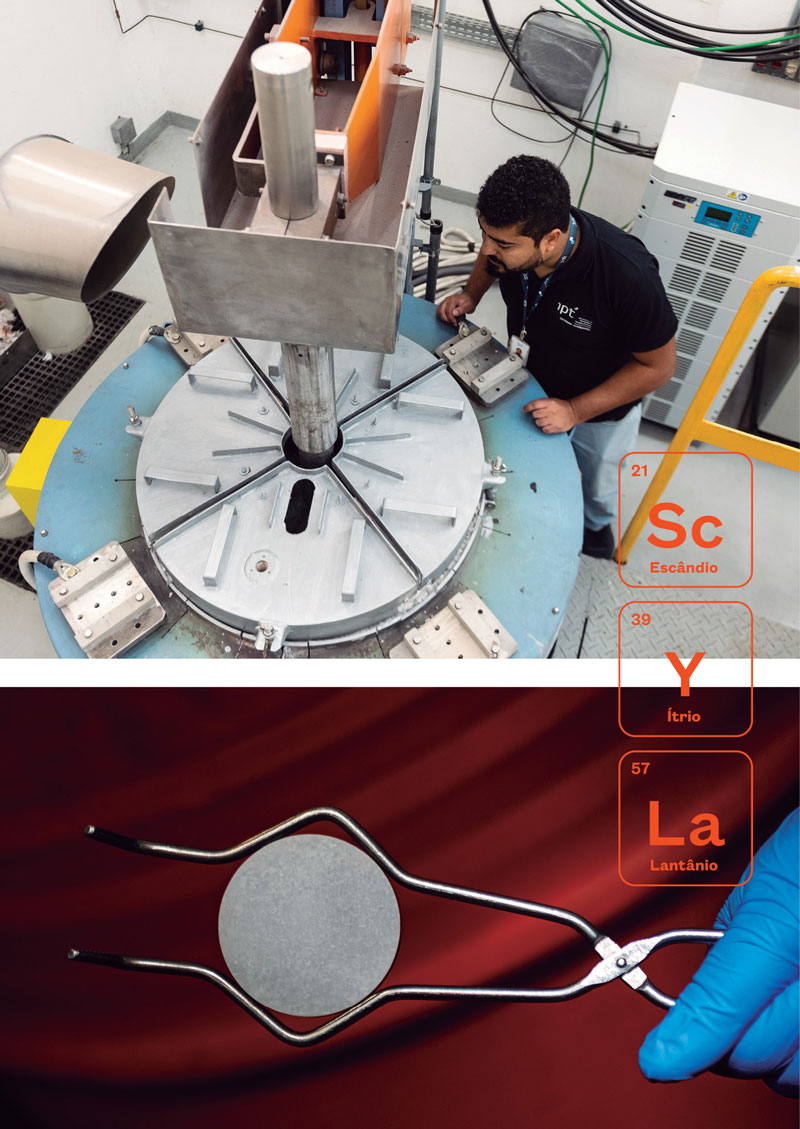
Léo Ramos Chaves / Pesquisa FAPESPIPT researcher André Nunis (above) at the pilot reactor used in the rare earth oxide reduction stage; in the second image, neodymium and praseodymium alloy produced at the instituteLéo Ramos Chaves / Pesquisa FAPESP
The aim of the laboratory-factory is to provide a link between research and industrial application; its output will be used to validate prototypes and processes in a semi-industrial manner. The maximum output capacity of the unit is 100 tonnes per year of permanent magnets, but as it is also a research center, this volume will not likely be achieved. “It is not our intention to commercially fabricate these magnets—as a research institute we cannot do that,” explains Faria. “We are seeking to master the productive chain of these components and then transfer technology to companies interested in producing the magnets in Brazil.”
The CIT SENAI ITR is a part of the project MagBras: From Mine to Magnet, approved after a call under the Brazilian federal government’s Green Mobility and Innovation program. Launched in July, the initiative brings together 38 companies, start-ups, innovation centers, universities, research institutions, and support foundations. With a budget of R$73 million, of which R$60 million is provided by the federal government and the remainder cofunded by the participating entities, the program is aimed at consolidating the Brazilian productive chain for permanent magnets from rare earth mining to final product fabrication (see infographic).
“Here in Brazil we have the world’s second biggest reserve of rare earths, second only to the Chinese, and all the right conditions to achieve an industrial-scale production cycle of these minerals and permanent magnets,” says mechanical engineer Luís Gonzaga Trabasso, coordinator of MagBras and chief researcher at the SENAI Institute for Innovation in Manufacturing and Laser Processing Systems, in Joinville, Santa Catarina State. “MagBras is a technical alliance forged with this aim, and we are looking to achieve this objective by 2030,” adds Trabasso, also a professor at the Aeronautics Technology Institute (ITA) in São José dos Campos (São Paulo).

The separation bottleneck
Despite the name rare earths, these elements are relatively abundant in nature. The issue, explains chemist Henrique Eisi Toma of the Institute of Chemistry at the University of São Paulo (IQ-USP), is that they are found in very low concentrations, normally mixed, with considerable chemical similarities between them, meaning that they require advanced extraction and refinement technologies, primarily during the chemical separation stage, when a specific element is isolated from the remainder of the rare earth concentrate.
In order to achieve its aims, the team from the Lagoa Santa facility will be able to draw upon valuable knowledge generated by research into the technological chain of rare earths, which has been gaining momentum in Brazil for over a decade now. An important part of the studies was conducted by the Brazilian National Institute for Science and Technology (INCT) Rare Earths, also known as Processing and Application of Rare Earth Magnets for the High Technology Industry (PATRIA). Active between 2018 and 2024, the project received support from FAPESP and the federal government via the Brazilian National Council for Scientific and Technological Development (CNPq), and the Federal Agency for Support and Evaluation of Higher Education (CAPES).
The INCT promoted dialogue between the different groups researching these elements at different stages of the productive cycle, such as the University of São Paulo Polytechnic School (POLI-USP), the Institute for Technological Research (IPT) and the Nuclear and Energy Research Institute (IPEN), both in São Paulo, the Center for Mineral Technology (CETEM) in Rio de Janeiro, the Center for the Development of Nuclear Technology (CDTN) in Belo Horizonte, the Federal University of Santa Catarina (UFSC), and the Centers of Reference in Innovative Technologies (CERTI), headquartered in Florianópolis (Santa Catarina).
At the CETEM, a public research institution linked to the Brazilian Ministry of Science, Technology, and Innovation (MCTI) and dedicated exclusively to mineral-sector technology, the most significant progress has been made in the chemical separation stage, the primary pinch point in the chain and one of the most expensive phases. Chemical engineer Ysrael Marrero Vera, who heads the Extractive Metallurgy Service, says that the center has successfully separated praseodymium (Pr) and neodymium.

“We separate these materials using what we call synthetic solutions, and not with real chemical rare earth mineral concentrate, because for the time being we don’t produce that,” he explains. “We purchase the reagents and rare earths from Chinese companies and steep them in an aqueous solution, then separate them using specific solvents.” The process was registered with the National Institute of Industrial Property (INPI), and the patent granted in 2022. Some of the separation study results are published in an article in the journal Minerals Engineering, March 2020 edition.
The MagBras project, says Vera, will be an opportunity to work with the real material, since there are twelve mining companies involved in the program, focused on producing rare earth concentrate, the stage immediately preceding separation, from deposits found in Brazil. “I am very confident that the technology we developed will also work with real concentrates extracted from Brazilian minerals,” he states, going on to explain that to chemically separate rare earths, a minimum of 20 kilograms (kg) of chemical rare earth concentrate is required, and very few companies in Brazil are currently capable of providing this quantity.
In São Paulo, INCT PATRIA made its biggest investment in the Institute for Technological Research (IPT), says metallurgical engineer Fernando José Gomes Landgraf, coordinator of the INCT and a professor at POLI-USP. Over the years, the Institute has acquired knowledge on a laboratorial or pilot-plant scale of the final stages in the productive chain following chemical separation, including oxide reduction in rare earths and the production of metal alloys used to manufacture magnets (see Pesquisa FAPESP issue n° 241).
“The magnet primarily comprises neodymium and praseodymium. Dysprosium [Dy] and terbium [Tb], other magnetic rare earths, are used to confer additional properties upon these magnets,” outlines chemical engineer André Luiz Nunis da Silva, technical lead at the IPT Metallurgical Process Laboratory. The Institute began working with these materials in 2014, before the INCT was created, as part of a project cofunded by the Brazilian Agency for Industrial Research and Innovation (EMBRAPII) and mining corporation CBMM, the world’s biggest niobium producer, whose mine in Araxá (Minas Gerais) also contains rare earths.
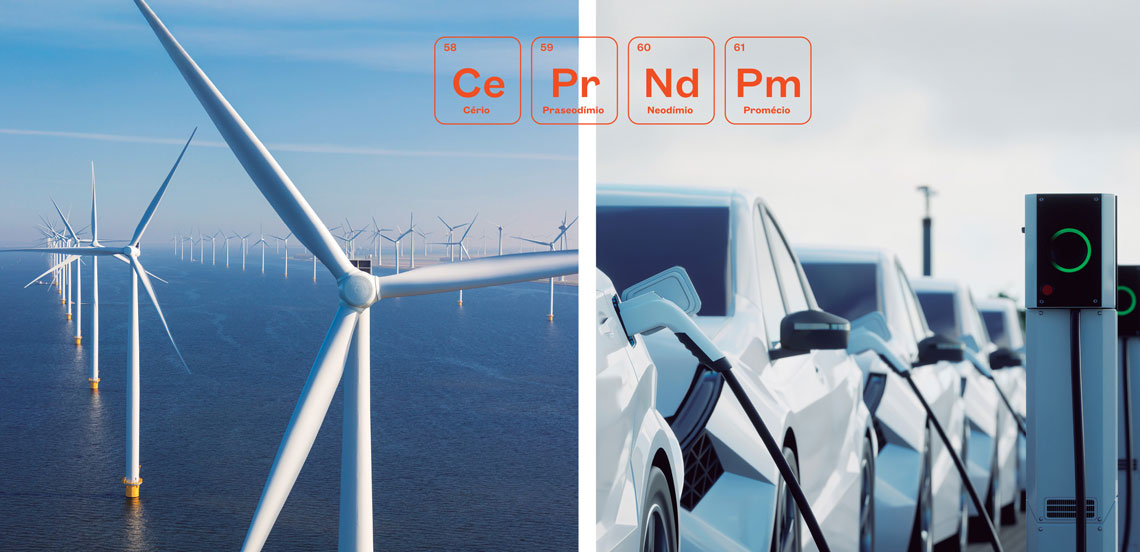
Danita Delimont / Getty Images Wind turbines and electric cars: permanent rare earth magnets are essential for the good performance of their motorsDanita Delimont / Getty Images
“At the time, CBMM contacted us because the rare earths from their mines were treated as tailings (mining waste)—the focus of their extraction was and continues to be niobium. However, they saw that there was a demand, and the need for a rare earth element supplier as an alternative to the Chinese,” recalls Nunis. The stages preceding the productive cycle—concentration and oxide separation—would be conducted internally by engineers and designers hired by the corporation.
The IPT was invited to conduct the reduction process, which involves transforming any rare earth oxide, in the form of a sandy powder, into a metal. In order to do this, oxygen needs to be removed from the oxide of interest to leave only the metal; in this case the aim was to reduce neodymium oxide to obtain the metallic neodymium. The institute studied two pathways: electrochemical reduction and calciothermic reduction, a metallurgical extraction using calcium. “We saw that electrochemical was more feasible, and we ruled out the other method,” says Nunis. The chosen pathway uses electrical energy in a reactor at a temperature exceeding one thousand degrees Celsius (ºC) to produce the metallic neodymium in the liquid (cast) state. During the second phase of the study, which commenced two years later in 2016, the IPT began producing the metal alloy required to manufacture the super magnet, always on bench scale.
In a 2022 technical note published in the Brazilian Journal of Analytical Chemistry, Silva, Landgraf and colleagues from the IPT, IPEN, POLI-USP, and IQ-USP presented an analytical method to quantify the key elements in the production of rare earth super magnets. “Small variations in the percentage of neodymium and praseodymium only influenced the alloy’s physical-chemical properties,” the researchers wrote. For this reason, analytical chemical methods need to be capable of distinguishing small variations in the concentration of the constituent elements.
During the next project stage in 2019, electrical motor giant WEG came on board as a partner, together with UFSC, cofunded by the Brazilian Development Bank (BNDES)—IPT, WEG, and UFSC are participants in the MagBras initiative. New equipment was then designed for the reduction stage, and pilot-scale neodymium production. “The reactor is around one-third industrial size and can produce up to 1 kg of material per hour,” Silva says. He explains that to obtain 1 kg of metallic neodymium, you first need 1.5 kg of neodymium oxide.