Open science—a set of practices to promote collaboration and free access to scientific research—is not without its unintended consequences. Although designed to democratize both the process and application of science, it can inadvertently accentuate disparities. Large international collaborations often include researchers from countries with limited research funding and heavy reliance on external partnerships—conditions common across much of Africa.
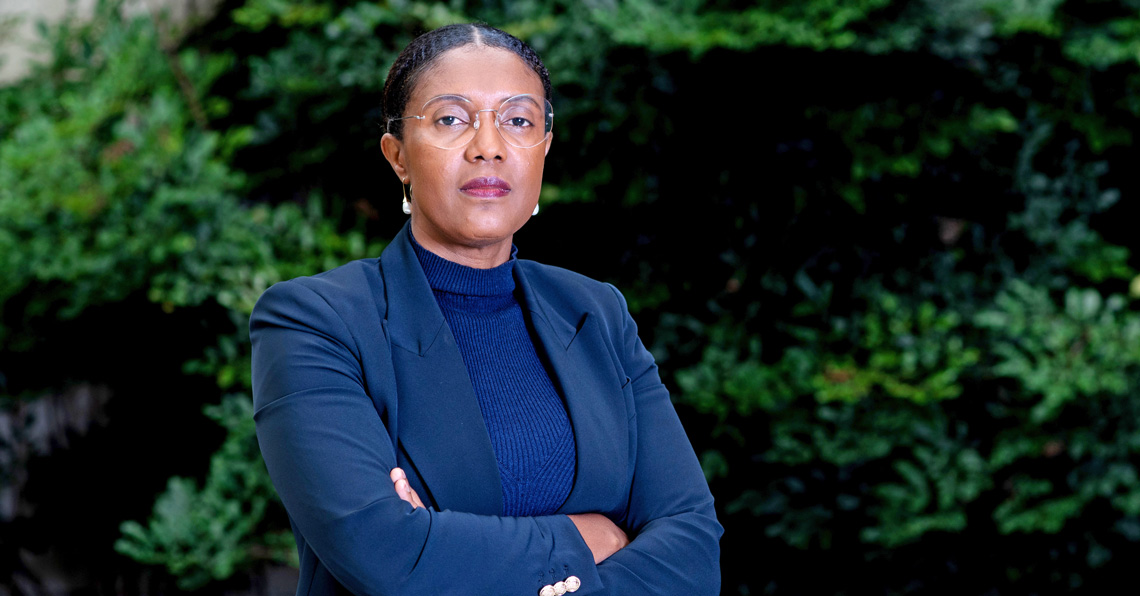
Sociologist and political scientist Eurídice Monteiro, from the University of Cape Verde, sees open science as a double-edged sword: it can accelerate international visibility for nations where research infrastructures are still developing, but it can also reduce their scientists to secondary contributors. “Africa must be recognized as a legitimate producer of research and perspectives on the world,” Monteiro emphasized on June 27, during a lecture on the challenges of open science at FAPESP’s head offices in São Paulo.
Monteiro spoke from experience: she completed both her undergraduate and doctoral studies at the University of Coimbra in Portugal, relying on international support, and she is deeply familiar with the realities of doing science in Africa. From May 2021 to February 2025, she also served as Cape Verde’s Secretary of State for Higher Education. Shortly before departing Brazil for Lisbon, Monteiro sat down with Pesquisa FAPESP for this interview.
In your talk, you noted that while open science can broaden access to research, it also risks reinforcing inequalities. How so?
Open science has real benefits: it makes research widely accessible and provides shared infrastructure that allows the global academic community to learn about the work coming out of different regions. But the critical issue is how science is produced. Unless we confront the uneven research playing field, not all countries will be seen—or treated—as legitimate producers of knowledge and worldviews. Open science may end up reinforcing the dominance of countries and communities that already enjoy structural advantages. We want access to research—not only to import knowledge produced elsewhere.
How do you view the practice where a researcher from the Global North collects data locally with the help of partners, then leaves—often without building respectful collaborations or crediting those partners as coauthors or patent holders?
These practices are widely criticized, especially in African contexts, where local partners are often relegated to the role of mere “informants.” Such disparities are evident in North–South relations, but they also exist within Africa itself—academic communities across the continent are far from uniform. Traveling from South Africa to Cape Verde or Guinea-Bissau will reveal disparities in research capabilities and knowledge-sharing across the continent. What is most troubling is the unequal relationship with dominant research hubs—and scientific cooperation has been less than equitable. Collaboration needs to be done in a way that safeguards the dignity of local researchers engaged in the global research scene.
What needs to change?
Every researcher in Africa feels compelled to work collaboratively. Internationalization is now a key metric for evaluating not only institutions but also individual scientists. The question is under what terms are they collaborating? The more inclusive and equitable the research environment, the better the outcomes—not just in research results, but in the overall process of producing and sharing knowledge.
Open science may end up reinforcing the dominance of certain countries
What is lost when collaborations are asymmetrical?
Imagine if scientific communities walled themselves off, like isolated islands. They would be limited to knowing only what they themselves produce. Our demand is clear: we must be recognized as subjects in research—not reduced to objects of external observation.
How has Africa been able to expand its research output?
Research conditions across Africa have been improving—in terms of technology, science capabilities, and researcher training. Yet, many of those trained have left the continent, joining and often remaining in the Euro-American diaspora. Take Cape Verde, for instance—a small island nation. Its domestic academic community is modest in size, while a much larger portion of its scientists live abroad. Universities there were only recently established, and so far their focus has been primarily on teaching. The country is still working to build an internal culture of research—something that has long been pushed to the back burner because of scarce funding. The strategy so far has been to rely heavily on international partnerships.
How is science funded in Cape Verde?
Efforts are underway to build a national science funding system, but currently funding mechanisms are fragmented. There are some scholarship programs that provide a certain level of support for researcher training. At present, most of the science funding in Cape Verde is tightly linked to international cooperation agreements. Roughly 2,000 people are engaged in research and higher education, most with master’s or doctoral degrees. The country’s academic community is highly receptive to joining international networks. Without such collaborations, there is very little we could accomplish.
How did you first become involved in science and technology policy?
I completed my education through high school in Cape Verde. Afterward, I won a scholarship from the Portuguese government to study at the University of Coimbra. There, I continued my studies with support from fellowships awarded by Portugal’s Foundation for Science and Technology. Later, I spent time in the United States and other countries, benefiting from programs that promoted international scientific cooperation. Cape Verde does not fund researcher travel, either domestically or abroad. My interest in science policy came while attending international conferences. Comparing my own circumstances with those of colleagues from other countries made the disparities impossible to ignore. That experience awakened me to the urgent need for Africa to build mechanisms that can ensure better working conditions for its researchers.
While in government, to what extent were you able to advance these strategies?
There is still an enormous amount to be done. In my case, I was constrained by limited resources and the many conflicts of interest that come with competing for them, as well as by political positioning. Even so, I intend to keep contributing—through other channels—to advancing science in Cape Verde. I brought with me into public service the experience I had as an academic and the networks I was part of, which helped me identify and frame key issues. For nearly four years, my agenda centered on improving both the conditions for scientific research and the quality of higher education—and throughout, my academic peers were very helpful.
Do your research collaborations include Brazil?
Yes. I’ve collaborated on projects in education, democracy and civics, gender studies, and racial issues. Like Brazil, Cape Verde was colonized by Portugal, and slavery is woven into its social fabric. In Brazil, there is a vigorous debate about affirmative action, social inclusion, and the struggle against racism, which are now global issues. These debates resonate strongly with us, because we too are the product of the transatlantic slave trade—which gave rise to the racism that still exists in the world today.
The above interview was published with the title “Eurídice Monteiro: No one is an island“in issue 354 of August/2025.
Republish