At slightly past 11 a.m. on September 20, a futuristic-looking aircraft took to the skies from the Aeroquadra Flight Club in Quadra, a town 160 kilometers from São Paulo. With a semi-oval two-seater cabin and 16 rotors encircling its airframe, the craft made a striking debut. Unmanned and controlled remotely, it ascended to a height of 40 meters and glided over the airstrip’s grass runway. The flight lasted six minutes and covered 1,800 meters, followed by a shorter second flight test.
These flights marked the first trial of an electric vertical takeoff and landing (eVTOL) aircraft—or more commonly known as a flying car—in Brazil. The event was organized by Gohobby Future Technology, a Brazilian company that imported the EH216-S model from Chinese manufacturer EHang.
“Brazil was selected for an experimental flight of this Chinese aircraft because it is one of the largest potential markets for this technology, alongside the US, China, and Europe,” explains William Roberto Wolf, a mechanical engineer and aerospace expert from the School of Mechanical Engineering at the University of Campinas (FEM-UNICAMP).
Powered by electric motors, eVTOLs are designed to provide quick urban transport while offering a greener, more economical alternative to helicopters. “They promise lower operational costs, significantly reduced noise, and minimal emissions thanks to their use of batteries,” says Wolf. “Noise reduction remains one of the biggest technological hurdles in this field,” he added. Wolf is currently leading a FAPESP-funded research project focused on reducing noise from rotors and propellers in aircraft and industrial machinery.
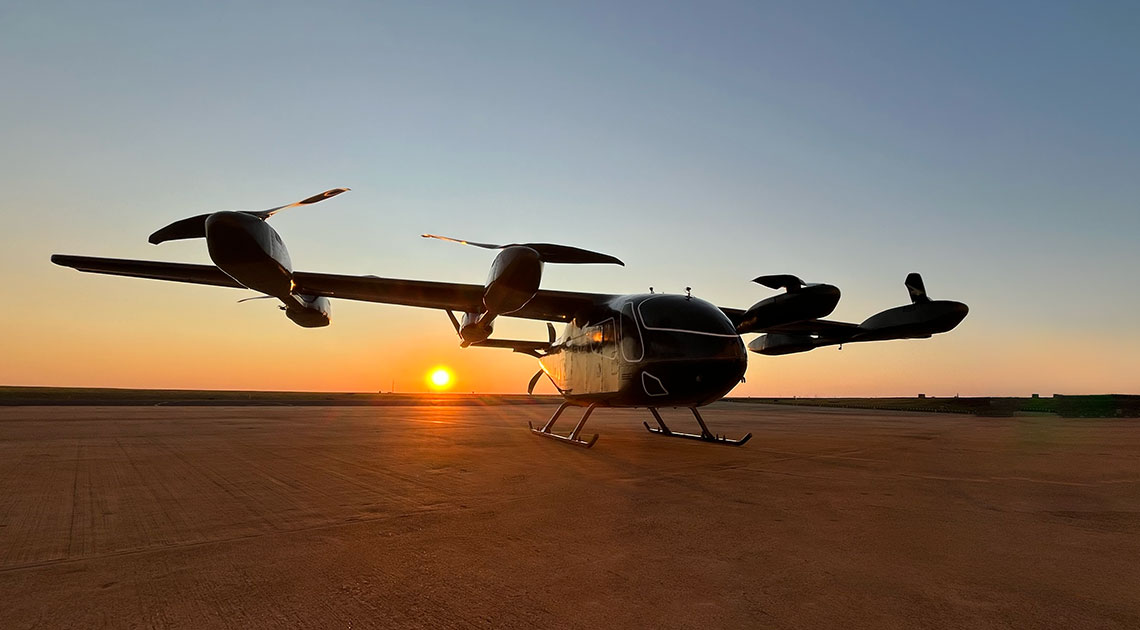
EVE/EMBRAEREve’s full-scale eVTOL prototypeEVE/EMBRAER
Industry analysts anticipate the first commercial eVTOLs to begin operations globally by 2025. Brazilian aerospace giant Embraer is looking to capture a share of this emerging market through its subsidiary, Eve Air Mobility, founded in 2020. In July, Eve showcased its first full-scale prototype at an aviation expo in England—an all-electric eVTOL seating four passengers and a pilot. Currently undergoing ground tests, it is expected to begin flight trials soon. Eve has already secured letters of intent for 2,900 units of its eVTOL model.
Projects
1. High-fidelity numerical simulations applied to unsteady aerodynamics, turbulence, and aeroacoustics (n° 21/06448-0); Grant Mechanism Young Investigator Award; Principal Investigator William Roberto Wolf (UNICAMP); Investment R$2,290,390.27.
2. Future Air Mobility Engineering Research Center (CPE-MAF) (n° 21/11258-5); Grant Mechanism Engineering Research Centers; Principal Investigator Domingos Alves Rade (ITA); Investment R$6,977,884.83.