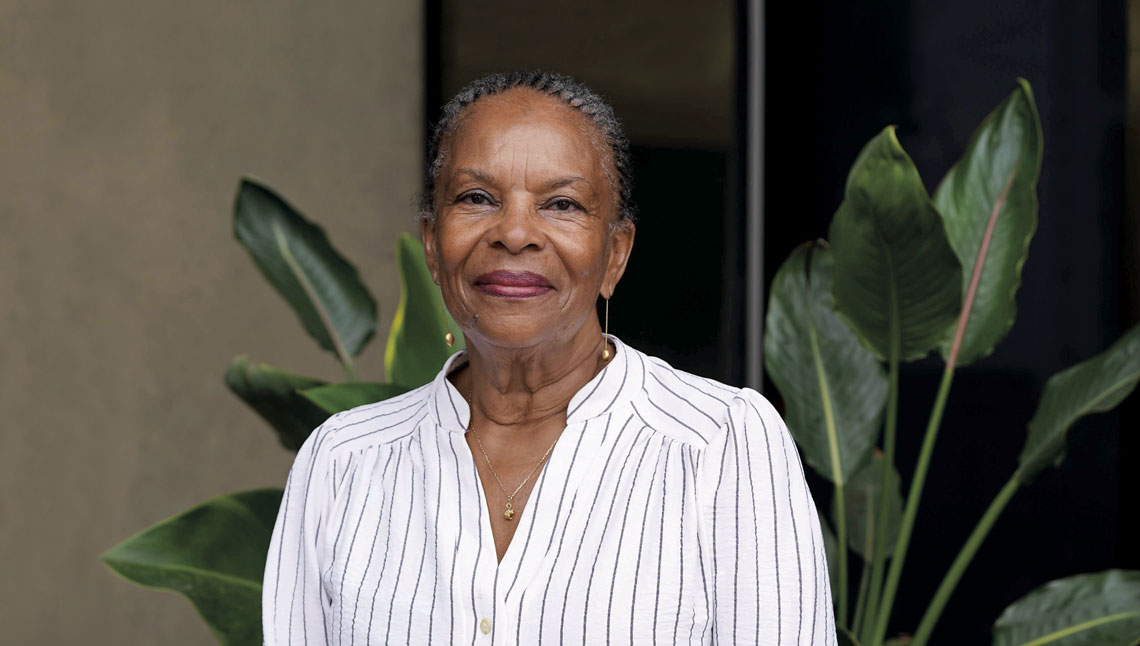
Born in French Guiana and holding a university degree in economics, Christiane Taubira served as a French Member of Parliament for 19 years and as a Member of the European Parliament for five. She authored the law that bears her name, which classifies slavery and human trafficking as crimes against humanity. From 2012 to 2016, she served as Minister of Justice during President François Hollande’s administration. Now 73, with her political career behind her, she has returned to Cayenne, the capital of French Guiana and her hometown.
Since October 2024, Taubira has held the José Bonifácio Chair at the University of São Paulo (USP), a program that annually hosts a prominent figure from the Ibero-American region to conduct research on a pressing contemporary issue. She is the first French-speaking scholar to occupy the position.
Her research project, titled “Amazonian Societies: Plural Realities, a Common Destiny?,” will result in a book to be released in September. The work will be presented at the COP30 climate conference in Belém this November. Drawing on her eloquence—shaped by years of political struggle and a passion for poetry—Taubira aims to amplify the voices of Amazonian peoples during this major multilateral event.
This month, her book A escravidão contada à minha filha (Slavery as told to my daughter) is being released in Brazil by Todavia publishing house. It offers a vital reflection on the enduring impacts of colonialism.
In her very limited free time, Taubira enjoys reading, going to the movies, attending concerts, and cycling. At the end of March, between engagements at the Federal University of Pará and the State University of Pará, she made time for this interview with Pesquisa FAPESP, conducted via video call.
You took on the José Bonifácio Chair in October, with a project on Amazonian societies. What are your goals?
I accepted the José Bonifácio Chair for one academic year because of its core mission: openness to the pressing issues affecting the Americas, particularly South and Central America. My selection was also tied to my international profile—as a former French Minister of Justice, and former member of both the National Assembly and the European Parliament. At the same time, it resonated personally because of my roots in the Amazon. That’s why I chose to focus on Amazonian societies, which, as I always emphasize, are plural despite sharing a common geographical region.
Are you working with a network of researchers?
Absolutely. Approximately 60 researchers from diverse backgrounds—including postgraduate scholars—have signed up to participate. In January, we held a consultation to identify those willing to contribute written pieces. As a result, we now have 35 proposed contributions for the book, which is expected to be completed by September. In addition to my own writings, I have invited other prominent figures to share their perspectives. I made it clear to the researchers that I am highly demanding and I expect academic rigor, but also the capacity to transcend traditional academic boundaries and challenge the paradigmatic frameworks shaping our reflections on both the Amazon and other fragile ecosystems such as the Cerrado and the Pantanal in Brazil, the Congo rainforest, Canada’s boreal forest, Australia’s coral reefs, and the ocean itself.
Will the publication with these works be presented at COP30?
Yes. I will be attending the conference, which is one of the reasons I am currently spending time in Belém. I am collaborating with both federal and state universities, while also establishing institutional contacts with local authorities. I am involved in the planning of a series of events leading up to this international summit. This is why the book must be ready by September.
With regard to COP30, there has been significant discussion about the potential for Amazonian peoples to assume a leading role. In your view, is that possible?
If it were not possible, it would be nothing short of a scandal. You cannot enter people’s homes, sit in their living rooms, speak loudly, eat, drink, make a mess, and then leave. That is unacceptable. Many of us will be present, and organizations are mobilizing. In any case, there will also be a Peoples’ Summit, where freedom of expression may be even greater. I have the opportunity to speak as a high-ranking international figure with access to global media, and I will make this point loudly and in advance: “Be mindful of your behavior and your language. Do not be indifferent to the realities of the places you visit.” There is no use in expressing regret afterwards. The United Nations was established in an era marked by imperialism, in the aftermath of the Second World War, and the multilateral imagination remains imbued with this legacy. The French Empire still exists through its overseas territories, as does the British Empire. Although the Portuguese Empire has been dismantled, it continues to maintain ties with former Lusophone colonies such as Angola and Mozambique. We are still resisting the influence of colonial metropoles. What I am asking is that we question the persistence of this legacy.
Your position is very special, being both European and Amazonian. How do these two worlds come together?
I would say that, fortunately, there are several worlds within me. That is what makes my presence in different contexts so enriching, because I am deeply Amazonian. I am also what is known as a créole, a Guyanese. And I am French, without any inner conflict of the mind or heart. I have acquired extensive professional experience in Europe, yet I have never ceased to travel the world as a political representative, both in the French National Assembly and in the European Parliament. In 2008, during France’s presidency of the Council of the European Union, I authored a report on Economic Partnership Agreements between the EU and African, Caribbean, and Pacific countries. These diverse experiences have made me increasingly aware of what it means to be from the Amazon. They ground me in my origins, while also connecting me to the world. By traversing societies, continents, historical moments, and thematic fields, I come to belong fully to humanity. I carry a constant and acute awareness of this belonging. Wherever I am, I bring with me the things I have seen, heard, and experienced in other places.
When we talk about saving the Amazon, global interest often takes precedence over local and cultural realities. How can we integrate these perspectives?
That is absolutely true, which is why I urge researchers to question the multilateral imaginary embedded in the Amazon project. I ask that they examine the notion of “Amazonians” in their geographic unity and in the plurality shaped by histories that have since become national. They must also consider the hierarchical relationships between Amazonian countries and their historical links to former colonial metropoles, as well as their engagements with the United Nations—both its multilateral institutions and their conceptualizations of the Amazon. It is essential to recognize that Amazonians are diverse, contradictory, and multifaceted. They include Indigenous communities that have existed for millennia and developed complex urban networks. These populations traversed continents and often came into conflict with one another. With the arrival of Europeans, human trafficking and slavery rapidly ensued, generating new social realities and communities—such as the quilombolas and the mixed-race communities of my America. This history involved not only conflict but also encounters. It gave rise to marriages, miscegenation, and the exchange of knowledge. My hope is that we can represent Amazonians as Indigenous, but also as mestizo societies, as complex urban civilizations, including architectural achievements with strong European influences—such as the Municipal Theater of Manaus. When the UN declares the need to “save the Amazon, the green lung of the Earth,” it confronts a significant challenge. It must recognize that the people who inhabit this region are fully aware of its composite realities. Through their ancestral relationship with the forest, they understand this biodiversity and how to maintain equilibrium and conservation. There is, indeed, a cooperation framework—the Amazon Cooperation Treaty Organization (ACTO)—which reflects a shared awareness of the work required among the nine countries that each encompass part of the Amazon. But we must remember that the states are political entities—they have the capacity to protect or to destroy. The global perspective is often unitarist and homogenizing, which is ultimately lethal. Europe dominated the world for nearly four centuries through a model of violence, oppression, and the erasure of the communities and cultures it encountered during its so-called “discovery” of the Americas.
As an economist, are you interested in the bioeconomy as a development opportunity for the region and for the livelihoods of local populations?
Absolutely. The global neoliberal economy has unified the world and globalized its circuits. We are inundated with cultural references that originate in just one or two countries and are then imposed on the rest of the world. We live in a system where financial flows and commodity markets circulate easily and abundantly, while barriers are increasingly erected against the movement of people, ideas, and values. Many individuals are unable to migrate simply because they lack a visa, and so they embark on perilous sea journeys. I believe this voracious economy is profoundly destructive. It is responsible for widespread poverty and hunger. It even kills. It has also contributed to the destruction of biodiversity, which impoverishes populations, particularly in the Global South, and destabilizes the planet. There is no shortage of alternatives to this deadly economy. The bioeconomy is based on better relationships with nature and is rooted in renewable principles. We must learn to live without the violent ideology that views nature as a body to be conquered—an ideology that also extends to women. We can envision economic activity on a more reasonable scale than the global markets, ruthless competitiveness, and predatory capitalism.
The Amazon also faces serious human rights challenges, a key issue in your career. What possibilities do you see for change?
I believe the foundation of this issue lies in legitimacy—that is, in the ability of individuals and communities to exercise self-determination. We must respect the capacity of human communities, whether they consist of 150, 3,000, or 20,000 people, to organize themselves. The role of the state is to ensure that such self-organization does not harm others; if it does, the justice system must intervene. What causes real harm are economic units ensnared in the mechanisms of the global productivist economy. These are the actors who oppress others, destroy nature, and jeopardize the health and very existence of local communities. The communities living in these regions understand their environments. They know what is good for them. They do not destroy, nor do they cause harm to others. Human rights violations are unacceptable, anywhere and under any circumstances.
How can academic research contribute to the defense of these rights?
First and foremost, by shedding light on social and cultural realities. I have asked researchers to pay close attention to cosmogonies, because from a European perspective, there is often the assumption of one God, one civilization, one culture, one language. In contrast, these communities have formed profound connections with the origins of the Universe and the world around them. They have named places, trees, and animals. They have shaped their environments. This is all part of our shared human heritage. It is not enough to assess whether manioc is being planted efficiently or sold at a good price. That is not the core of human rights. What is fundamental is the right to be oneself, to exist, to self-identify. There must also be the means for communities to achieve self-sufficiency.
Academic knowledge and politics are often seen as very different realms. What is the connection between them?
My political commitment has always been fueled by knowledge, which I constantly renew. I have been involved in activism since high school. We went on strike to demand the teaching of Afro-descendant literature from Brazil, the United States, and Africa—literature that was not European, although I appreciated European literature as well. We were not asking for more comfortable chairs. I did not benefit directly from the results, but those who came after us did: they had a lounge with a library, a chess club, a photography club, and subscriptions to international magazines, including Granma from Cuba. My political struggles, therefore, have always been linked to knowledge. Ministers work very hard, but even when I served as Minister of Justice, I continued to attend the opera and the theater, and I read every night. I went to bookstores to buy books and visited universities to talk with students, to listen to their questions, and to read academic work. Knowledge and politics truly go hand in hand, and I want researchers to understand that.
In your book A escravidão contada à minha filha (Slavery as told to my daughter), recently published in Portuguese by Todavia, revisiting history seems essential to understanding the consequences of enslavement.
There was enslavement even under the Romans, but the slave trade and enslavement that began in the fifteenth century and lasted until the nineteenth century—and, in some countries, into the twentieth—shaped the modern world. Its marks are still visible. It is the system in which we live today. The fact that it turned millions of human beings into merchandise, used unpaid labor for four centuries, and occupied territories, following the genocide of Indigenous peoples, for agricultural monocultures and mining, was what fueled the industrial revolutions in Europe. So the entire world bears the imprint of trafficking and enslavement. We need to understand why certain relations of domination persist. Why does the UN say, “We will save the Amazon,” but not say to Norway, “We will save your river, because you are not serious?”
The book is written in dialogue form. Does it actually begin with your daughter’s questions?
I have two daughters and two sons, but I wrote it based on questions similar to those one of my daughters asked when she was a pre-teen. I wrote it after the French National Assembly and Senate adopted the law recognizing trafficking and slavery as crimes against humanity. France is the only developed country to have such a law, which is known as the Taubira Law. The following year, the René Cassin competition, which includes all French schools, was dedicated to slavery. I thought, “Young people need material on this subject across all fields—history, economics, culture, civilization, languages.” At that time, only very technical books were available. So, I wrote quickly, at night, over two weeks, to ensure the book would be ready in time for the competition.
You are also a poet and have even used poetry for political impact in the French Parliament. How do you explain that choice?
When I was a member of Parliament, and especially when I was a minister, I used to say that poets were my best friends. I fought some very difficult battles—such as the one for the law on trafficking and enslavement, which lasted nearly four years, from 1998 to 2001. It was very violent in the Assembly. I was subjected to racist insults, including being called a monkey and being told to “go back to my tree.” I even stopped a session to demand that a deputy apologize. I can tolerate attacks directed at me, but I do not allow offenses against the victims, the people for whom I made these laws. There were fewer insults on the radio than what is now seen on social media, which didn’t exist at the time and which now filters less. But it was still very difficult. Every time I was in a confrontation, during the most sensitive moments, verses would come to me as responses. I did not write poetry in my notes; it came to me spontaneously. I answered with poetry, and people were disarmed. Poetry is the deep substance of human thought and the supreme form of beauty.