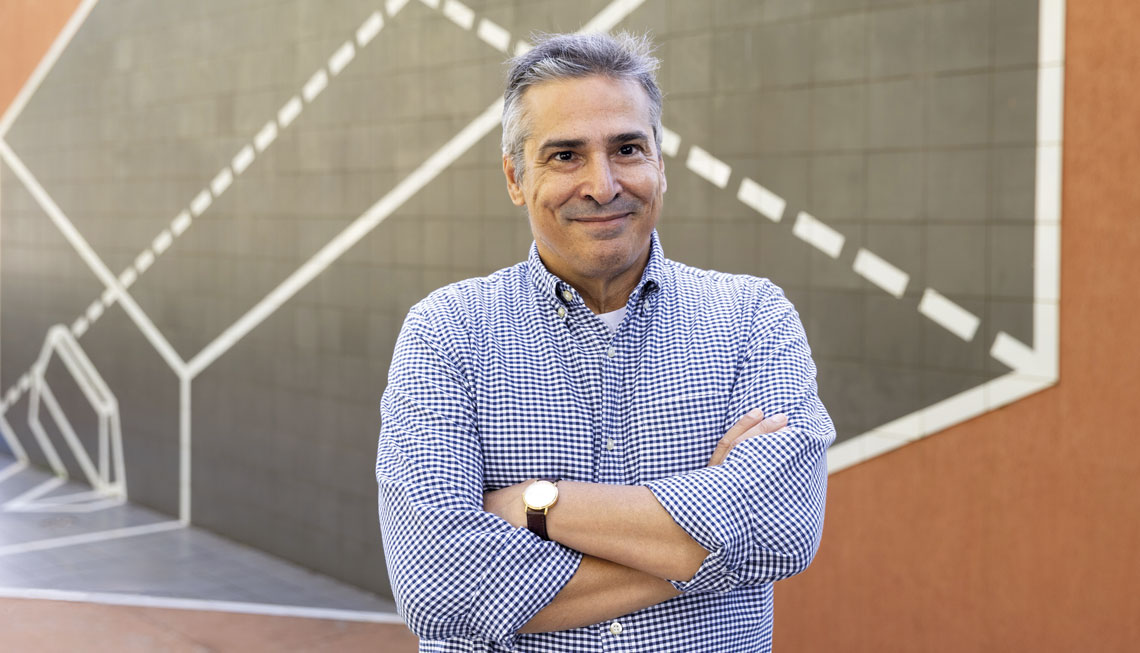
In 2020, after a series of tests, a psychiatrist confirmed the diagnosis: autism. It was a shock. To make things worse, the doctor advised me to keep it a secret. I was 54 years old and I had an established career—maybe he was trying to protect me. Despite understanding his good intentions, I decided not to take his advice. Being neurodivergent is not a problem and should not stop anyone from being who they are. We are different, and that is part of the beauty of life.
Autism Spectrum Disorder [ASD] is of multifactorial origin and has a strong genetic component. It emerges in childhood and presents with a wide range of characteristics and levels of intensity. The diagnosis helped explain many things for me. As a child in the 1970s, I was lucky enough to go to a constructivist school and I made friends easily, but I was also a bit rebellious. I had some clashes with my father and I ran away from home three times.
I spoke very quickly and it was hard for people to understand, so I started to automatically repeat every sentence twice. For all these reasons, I started seeing psychologists and psychiatrists from an early age. But none of them discussed the possibility with me that I might be on the autistic spectrum.
During adolescence, I began to feel very different from other people. In sports I was always the last one picked and I was always left on the bench. In swimming I became “the phenomenon” because I always came last in competitions. Whenever I showed up, someone would make a joke. I had a collection of nicknames, and to this day it hurts me to remember them. I know it is natural for kids to make fun of each other, but I felt like it was more common with me than with others, and it affected me a lot.
I have difficulty looking people in the eye, but since I know people do not like that, I try hard to do it. Any noise disturbs me. When there are many people talking at the same time, I try to calm myself down by mentally telling myself a story—it is a strategy I invented to cope with the chaos, but it does not always work. When the sound stimulus is too intense, my body reacts instinctively, as if it were pulling the plug out of the socket to avoid a short circuit. I just shut down. And people notice. A colleague from my PhD in England always noticed these sudden absences and gave me the nickname “instantaneous sadness.”
I am already talking about England, but I forgot to tell you how I ended up there. I spent my first years of life in the interior of Piauí, on a construction site. My father was a civil engineer and worked on the construction of the Boa Esperança Hydroelectric Power Plant. The city was so small that my mother had to travel to Recife, the state capital of Pernambuco, for my birth in 1965. When I was 4 years old, we moved there.
In high school, I did a vocational test that suggested I had an affinity for computers and electrical engineering. In the early 1980s, I even took both undergraduate courses simultaneously for a while. But one day, in engineering class, the professor told us to go to the board and draw cubes. Me, who can barely draw a square. I left and never went back.
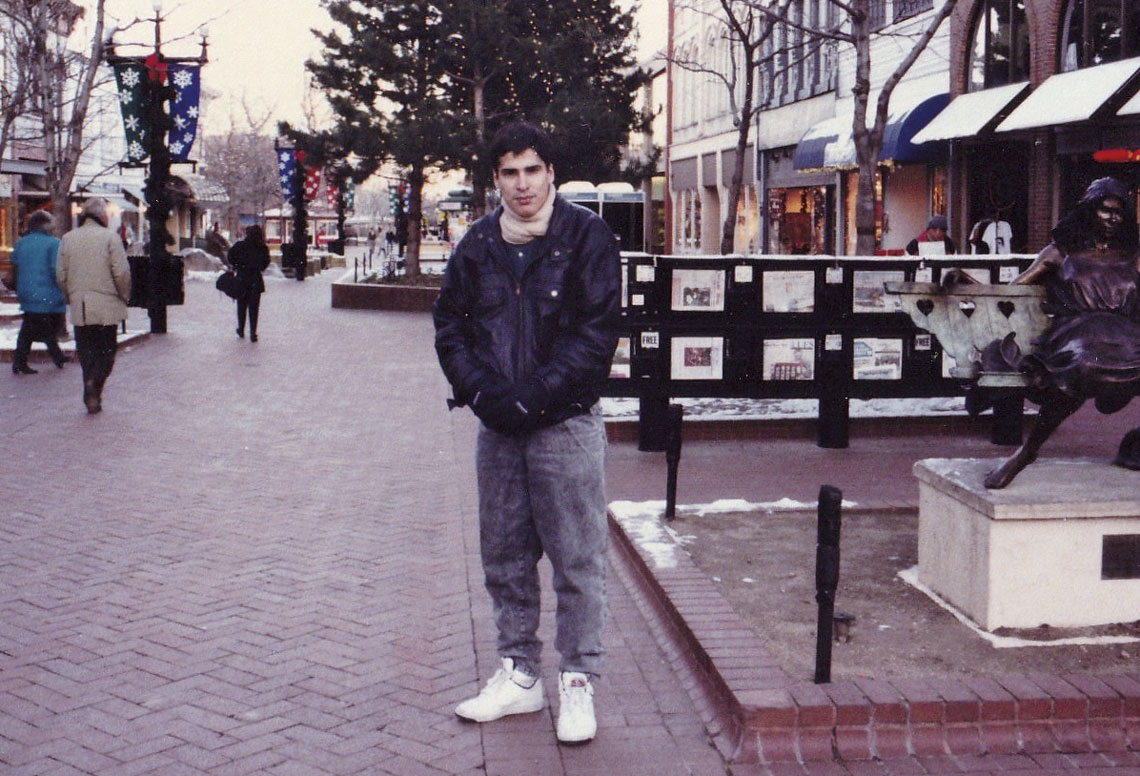
Personal archiveIn England in the early 1990s, during his PhD in electronic engineeringPersonal archive
I began my career in computer science at the Federal University of Pernambuco [UFPE], back in the days of punched cards. Artificial intelligence [AI] was practically unknown in Brazil, but I was lucky enough to participate in one of the country’s first courses offered on the subject, and that was what sparked my interest in the subject. I completed my undergraduate degree in 1987 and shortly after began my master’s degree at the same institution, on the use of neural networks for sequence recognition. I finished my research in 1990.
At the time, there were only two professors working in AI at UFPE. Like many of my classmates, I went abroad to do my PhD, since the field was so incipient in Brazil. I completed my doctorate in electronic engineering, researching the use of neural networks for image recognition, at the University of Kent in the UK. The idea of living in a small, quiet city really appealed to me—the traffic in Recife had left me on the verge of a breakdown, which I now know is related to ASD. But it was not only that: I admit that I also got excited after seeing photos of people drinking beer in a medieval square.
I lived with students from other countries in a shared house. We each had our own bedroom, but we shared the kitchen, which in the end was great, because it encouraged me to socialize. In 1993, a year before I finished the course, I came back to Brazil to decide where to live, and I chose São Carlos in São Paulo State, both for the quality of the universities and because it is not a big city.
I had also met some Brazilians from there during my PhD. A colleague invited me to stay at her family home when I returned. Little did she know that six months later I would marry her sister, a civil engineer. We have three daughters. Our eldest is a psychologist and it was she who suggested that I undergo an evaluation. After my diagnosis, our middle daughter, the one who looks most like me, discovered she also has ASD. She is dealing with it very well.
When I arrived in São Carlos, I only had a grant from the CNPq [Brazilian National Council for Scientific and Technological Development], but I soon got a job as a professor at the Institute of Mathematical and Computer Sciences of the University of São Paulo [ICMC-USP] in 1994. I am now the director of the ICMC, where I head the IARA research center (which in Portuguese stands for Artificial Intelligence Recreating Environments), funded by FAPESP and focused on creating more inclusive and sustainable cities.
I am involved in several research networks through which I argue for the use of machine learning as a tool for social inclusion, not just as a technical innovation. Since 2023, in collaboration with psychiatrist Helena Paula Brentani of the School of Medicine and the Hospital das Clínicas at USP and computer scientists Fátima Nunes and Ariane Machado Lima, both from the School of Arts, Sciences, and Humanities [EACH-USP], I have been developing AI tools designed to make ASD diagnoses more accessible, more accurate, and earlier. To this end, our group is investigating the use of facial recognition, brain signal analysis, molecular biomarkers, and movement patterns in young children.
Many people claim that cases of autism have increased in recent years, but the truth is that in the past, only the most severe cases were diagnosed. Today, with more trained professionals, greater awareness, and less stigma, it is more frequently identified. Despite this fact, it is crucial that we distinguish autism from other conditions that also significantly impact people’s lives, such as Attention Deficit Hyperactivity Disorder (ADHD).
The story above was published with the title “Logic in the chaos” in issue 352 of April/2025.
Republish