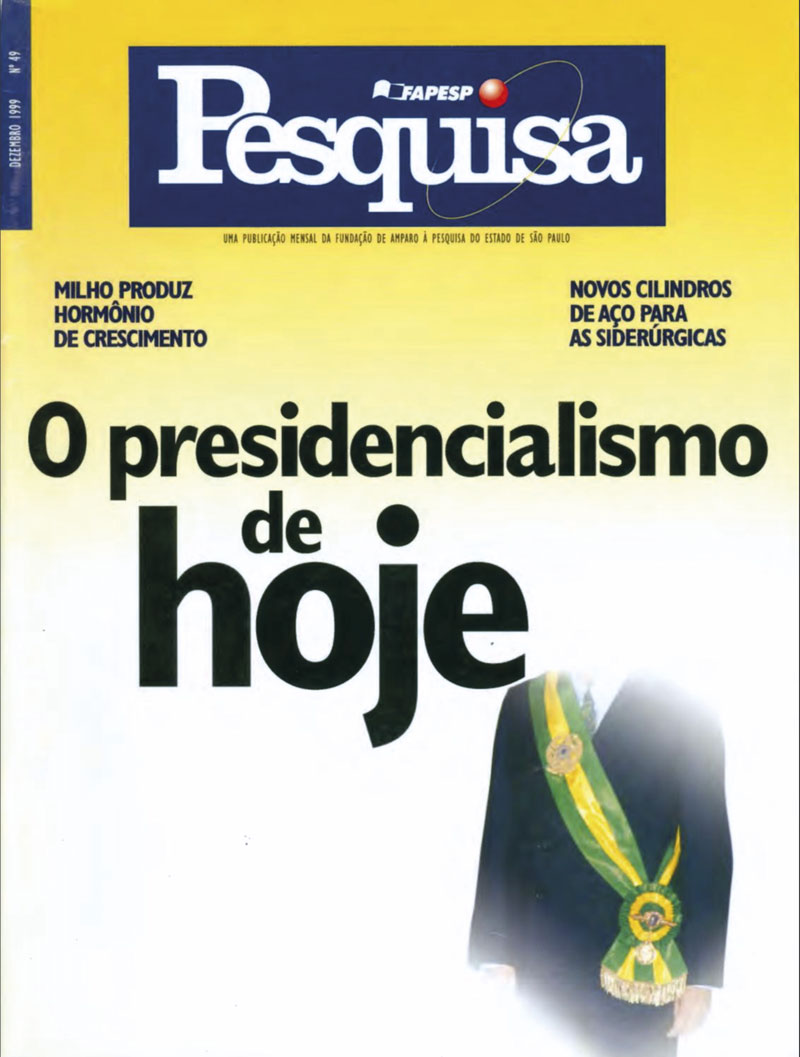
ReproducedPesquisa FAPESP’s December 1999 cover article on the strength of the Brazilian presidential system: researchers conducted a pioneering review of congressional voting patternsReproduced
Revisiting the first issues of Pesquisa FAPESP offers insight into how certain fields and research questions have evolved within the Brazilian academic community over the past 25 years. An early feature article from April 2000 highlighted 104 Brazilian scientists recognized by the Institute for Scientific Information (ISI)—the organization behind the Web of Science (WoS) database—for their high-impact research papers, defined as those cited at least 50 times, between 1990 and 1999. “I remember receiving a certificate that I still keep,” recalls Roberto Zatz, a professor of nephrology at the University of São Paulo’s School of Medicine (FM-USP). Zatz coauthored a 1992 study published in Hypertension that topped ISI’s list for Brazil with 259 citations in 2000, a number that has since exceeded 700.
The paper reported on research by Zatz and his colleague, Gilberto de Nucci from the University of Campinas (UNICAMP), on nitric oxide—a molecule produced by blood vessel walls that regulates blood pressure. This research led to the development of new vasodilator drugs and became a widely cited source of reference after Zatz’s team demonstrated how inhibiting nitric oxide production in rats led them to develop hypertension. “Since it provided a relatively straightforward method to induce hypertension in rats, many researchers began using this animal model and citing our work,” Zatz notes.
– Research topics that have stood out since the magazine was launched in 1999
– Researchers explain important humanities concepts
– Teachers use articles from the magazine to discuss science in class
– Magazine wins over readers in every state
To assemble the list of highly cited papers, ISI analyzed 66,974 articles by researchers who were either Brazilian or working in Brazil during the 1990s, and singled out 27 standout articles for special mention. This number pales compared to the current scale of Brazilian science output, with roughly the same number—66,900 articles—published in 2019 alone, according to WoS. In 2023, pandemic-related factors reduced this output to 56,300 papers.
The nature of highly cited research has also shifted—both in Brazil and globally—with the advent of large-scale research collaboration networks. “Multicenter trials—which evaluate treatments across multiple sites worldwide to generate robust data—often include hundreds of authors. “When these studies deal with conditions like cardiovascular disease, cancer, or diabetes, and especially when they establish treatment guidelines, they tend to be widely cited,” notes Zatz. While nitric-oxide research has since waned, other research topics have waxed in prominence. In 2021, Pesquisa FAPESP published an article spotlighting 21 Brazilian researchers who were among the world’s most-cited at that time. These scientists—working in fields such as ultra-processed foods, epidemiology, virology, and climate change—authored studies that, in some cases, garnered up to 4,000 citations (see Pesquisa FAPESP issue n° 310).
Science publishing has expanded dramatically since the late 1990s with the advent of online journals and the rise of the open-access movement. A Pesquisa FAPESP article from June 2000 featured the Electronic Library Program (ProBE), launched by FAPESP in 1999 to provide online access to international scientific journals for researchers and students at public universities and research institutes in São Paulo State. The article highlighted in particular the number of available journals: 841. ProBE became defunct in late 2002 and was absorbed into a national initiative, the Journal Portal, managed by the Brazilian Federal Agency for Support and Evaluation of Graduate Education (CAPES). This portal now provides researchers at public universities across Brazil with access to over 40,000 journals and 150,000 books. “ProBE was originally created to streamline journal subscription costs by sharing them among several universities in São Paulo. But the initiative quickly outgrew initial expectations—researchers welcomed having journals available directly on their computer screens,” says Rosaly Fávero Krzyzanowski, a librarian who served as ProBE’s operational manager and established the FAPESP Virtual Library.
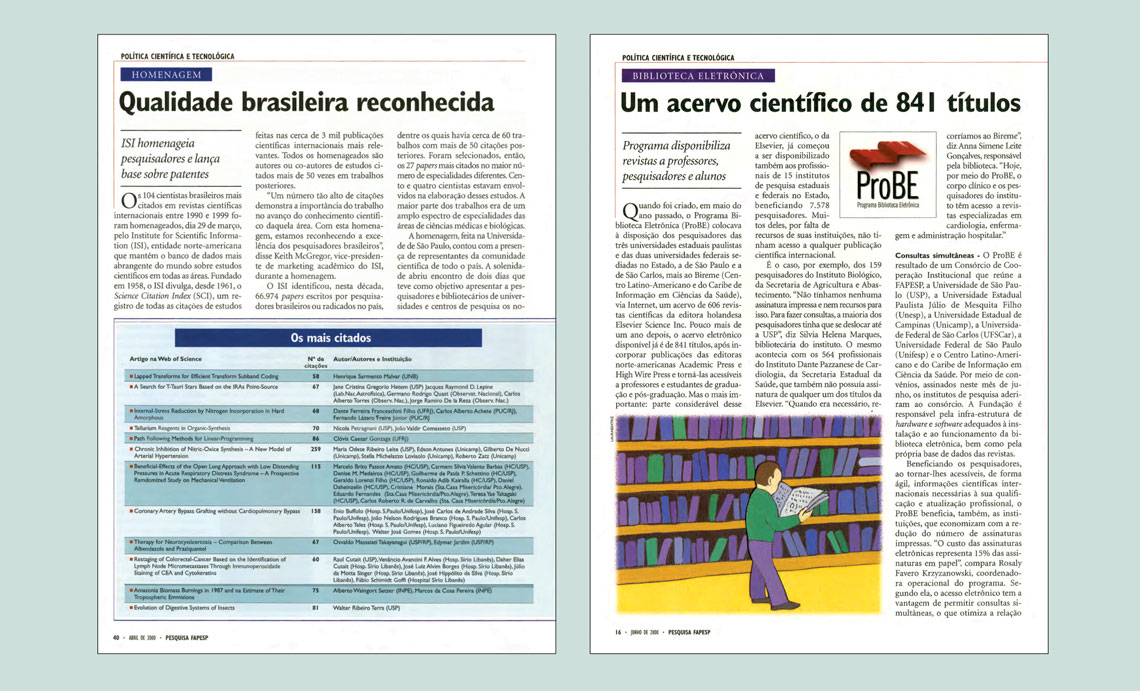
ReproducedArticles on the most-cited Brazilian researchers of the 1990s and a digital library providing online access to scientific journalsReproduced
The research problems Brazilian researchers were dealing with when Pesquisa FAPESP was first launched now appear to have either been resolved or faded in relevance. At the 51st Annual Meeting of the Brazilian Society for the Advancement of Science (SBPC), held in Porto Alegre (RS), discussions became particularly acute on two issues—Mercosur and genetically modified foods—according to a July 1999 article in one of the last issues of Notícias FAPESP, a newsletter preceding Pesquisa FAPESP. The regional economic bloc was central to discussions about the potential and limitations of economic integration, attracting considerable attention from researchers—the meeting’s official theme was “Mercosur: Breaking Down Barriers.”
Meanwhile, controversy around GMOs highlighted a divide within Brazil’s scientific community over a ban on genetically modified soybeans produced by the multinational corporation Monsanto. While the SBPC’s leadership pushed for a five-year moratorium on planting GMO crops to allow for further studies, geneticists at the meeting, such as Francisco Salzano (1928–2018), who was honored at the event, supported the immediate approval of these products.
At the latest SBPC meeting, held in Belém (PA) in July, neither Mercosur nor GMOs were on the agenda; instead, the discussions primarily centered on the sustainable development of the Amazon. Among the top issues discussed—reflecting some of the pressing challenges currently facing scientists in Brazil—were climate change, vaccine development, and artificial intelligence. Certain issues, however, have remained a constant over the years. Ensuring adequate funding for science and higher education was a priority topic in both the 1999 and 2024 meetings. Twenty-five years ago, discussions revolved around the need to expand sources of funding for research and increase budgets for federal universities. In 2024, improving federal university budgets remained an area of concern, in particular the need for increased funding to cover operational costs and student support to sustain affirmative-action policies.
An article in the March 2000 edition of Pesquisa FAPESP discussed a research project investigating chemical compounds found in plants from the Atlantic Forest and Cerrado (wooded savanna) ecosystems of São Paulo State that showed promise as potential pharmaceuticals. In initial lab tests, six plant species exhibited antibiotic properties, while eight others demonstrated antioxidant activity effective against tumors or Chagas disease. Vanderlan Bolzani, a chemist at the Institute of Chemistry at Araraquara, São Paulo State University (UNESP), who led the project, recalls how the search for pharmaceutical compounds within biodiversity was an exciting new field at the time. “Bioprospecting was a hot topic and this project, launched one year after the FAPESP Biota program, was part of this growing trend,” she says, referring to a program established in 1999 to catalog and study species in São Paulo State’s biodiversity.
The program launched the Biota Network for Bioprospecting and Bioassays (BIOprospecTA) to discover biologically active substances within São Paulo’s biodiversity and to identify chemical models for drug and cosmetic development. Bolzani, who later served as head of the network, notes that pharmaceutical companies like Apsen and Aché were initially keen to fund research efforts to discover these molecules. However, as research and development costs became increasingly prohibitive, especially in drug development, this line of research lost momentum. “When it came to the costly preclinical studies for compounds, these companies ultimately lost interest,” she explains. Research into natural products shifted to a more cost-effective approach: either modifying existing compounds to achieve new properties or using computational modeling.
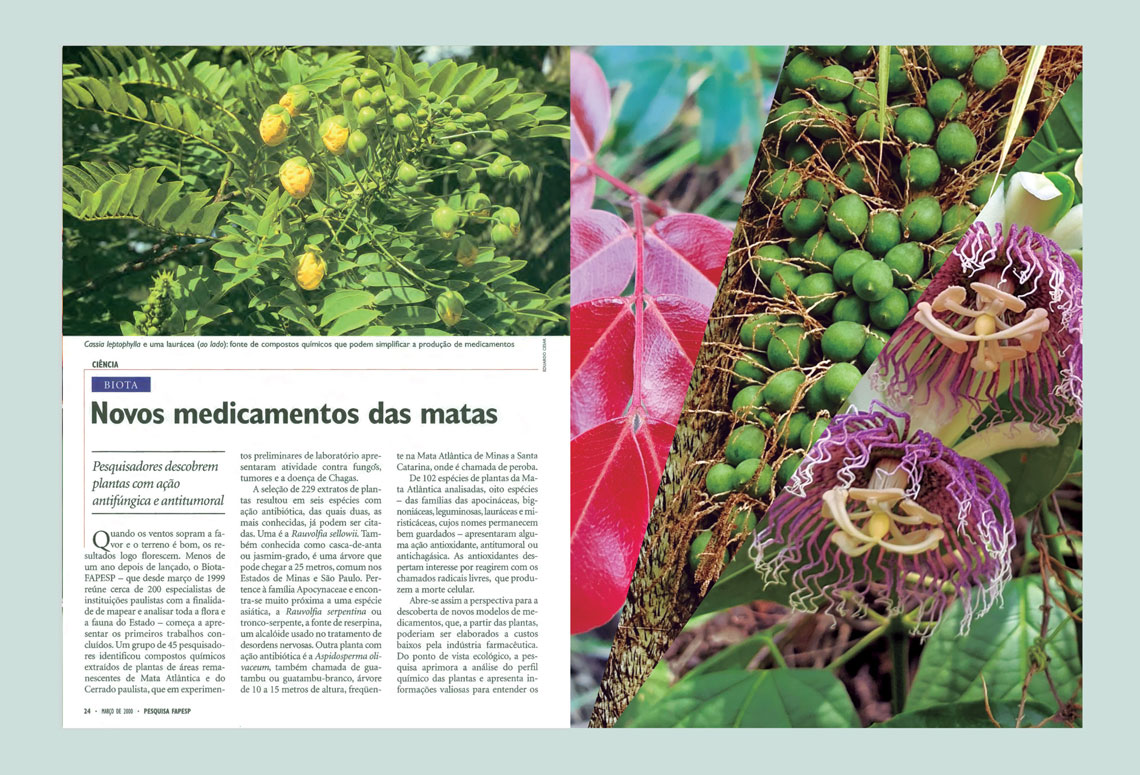
Reproduced | Plants: mscompost / iNaturalist | Eduardo Cesar / Pesquisa FAPESP | Madsissi / iNaturalist | Tomaz Melo / iNaturalist | Mayk Oliveira / iNaturalistEarly bioprospecting efforts, described in a March 2000 article, generated an expanding body of knowledge but did not lead to the development of new pharmaceuticalsReproduced | Plants: mscompost / iNaturalist | Eduardo Cesar / Pesquisa FAPESP | Madsissi / iNaturalist | Tomaz Melo / iNaturalist | Mayk Oliveira / iNaturalist
Although the title of the 2000 article “Novos medicamentos nas matas” (New medicines from the wild) never fully materialized, the body of knowledge developed within this field has grown substantially. The Center for Bioassays, Biosynthesis, and Ecophysiology (NuBBE) at São Paulo State University (UNESP) in Araraquara, founded by Bolzani, has built a database of 640 chemical compounds derived from Brazilian biodiversity, along with an “extract library” containing 1,500 samples. “These resources are now available for other researchers to tap into,” she says.
Political science
The December 1999 cover story of Pesquisa FAPESP, titled “Presidencialismo torna fácil governar” (Presidentialism streamlines governance), reported on a research project that analyzed interactions between Brazil’s Executive and Legislative branches. Political scientists Argelina Cheibub Figueiredo, then at UNICAMP, and Fernando Papaterra Limongi, then at USP, conducted an extensive review of roll-call votes in the Brazilian Parliament, in the first study of its kind. They concluded that the presidential system recently established by the 1988 Constitution had equipped the Executive branch with robust and sufficient institutional tools to advance its agenda in Congress and to foster cooperation among political parties.
These findings may seem somewhat anachronistic today, given the current debates on Congress’s increased control over the federal budget and the recent legislative setbacks for the Federal Government in areas such as public security, environmental policy, and Indigenous rights—despite alignment on economic agendas. Limongi points out that the perception of Brazil as a challenging country to govern, where the Executive struggles to secure necessary cooperation from a Legislature driven by special interests, is far from a new one. “This interpretation resurfaces, and is often voiced by Brazilian scholars or Brazilianists, whenever the country’s political system is in crisis,” he says. Limongi believes that the current perspective on the power balance between the Executive and Legislative is simply a rehash of this theory and similarly lacks substantive evidence. “To be sure, Congress has expanded its budgetary authority through imposed budgetary amendments [emendas impositivas], caucus-based funds, and direct transfers. However, this doesn’t mean the President has been weakened or lost the capacity to govern,” he assesses. “The president remains influential, with both the power and the tools to exert budgetary influence, control much of the political process, and secure party cooperation. In my view, the conclusions from the earlier research still hold true.”
Limongi sees the source of today’s issues as lying elsewhere. “It’s a legacy of the previous administration, which, to some extent, ceded its governing role and transferred budget control to the speakers of the House and Senate as a way to ward off potential impeachment proceedings. While reverting back to prior norms won’t be a simple task, we’re already seeing a gradual reassertion of Executive control over the budget,” notes Limongi, who continued to explore Executive-Legislative relations through three FAPESP-funded research projects from 2001 to 2023. He is now preparing for a new direction: investigating the causes and consequences of political instability to understand why many Latin American administrations fail to complete their terms, ending in deposition or impeachment.
The story above was published with the title “Shifting with the times” in issue 344 of October/2024.
Republish