


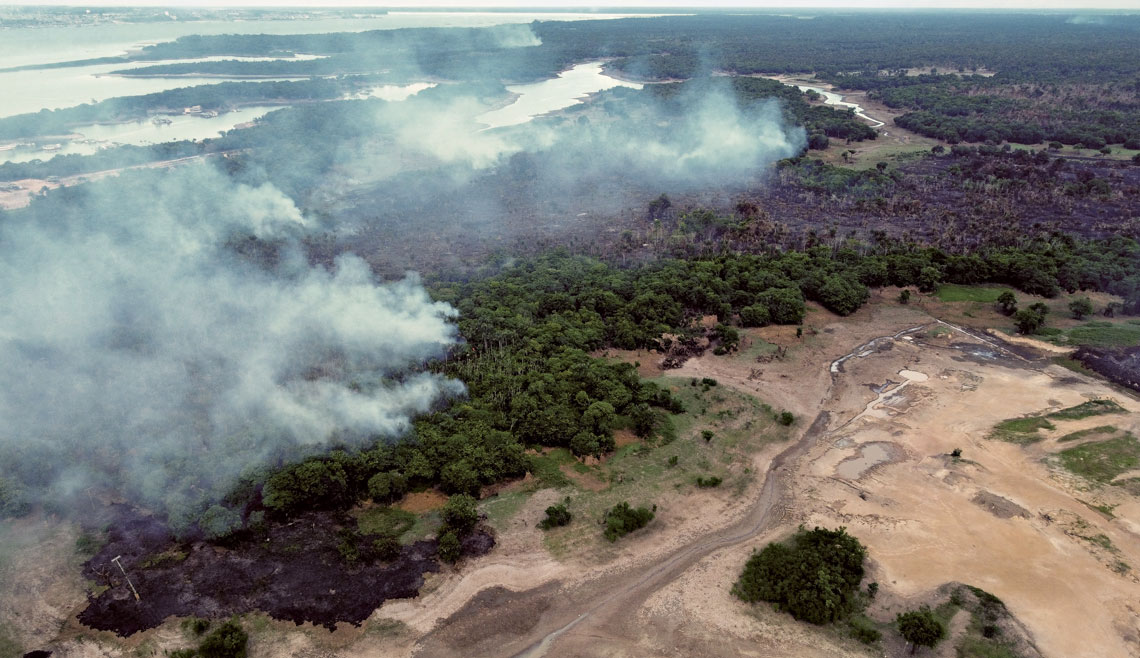
Recent studies indicate that the climate in the Legal Amazon (a geoeconomic region of Brazil covering all or part of nine states) is becoming hotter and wetter this century, particularly during the driest period between the first and third trimesters of the year. An article coordinated by Brazilian researchers, published in September in the scientific journal Nature Communications, not only confirmed this trend but went beyond: it calculated the relative weight of the two primary factors that cause increased maximum temperatures and reduced rainfall in the dry season—deforestation of the planet’s biggest tropical forest and global climate change.
According to the study, deforestation is the principal cause of reduced rainfall in Amazonia, while warming of the planet, influenced by greenhouse gas emissions, contributes most significantly to higher readings on our thermometers. “We developed statistical modeling to single out how much increased maximum temperatures and reduced rainfall in Amazonia is due to regional deforestation, and how much is brought about by global warming during the dry season,” says the article’s lead author, physicist Marco Franco of the Institute of Astronomy, Geophysics, and Atmospheric Sciences at the University of São Paulo (IAG-USP).
Both these phenomena affect temperatures and rainfall in Amazonia throughout the year, but in the equations devised by the researchers this influence is more accentuated and visible in the three driest months. “For that reason we focus our work specifically on the driest period.” In different parts of Amazonia, the dry season occurs in different months: June to August for some, and July to September for others.
Between 1985 and 2020, the article says, there was an average dry-season reduction in precipitation of 21 millimeters (mm). The felling of the forests accounted for 74.5% of this drop (15.8 mm), and global climate change for 25.5% (5.2 mm). The weight of the two phenomena is exactly the opposite for maximum temperatures. Taking the 2 degrees Celsius (ºC) of average temperature increases during this 35-year period, the study attributed 83.5% of this rise (1.67 ºC) to global warming, and 16.5% to vegetation grubbing (0.33 ºC).
Between the first and last year covered by the research, the area of vegetation removed in the Legal Amazon doubled, from 10.9% of the total in 1985 to 21.3% in 2020. During this same interval, the atmospheric concentration of carbon dioxide (CO2), the primary villain of greenhouse gas, which drives global climate change, increased by some 20%.
Advancing deforestation is expected to reduce rainfall and raise temperatures in Amazonia. The gases emitted by the tropical forest are important for the process of forming condensation nuclei, the initial “raw material” for clouds that generate rainfall, in the atmosphere (see Pesquisa FAPESP issue n° 285). It is therefore common for climate specialists to say that Amazonia produces its own rain and some of the moisture is transported to other regions of Brazil.
It is also no secret that warming is caused by flora suppression in areas that have lost their coverage. “The study has contributed by developing an approach enabling the effects of deforestation—a regional alteration—from the impacts of climate change, a global phenomenon,” says meteorologist Luiz Augusto Machado, of the Institute of Physics at the University of São Paulo (IFUSP).
21 mm less rainfall fell each year in dry-season Amazonia between 1985 and 2020 due to deforestation
Declining volumes of rain during the dry season may seem somewhat insignificant, particularly in a region such as Amazonia, where the total annual rainfall frequently exceeds 2,000 mm. “Happening as it does during the driest season when the forest is debilitated by drought stress, this 21-mm drop in rainfall, although small in absolute terms, has a considerable impact on the region,” adds Machado. Such a reduction during the wetter months would not have major consequences, and would go practically unnoticed.
The values given in the article are an average for the driest months in the Legal Amazon, which covers all of the Amazon rainforest biome and sections of the Cerrado (wooded savanna) and the Pantanal floodplain; the land area of the region is 5.2 million square kilometers (km2), corresponding to 59% of Brazil’s total area. To calculate the impact of deforestation and global climate change on this vast expanse, the article divided the Legal Amazon into 29 smaller forest segments, each with an area of approximately 90,000 km2. Analyses were conducted on each segment, which together cover around half the Legal Amazon, and also on the region as a whole.
In the sections with more deforested area (almost 30% of the forest has been removed in these segments), the total reduction in rainfall over the 35 years reached 50 mm in the dry season, more than double that recorded across the entire region. “During this season, less water comes into Amazonia from the Atlantic Ocean, and the preserved forest takes on an even more crucial role in generating rainfall than in the wetter months,” observes biochemist Luciana Gatti, who coordinates the Greenhouse Gas Laboratory (LaGEE) of the Brazilian National Institute for Space Research (INPE), which took no part in the study.
The article drew on deforestation data provided by MapBiomas, a collaborative civil society initiative with a network of more than 70 NGOs, universities, and tech startups. “We contributed with the background series of annual maps on land coverage and use in Amazonia,” explains ecologist Julia Shimbo, scientific lead at MapBiomas and a coauthor of the article.
The main study authors favored the MapBiomas data over information from the Brazilian Amazon Deforestation Satellite Monitoring Program (PRODES), an INPE project that calculates the official deforestation rate disclosed annually by the Brazilian government. The better spatial resolution of MapBiomas, which can observe grubbed vegetation in areas of up to 30 m, was a factor in this preference. The Amazonian rainfall pattern adopted in the research was obtained using data from multiple satellites used by the Global Precipitation Measurement Mission (GPM).
Another interesting conclusion was that the tropical forest climate does not respond in a linear fashion to the loss of native vegetation. At the beginning of the deforestation process, when the amount of original vegetation grubbed falls between 10% and 40% of the total, the climate impacts of this alteration become apparent more quickly. “We are still within this initial deforestation range when we look at the current situation in Amazonia as a whole,” says Franco.
The article also projects the likely climate in Amazonia in the middle of the next decade. If the tropical deforestation rate remains constant for 10 more years, the maximum dry-season temperature will increase by 2.64 oC, with 28.3 mm less rainfall in 2035, considering the 1985 base figures.
The story above was published with the title “Double trouble” in issue 356 of October/2025.
Project
Research and Innovation Center for Greenhouse Gases – RCG2I (n° 20/15230-5); Grant Mechanism Engineering Research Centers (CPEs); Agreement BG E&P Brasil (Shell Group); Principal Investigator Julio Romano Meneghini (USP); Investment R$25,376,639.63.
Scientific article
FRANCO, M. A. et al. How climate change and deforestation interact in the transformation of the Amazon rainforest. Nature Communications. Sept. 2, 2025.
