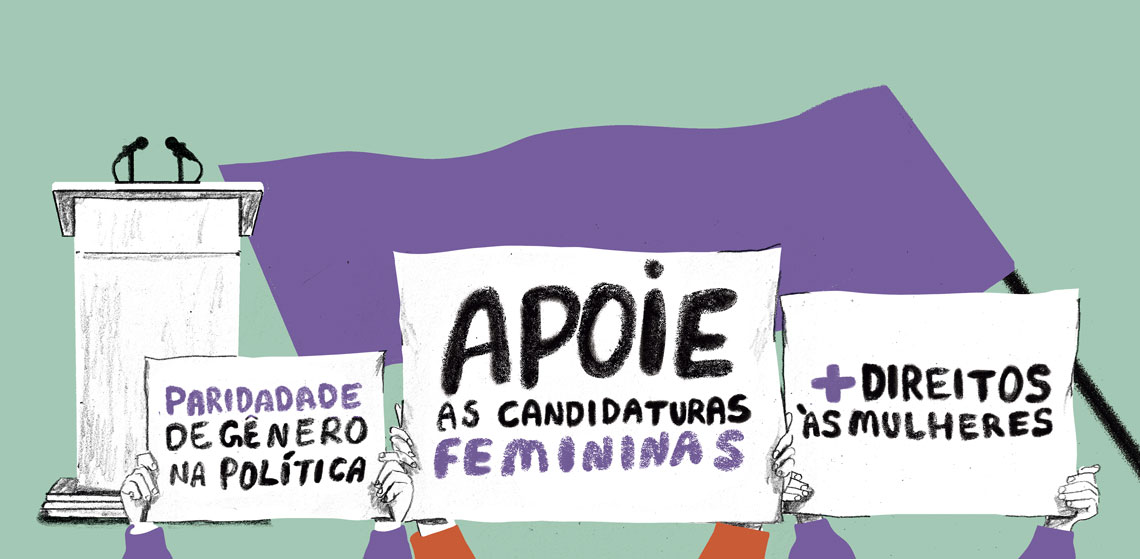
Despite having had quotas for female candidates for almost 30 years, the country ranks 132nd in a gender equality index that includes 180 countries
Gustavo Nascimento
Almost 30 years after Brazil first passed legislation establishing gender quotas for elections, the representation of women in the country’s Chamber of Deputies has risen from 6% in 1998 to 18% in 2022. This is slower progress than in countries like Argentina and Mexico, which adopted similar measures in the 1990s and 2000s and whose governments are now 42% and 50% women respectively. In efforts to understand why Brazil has improved at a slower pace than other Latin American nations, researchers from various universities have shown that certain characteristics of the country’s electoral system and party dynamics create barriers for women wishing to enter Brazilian politics.
Data from the Inter-Parliamentary Union (IPU), an international organization that measures female participation in the government administrations of more than 180 countries, indicate that 73% of politicians worldwide are men. Although low female representation in politics is a global problem, the situation in Brazil appears to be critical. The country is placed 134th in the IPU’s gender equality ranking—the lowest in Latin America. Women represent more than 50% of the Brazilian population, but female participation in the Chamber of Deputies is 17.5%, while in the Senate it is 17.3%.
“This disparity results in institutional barriers that perpetuate gender inequality in public administration,” says Brazilian political scientist Malu Gatto of University College London (UCL), who recently published the book Candidatas – Os primeiros passos das mulheres na política no Brasil (Candidates – Women’s first steps into politics in Brazil; FGV Editora, 2024). Gatto wrote the book together with political scientist Débora Thomé, who is doing postdoctoral research at the Center for Studies in Public Sector Politics and Economics (CEPESP) of the Getulio Vargas Foundation (FGV), São Paulo, with a grant from FAPESP.
The distribution of resources in political parties tends to favor candidates who already have political capital, and these are generally men
It was based on research carried out between 2021 and 2023, which involved 188 interviews with 102 candidates from across the country (79 women and 23 men). The responses were cross-referenced against electoral data. “The objective was to identify the obstacles they faced in their political careers, especially at the time of candidacy, which has historically been less explored in academic studies,” says Gatto. One of the reasons for this, according to the UCL political scientist, is because it is easier to obtain data on women who have already been elected than on candidates, who often do not have support teams, making it difficult to get in touch with them.
The results of the study indicate that one of the major barriers faced by women running for election is a lack of support from party leaders. This results in low visibility at rallies and last-minute invitations to decision-making meetings. Furthermore, although Constitutional Amendment 117 of 2022 states that 30% of party resources be allocated to female candidates, this rule is not always followed and the money often reaches them last, hindering their ability to run an efficient electoral campaign. Another financial problem, says Gatto, is that candidates do not receive legal support and guidance on how they are allowed to spend money from party funds. Many of them thus depend on their own resources or donations from volunteers to gain public awareness and competitiveness, points out the researcher.
Violence was another issue mentioned as a recurring issue by interviewees. “Women reported experiences of harassment and online attacks during election campaigns, while more serious cases of aggression are frequently reported by Black and transgender women, including sexual harassment and direct threats to their safety,” says Gatto. She also points out that although men are also victims of violence, they tend to consider the attacks as an inherent part of the political game. “Women, on the other hand, identify and denounce these occurrences, highlighting the negative impact they have on their campaigns and on a personal level,” she explains.
Alexandre Affonso/Pesquisa FAPESP
Clara Maria de Oliveira Araújo, a sociologist from Rio de Janeiro State University (UERJ), is also studying why women are making slower progress in politics in Brazil. One possible reason is the specific characteristics of the Brazilian electoral system and the rules for electing deputies and councilors. Countries like Argentina and Mexico use a closed-list system, in which people vote for the party, not the candidate. In this system, every party establishes an order by which candidates are allocated votes, while quota laws require men and women to be alternated on these lists.
In an open-list system, which is the approach used in Brazil, people can vote for a specific candidate or the party. However, votes for the party are attributed to the candidates with the most votes. According to Araújo, open lists generate internal competition within parties, which is detrimental to women. “The distribution of resources, media coverage, and financial support in parties tends to favor candidates who already have political capital, and these are generally men,” says the sociologist. Since women have less access to these resources, their chances of electoral success are lower. According to the researcher, this shows that in addition to quotas, parties need to increase investment and institutional support for women.
Araújo points out that the open-list system partly explains the ease with which the quota policy was approved in Brazil in 1995, progressing more quickly than in other Latin American countries. “The open lists of the Brazilian electoral system mean that quota policies are incapable of significantly altering women’s chances of being elected, unlike in countries with closed lists,” explains the sociologist.
Between 2022 and 2023, she also carried out research for the National Observatory of Women in Politics at the Chamber of Deputies, analyzing the chances of electoral success among candidates who already hold political office. Her results suggest that people with government experience are much more likely to be elected again, reinforcing the circular effect that perpetuates gender inequality in politics.
Gustavo Nascimento
In 1982, Araújo became the first woman to be president of Brazil’s National Students’ Union (UNE). At the time an undergraduate student and director of the union’s Women’s Department, she says she was appointed to the position after the UNE president stepped down due to political persecution. During her time in the role, she was the only woman among the institution’s directors. “Because few people were willing to take on the presidency of the union for fear of being retaliated against by the regime, I ended up being chosen. In a way, it was because there were no other alternatives,” she admits.
According to the researcher, she faced prejudice and discrimination, including from progressive groups, during her term, which lasted until 1983. “In assemblies with thousands of students, my arguments were often invalidated by other leaders,” she says. The experience motivated her to study women’s participation in social movements. In 1986, she began her master’s degree at the Federal University of Rio de Janeiro (UFRJ), investigating the presence of women in three unions, in the metalwork, banking, and telecommunications sectors. “Women in these industries also found it difficult to make themselves heard and people were resistant to accepting them as leaders. Some were even told they could not make announcements through loudspeakers because their voices were too high-pitched,” she says.
It was also personal experience that prompted Marcella Barbosa Miranda Teixeira, executive secretary of the Federal University of Ouro Preto (UFOP), to begin studying the presence of women in politics in 2019. She made the decision after UFOP, founded in 1969, elected its first female dean in 2019: Professor Cláudia Aparecida Marliére de Lima. During her PhD in business administration, completed at the Pontifical Catholic University of Minas Gerais (PUC-Minas) in 2022, Teixeira identified that thanks to quotas, women face little resistance when announcing their candidacy for the federal legislature, but they face obstacles when it comes to the electoral campaign. “There are few women in leadership positions in the parties, so they are unable to participate in important decisions about how financial support will be given to each candidate,” points out Teixeira.
She also identified that on the legislative floor, female deputies are more often asked to address issues generally associated with the female gender, such as education, health, and family. They are also less encouraged to serve on committees linked to finance, budgets, and justice. “Women with young children are often asked about their ability to reconcile political life with motherhood, while men are not subject to the same questions,” she highlights. Teixeira also noted that most federal deputies address two common agendas: the quest for greater female participation in public life, and the defense of specific health measures for women, such as prenatal care and childbirth.
In her ongoing doctorate at the University of São Paulo (USP), with funding from FAPESP, Vanilda Souza Chaves, who has a degree in international relations, is investigating the impacts of quotas in Brazil compared to other Latin American countries and the intra-party dynamics that affect women’s representation in Brazilian politics. She says that before 2010, Brazilian political parties often failed to meet quotas. The situation began to change after amendments to electoral legislation and intervention by the Supreme Electoral Court (TSE), which began monitoring the registration of lists presented by political parties. Chaves believes that the sanctions applied to parties in Brazil are less effective than those used in nations such as Bolivia and Mexico, which adopted quotas in 1997 and 2002 respectively and both instituted gender parity in 2010. Parity means men and women must be alternated on electoral lists, the same feature previously highlighted by UERJ’s Araújo. In these countries, parties are required to comply with gender quotas as a prerequisite to registering candidates and participating in elections.
Alexandre Affonso/Pesquisa FAPESP
In addition to identifying obstacles in electoral campaigns, the study by Gatto and Thomé determined the profiles and motivations that lead women to run for public office. Many are community leaders, who see politics as a way of representing and defending the interests of their groups, including religious organizations or LGBTI+ associations. Others run for election based on a desire to increase female representation in positions of power, to promote gender equality and inspire other women. There are also some who are invited by political parties, usually because they are already involved in institutional politics or because they have connections with influential figures. “However, this invitation does not always translate into proper support during the campaign,” reiterates Gatto.
Sociologist Alessandra Maia Terra de Faria of the Pontifical Catholic University of Rio de Janeiro (PUC-RJ) notes that during the First Brazilian Republic (1889–1930), women were not even mentioned in constitutional texts. Faria points out that although the situation seemed to be improving when women won the right to vote in 1932, it was only five decades later, in 1987, that things really began to change. “The Lipstick Lobby, created by a group of federal deputies elected to the Constituent Assembly [1987–1988], played a fundamental role in the inclusion of women’s rights in the Federal Constitution of 1988,” she says. Among the additions was the extension of maternity leave from 84 to 120 days.
According to the sociologist, as Brazil reestablished a system of democracy, universities also began playing a significant role in the inclusion of women in politics. One example is the career of philosopher and anthropologist Lélia Gonzalez (1935–1994), who initially worked as a professor at PUC-RJ and later ran for federal deputy (1982) and state deputy (1986) in Rio de Janeiro. “Despite not being elected, Lélia raised awareness of the debate about the importance of including marginalized communities in Brazilian government,” Faria says.
Gustavo Nascimento
Another important change she highlights was Law No. 9,100 of 1995, which established that at least 20% of candidates on the electoral lists of parties and coalitions for proportional elections must be women. In 1997, Brazil’s National Congress enacted Law No. 9,504, which has been amended various times over the years but is still in force today. The law states that at least 30% of party and coalition candidacies for city councils, the Legislative Assembly, the Legislative Chamber of the Federal District, and the Chamber of Deputies must be reserved for women. The 30% minimum came into effect in 2000. In 1998, quotas for women in political parties were 25%.
Despite the challenges identified by Gatto and Thomé, most of the 79 women they interviewed demonstrated a desire to remain in politics, whether by running in future elections, supporting other candidates, or being involved in social activism. “In the interviews, the participants talked about their frustration with party dynamics, but in the end, they expressed a renewed commitment to politics,” says Thomé.
Gatto believes that increasing female representation in government is essential to ensuring that policies reflect the diversity and needs of the entire population. “The presence of more women in politics has the potential to positively influence the legislative agenda, incorporating perspectives and priorities that have historically been neglected,” she explains. Despite this, a Proposed Amendment to the Constitution (PEC) was approved in August granting a reprieve to parties that failed to comply with quotas relating to Black and female candidates. In September, the leaders of various social movements and associations filed a petition asking the Brazilian Supreme Court (STF) to block the amendment.
Camila Galetti, a PhD student at the University of Brasília (UnB), believes having more women in government would not necessarily result in an expansion of women’s rights. She points out that female representation, which remained at around 9% for several legislatures, rose to more than 12% in 2018. “But this increase was marked by the appointment of deputies who reject feminist ideas, including the decriminalization of abortion, for example,” she says. Galetti analyzed more than 4,000 posts on social media by these officials during the 2018 election period and found that they used the notion of care as a political strategy, advocating for homeschooling, for example, to protect children from the supposed moral threats that they face at schools.
The story above was published with the title “Gender in elections” in issue 344 of October/2024.
Projects 1. Mapping different profiles and systematizing forms of political participation of brokers (n° 23/04679-0); Grant Mechanism Postdoctoral Fellowship; Supervisor George Avelino Filho; Beneficiary Débora Thomé Costa; Investment R$271,927.26. 2. Women in politics: Debates on quotas and gender parity in Brazilian political parties (nº 22/06702-6); Grant Mechanism Doctoral Fellowship; Principal Investigator Ana Paula Belem Hey; Beneficiary Vanilda Souza Chaves; Investment R$412,236.97.
This article may be republished online under the CC-BY-NC-ND Creative Commons license. The Pesquisa FAPESP Digital Content Republishing Policy, specified here, must be followed. In summary, the text must not be edited and the author(s) and source (Pesquisa FAPESP) must be credited. Using the HTML button will ensure that these standards are followed. If reproducing only the text, please consult the Digital Republishing Policy.