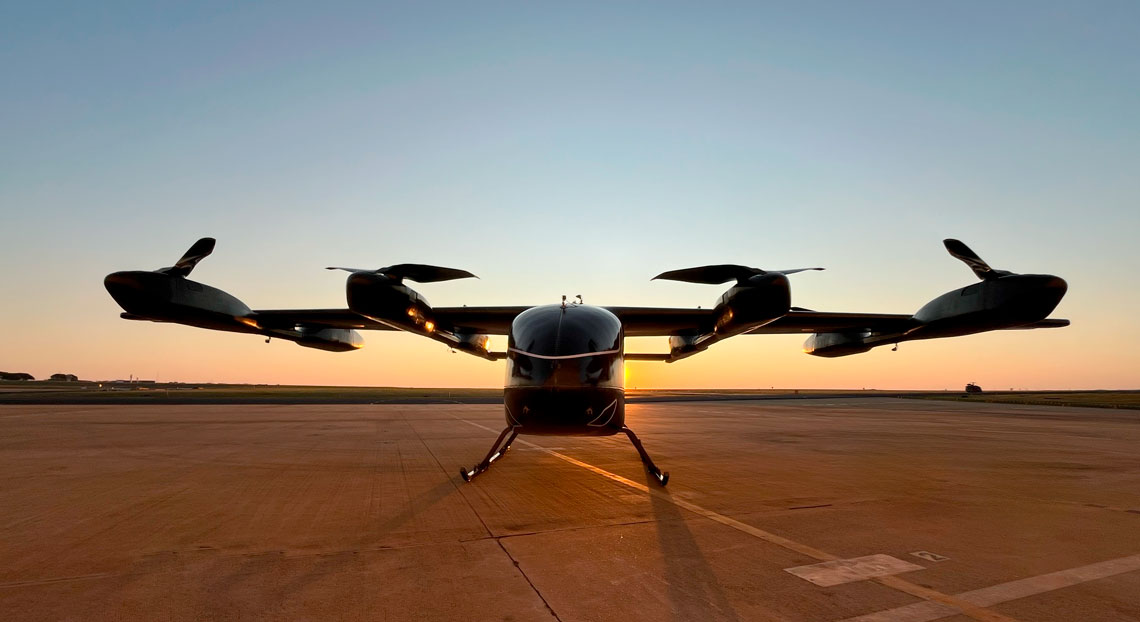
In the middle of this year, Eve Air Mobility, a company owned by Embraer, is expected to begin test flights of its flying car—a fundamental stage in its development and a step toward certification with the regulatory authorities. Flying cars, also known as electric vertical take-off and landing aircraft (eVTOL), are seen as a more sustainable alternative for air mobility in the coming decades. Designed for short journeys within or between cities, they are powered by batteries and electric motors, which do not emit any pollution during operation.
During the test campaign, which is expected to last several months, the company will verify whether its laboratory designs carry over to real-world production. “As well as analyzing the aircraft’s performance, safety, and maneuverability, the company will determine whether the equipment meets regulations in terms of pollution, noise emissions, and other aspects,” explains William Roberto Wolf, an aeronautical engineer from the School of Mechanical Engineering at the University of Campinas (FEM-UNICAMP).
The first full-scale prototype of the eVTOL was unveiled last year. The aircraft is equipped with eight rotors (formed of a motor and a propeller) for vertical flight during takeoff and landing, and fixed wings for movement during the cruise phase. “As part of our ground testing campaign, in January we conducted a first test of the pusher [the motor located in the tail], which is responsible for propulsion while cruising,” Eve CEO Johann Bordais told Pesquisa FAPESP.
With 2,800 intentions to purchase already received—the most in the sector—Embraer hopes to establish itself as a serious competitor in this new aeronautical segment. “The company has an advantage. It has already designed several aircraft models and has great expertise in the field. By combining rotors and wings, Eve’s device will have a greater range, which adds value to the project,” points out Wolf.
Almost 1,000 people are working full time on the development of the eVTOL, including engineers, technicians, and researchers. It will be produced at a factory in Taubaté, a city in the state of São Paulo. “Our plan is to initially produce 120 units per year, before expanding gradually according to market demand. The maximum capacity will be 480 units per year,” says Bordais.
Several companies around the world are working on eVTOL programs. In the US, Joby Aviation plans to begin commercial operations of its flying cars in 2026. Eve expects its eVTOL to begin flying with passengers in 2027. “The vast majority of companies in this sector are unlikely to survive,” says mechanical engineer Domingos Alves Rade, from the Mechanical Engineering Division of the Technological Institute of Aeronautics (ITA), based in São José dos Campos. “In addition to the inherent difficulty of designing a new aircraft, the certification process is complex and expensive.
Rade is head of the Engineering Research Center for Future Air Mobility, known as Flymov, created by FAPESP and Embraer in 2023. Flymov’s objective is to host studies on topics that contribute to the competitiveness of the Brazilian aeronautical industry. The research is focused on three areas: low-carbon aviation, autonomous systems, and advanced manufacturing.
“The synergy between the knowledge we are generating and Embraer’s commercial interests is high,” explains Rade. “Eve’s project is clearly part of the goal of future air mobility. We are certain that some of our studies can be used by Embraer in the design of its eVTOL.”
The story above was published with the title “Takeoff on the horizon” in issue 351 of May/2025.
Project
Future Air Mobility Engineering Research Center (CPE-MAF) (n° 21/11258-5); Grant Mechanism Engineering Research Centers Program; Principal Investigator Domingos Alves Rade (ITA); Investment R$4,604,615.14.