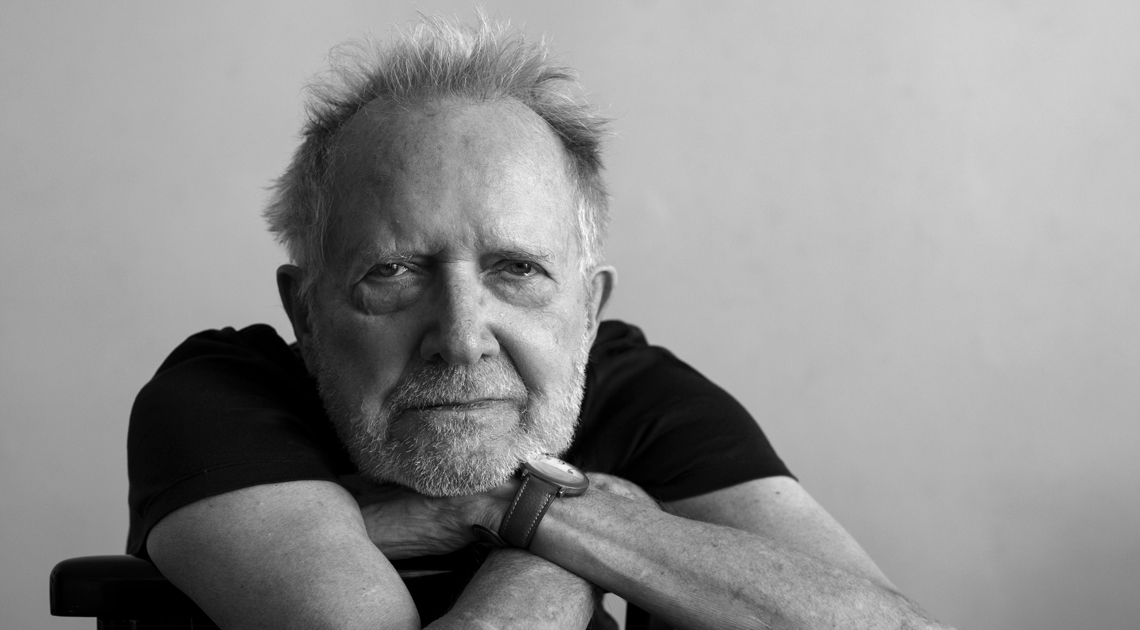
Jean-Claude Bernardet had just put the finishing touches to a new project. The book Viver o medo – Uma novela pornô-gourmet (Living the fear: A gourmet porn novel)—written with author and scriptwriter Sabina Anzuategui, a professor at the Cásper Líbero College—which shifts between his most intimate memories and fiction, is about to be published by Companhia das Letras. The researcher, film critic, cinematographer, and actor, to list one or two more of his facets, had other projects in the pipeline and wrote until his work was interrupted by a stroke that killed him at 88 years of age in the early hours of July 12 in São Paulo.
Leaving work unfinished had been a fear of his since 1993, when he was a professor at The School of Communication and Arts of the University of São Paulo (ECA-USP), working on the film São Paulo – Sinfonia e cacofonia (São Paulo: Symphony and cacophony), one of the first thematic projects funded by FAPESP in the humanities. Bernardet tested positive for the AIDS virus HIV, in those days a death-sentence diagnosis, and embraced the film with all the urgency of a swan song. He and his team managed to complete the film in 1994, but that was not the end. The advent of antiretroviral medication the following year allowed him another three decades of notable works, and he overcame health issues such as recurring prostate cancer, for which he opted not to seek treatment, and successive bone fractures.
Progressively losing his eyesight as a consequence of macular degeneration—for which the biography Wet macula (Companhia das Letras, 2023) is named, written with Anzuategui as part of a project with editor and translator Heloisa Jahn (1947–2022)—Bernardet maintained his habit as a moviegoer, avoiding subtitled films. At this stage he could not make out fine detail, and it became increasingly challenging to read and write, so he reinvented himself as an actor, up to then an occasional habit. Arthur Autran, a professor at the Arts and Communication Department of the Federal University of São Carlos (UFSCar), recalled a situation from when he was a student at ECA-USP. Vitor Ângelo, a student at the time, recruited Bernardet to act in his short 1995 film Disseram que voltei americanizada (They said I came back Americanized) (1995), and the professor rose to the challenge. “He turned up wearing heavy makeup, drag-queen style, although that term wasn’t used much at the time,” he recalls. “He removed the makeup little by little, doing a piece to camera about how he noticed those first skin rashes that come with AIDS; it was a really intense, unsettling scene,” says Autran, who had looked on as it was filmed. “We already knew that he had the virus, but that meant that the disease was developing.”
Ângelo talks of the love that Bernardet had for a challenge, both for himself and others. “In Historiografia clássica do cinema brasileiro (Classical historiography of Brazilian cinema) (Annablume,1995), the critic reassessed classical authors such as Paulo Emílio Salles Gomes [1916–1977], whom he considered his mentor,” he adds. “This was looked upon as disrespect, but I disagree: he had no time for untouchable icons, and critically reevaluated these authors from a different angle.”
This same spirit of irreverence is evident in Brasil em tempo de cinema (Brazil in the time of cinema) (Civilização Brasileira, 1967), through which he analyzed Cinema Novo, a style that started to take hold in the late 1950s, and concluded that films made to examine and portray the Brazilian people ultimately reflected a middle-class worldview. This had significant repercussions among filmmakers associated to the movement and, decades later, director Eduardo Coutinho (1933–2014) publicly declared that he had made the 1984 film Cabra marcado para morrer (Twenty Years Later) in response. The version of Brasil em tempo de cinema published in 2007 by Companhia das Letras carries a transcript of this conversation. History stands testament to Bernardet’s vision for the film critic: to be “a committed cultural participant” in cinematographic creation and production. “I needed to work with Brazilian films and topics because it was the only opportunity for having a dialogue,” he told Pesquisa FAPESP in 2014.
In book reeditions, Bernardet made no changes to the original texts, but resignified them with new material, both his own and that of others. The second edition of Cinema brasileiro: Propostas para uma história (Brazilian cinema: Proposals for a history) (Companhia das Letras, 2009), coproduced by Autran, is an example. “We included interviews with three lady cinema producers, because he saw it as an essential role, but this was not very widely perceived in Brazil.” The choice of female interviewees was not random either, according to the UFSCar professor: “Jean-Claude said that women were more engaged in the area at that moment.”
The desire to act and dance is usually separated from intellectuality, but he was all of those things: contemporaneous and futuristic
Bernardet was a professor at ECA-USP between 1967 and 1997, with an 11-year interval when he was “retired” by the military government. After the Amnesty was enacted, he obtained his PhD and in 2012 became an emeritus professor at the institution. According to Autran, Bernardet “almost aggressively provoked his students.” Anzuategui had such an experience during the third and fourth years of her undergraduate course, when she was studying script specialization. She found the professor’s original vision remarkable, combined with his “French straightforwardness, which Brazilians find so different.” While some colleagues were shocked, she admired his “zero tolerance for hypocrisy,” his courage to speak without fear of offending his interlocutor. She recalls that Bernardet would often show a clip for students to comment on, to find the problem. After everybody had taken their turn speaking, he would point out something unexpected and incisive.
Autran says that Bernardet was very active to the end, forging partnerships with young filmmakers such as Cristiano Burlan, Lincoln Péricles, and Fábio Rogério. “He was very open to the younger generations, curious about what we had to say,” agrees journalist Mariana Queen Nwabasili, currently doing doctoral work on audiovisual media and processes at ECA-USP.
Nwabasili sought Bernardet out a few years ago after reading a critique by historian Maria Beatriz Nascimento (1942–1995) on the film Xica da Silva (1976), by Cacá Diegues (1930–2015), published in the journal Opinião at the time of its release. When she read Brasil em tempo de cinema, the young student understood that there was this extra layer: the filmmakers of the age were not only middle-class, but also white males. “I wanted to speak to Bernardet about the possibility of deepening the racial dimension in the discussion about Cinema Novo authors, and he was generous with his interest,” recalls the researcher. The two soon developed a close relationship, enabling them to discuss a wide range of topics not restricted to the academic environment.
Nwabasili defines Bernardet as a blend of the artistic and the intellectual. “The desire to act and dance is usually separated from intellectuality, but he was all of those things; always contemporaneous and futuristic, detached from his time, until now.”
For Sabina Anzuategui, fiction was always foremost for Bernardet. Cartesian thinking served the cinema critic well, but he did not actually identify as a cinema person. The scriptwriter sees a literary quality in the critical texts that makes for good reading, regardless of the period and the film in question. “He didn’t want to define himself, he was kind of an orphan of existence, dragged away from his country, from his mother.” Bernardet was of French parentage, though he himself was born in Charleroi, Belgium, in 1936. He moved to Brazil with his father, mother, and brother at the age of 13. “He was extremely intelligent and sensitive; he was an artistic soul looking for somewhere to settle for a while.”
Radicalism was not restricted to his thoughts. At 70, he enjoyed a parachute jump so much that he repeated the experience several times. His first jump was photographed, and he acquired two copies: one for the Cinemateca Brasileira (Brazilian Film Library), which houses his document archives, and the other for his daughter Ligia. Bernardet is also survived by his granddaughter Alici—both live in the United States, but this never stopped them from occasionally playing cards in remote gatherings that he loved. On the Sunday prior to his passing, he beat the whole family.
The story above was published with the title “A free-flying artist” in issue 354 of August/2025.
Republish