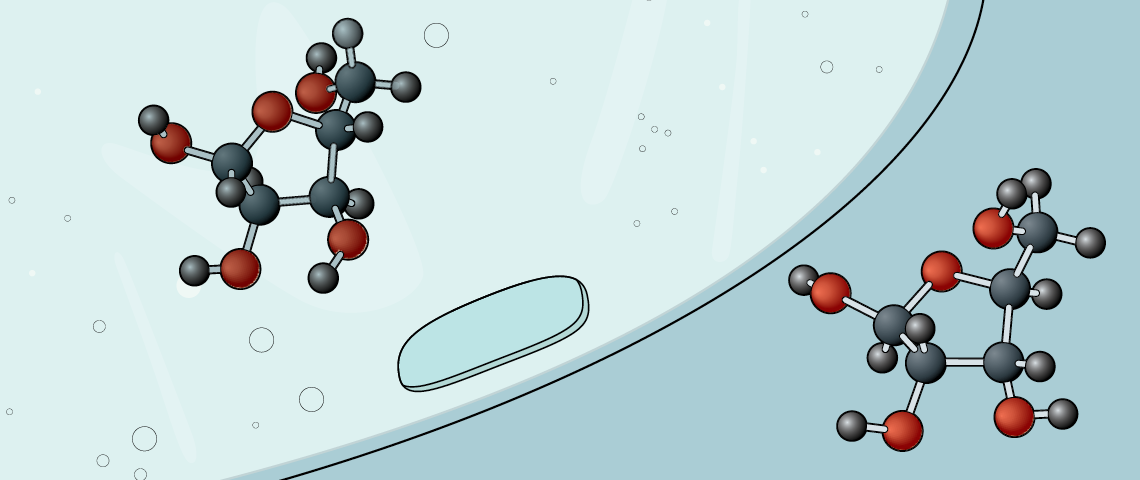
One of the biggest doubts about the origin of life on Earth may be a little closer to being answered: if molecules important for the organism exist in mirrored versions—or specular, as if they were the left and right hands—then why do the cells select only one of the two versions? Even more interestingly, the same choice goes for all organisms, which use the “right-hand” version of the sugars (such as D-ribose, contained in the DNA and RNA) and the “left-handed” version of the amino acids, which are marked with an L. A study published in May in the scientific journal PLOS Biology indicates that the selectivity of primitive membranes may have been the decisive factor in our choice between molecule forms, molding the building blocks of life as we know it.
The metaphor of handedness describes a fundamental phenomenon of chemistry: molecular laterality, or chirality. Though identical in composition, the specular versions do not align perfectly with each other, and practically speaking this means that one version of the molecule is a precise fit in biological processes, while the other is not.
“Life on Earth has a preference for sugars configured as the ‘right-hand’ [D] and for amino acids in the ‘left hand’ [L], with one or two small exceptions,” explains Brazilian biologist Juliano Morimoto, of the University of Aberdeen, Scotland, and the graduate Program in Ecology and Conservation at the Federal University of Paraná (UFPR). “When these compounds are chemically produced in situations simulating the origin of life, they present in equal proportions, both in the right- and left-hand configurations. However, as only one of them is used in biological systems, there needs to be some kind of selection mechanism,” explains the researcher, one of the study’s authors.
This explanation goes back billions of years, to when the planet was an environment full of chemical reactions capable of forming simple molecules, such as sugars and amino acids—a scenario demonstrated in the 1950s by the experiments of American chemist Stanley Miller (1930–2007), and also observed in meteorites. Life is thought to have emerged from the way in which they came to organize themselves and form primitive membrane structures, which later gave rise to cells.
In the laboratory, Morimoto and collaborators recreated models similar to the membranes of bacteria and archaea, the two main groups of single-cell organisms considered in theories on the origin of life, and found that these barriers were capable of selecting which molecules could pass through them. This process is thought to have resulted from a permeability determined by the physical-chemical properties of the membranes, whose molecules themselves also have characteristics of chirality in their composition: L in the archaea and D in the bacteria and eukaryotes.
The team also developed a hybrid version, combining bacteria and archaea characteristics to investigate whether any of the three presented properties compatible with what is observed in current biology. “What we found is that the hybrid membrane has the capacity of selecting certain ‘right-hand’ sugars, while amino acids opt for the ‘left hand,’ exactly the selectiveness we would expect in the origin of life as we know it through modern biology,” he goes on.
Using the recreated membranes, the researchers employed a technique to accurately control the passage of fluids containing different sugars and amino acids around the vesicles formed. They added a fluorescent marker to the inside of the membranes and monitored the intensity of the brightness emitted over time. When the external molecules were able to pass through them and interact with the marker, the fluorescence altered, indicating the entry of the substance. This method enabled direct comparison between the permeability of “right-hand” and “left-hand” molecules.
“Perhaps the solution to the mystery of life’s chirality lies in the selective permeability of protocell membranes,” says Brazilian physicist and astronomer Marcelo Gleiser, of Dartmouth College in the US, who did not take part in the research. He is the author of an article published in the scientific journal Origins of Life and Evolution of Biospheres in 2022, on the possible origins of homochirality (reference for L- amino acids and D-sugars) in terrestrial life.
In the publication, Gleiser proposes that this definition may have originated from three different mechanisms: local environmental fluctuations acting randomly, the influence of circularly polarized ultraviolet radiation in regions of star formation, or the subtle effects of parity violation at subatomic level. Each of these hypotheses, he says, would imply different observational consequences, both in the solar system and in exoplanets, suggesting that the search for life away from Earth may be essential to reveal the origin of this fundamental symmetry in the biological systems we know to date.
In respect of the hypothesis tested by Morimoto and collaborators, Gleiser finds it to be valid, presenting interesting results, even without the possibility of precise knowledge around the set of physical, chemical, and environmental factors of Earth at that time. “The biggest difficulty here is knowing whether this was the exact process that occurred 4 million years ago, since we don’t have access to planetary conditions from that primordial period,” he says.
Mindful of the challenges in reconstructing events from the remote past, Morimoto and colleagues are advancing on two fronts to deepen their knowledge of chirality. With funding of GBP £1.4 million from the Gordon and Betty Moore Foundation—a US-based supporter of the study—the researchers are deep-diving into how the chemical composition of protocell membranes influences the origin of selective permeability. In parallel, they are developing a mathematical model to understand the dynamic of this phenomenon and identify the minimum conditions required for a natural selection process to occur.
The story above was published with the title “Selective mirror” in issue 353 of July/2025.
Scientific articles
GOODE, O. et al. Permeability selection of biologically relevant membranes matches the stereochemistry of life on Earth. PLOS Biology. Online. May 20, 2025.
GLEISER, M. Biological homochirality and the search for extraterrestrial biosignatures. Origins of Life and Evolution of Biospheres. Vol. 52, pp. 93–104. Aug. 15, 2022.
Republish