A team of researchers from the University of Göttingen, Leibniz University Hannover (both in Germany), and the University of Pisa, Italy, has developed a technique to reconstruct the Earth’s early atmosphere using micrometeorites—tiny particles of rock and metal that traveled through space before reaching our planet. The team examined the ratio of oxygen isotopes (different forms of the same chemical element) in 100 cosmic spherule particles extracted from 2.7-billion-year-old sedimentary rocks, allowing them to determine the amount of carbon dioxide (CO2) in the atmosphere. When combined with carbon data from plants and computer modeling, the micrometeorite results revealed moderate CO2 levels during the Late Cretaceous period, about 87 million years ago, and during the Miocene, roughly 8.5 million years ago, after a dramatic rise in atmospheric oxygen that occurred 2.4 billion years ago. The micrometeorites ranged from 18 to 429 micrometers in diameter, with an average weight of 0.2 micrograms, and showed no signs of structural alteration on the surfaces (Communications Earth & Environment, July 23).
RepublishBiochemistry
Fossil particles reveal ancient atmosphere
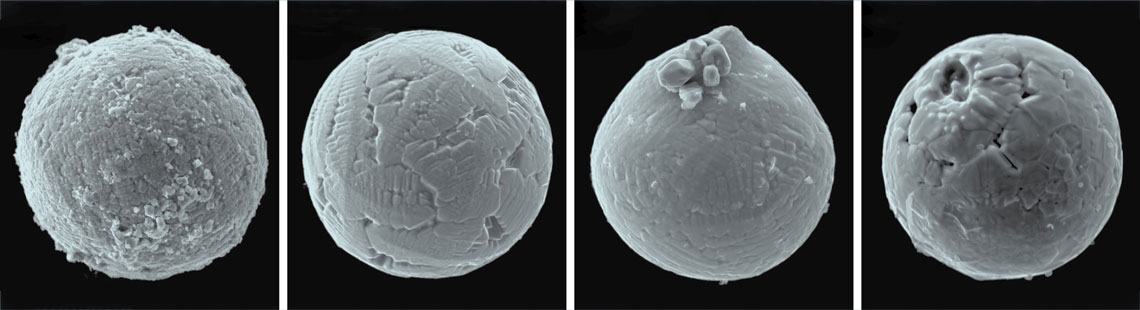
Micrometeorites, estimated at between 300 million and 20 million years old, before cleaning for oxygen isotope analysis
ZAHNOW, F. et al. Communications Earth & Environment. 2025