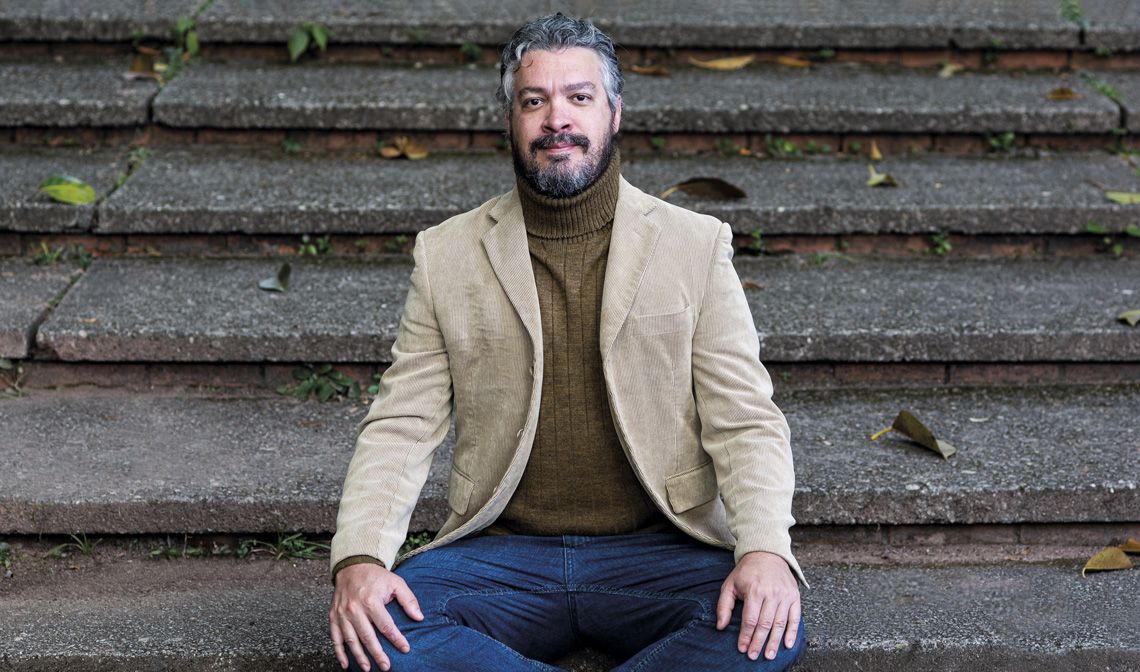
As a child, I spent hours poring over maps. I liked finding country borders, rivers, and deserts. When I was a little older, I became interested in aviation. I searched for the state capitals of Brazil and sketched new flight routes. One of my favorite outings was going with my father to Congonhas Airport in São Paulo—the city where I was born and raised—to take photographs of airplanes taking off and landing. But I never imagined that one day I would be on one of those planes, let alone studying and working abroad.
As an adult, I lived in Iran from 2009 to 2012. As well as learning Persian, the country’s official language, I discovered that like Brazil, Iran is a place of major contrasts. It is the world’s eighteenth-largest economy, fueled by vast oil and natural gas reserves, but that wealth is not reflected in the average household income. Despite its dependence on oil, Iran has tried to diversify its economy by investing in sectors such as agriculture and tourism, while also reinforcing bilateral trade relations.
My interest in the Middle East arose during my undergraduate studies in geography at the University of São Paulo (USP) from 2002 to 2008. I was especially influenced by a course on the regionalization of the world, taught by Professor André Martin. In this class, we studied how the world is divided according to natural, cultural, or economic characteristics, with the aim being to facilitate analyses and public policy planning.
In my second year, I joined the Political Geography Laboratory (GEOPO), where Martin was one of the coordinators. For my undergraduate thesis, I analyzed strategies used by Iran and Qatar to circumvent the dominance of the US dollar in the global oil trade.
A few weeks after I graduated in 2008, I learned that Iran’s Ministry of Foreign Affairs was offering scholarships to new graduates to study a master’s degree on contemporary Iranian issues. I applied and was selected from among 75 Brazilian candidates.
I moved to Tehran in 2009. It was not too difficult to adapt, although some cultural shocks were inevitable given the authoritarian government. The internet is highly censored and Sharia law, the foundation of Iran’s legal system, imposes social restrictions that create great contrasts. Men and women attend separate schools, for example, but higher education is mixed. Women can study and work in any profession, but they are not allowed to enter football stadiums or sing in public.
Even so, I consider myself fortunate to have been part of the last class of the master’s program in middle-eastern regional studies at the School of International Relations funded by the Iranian government. Taught in English, the program was structured similarly to the training of Iranian diplomats. It thus offered a broad understanding of Iran through courses in history, geography, and international relations.
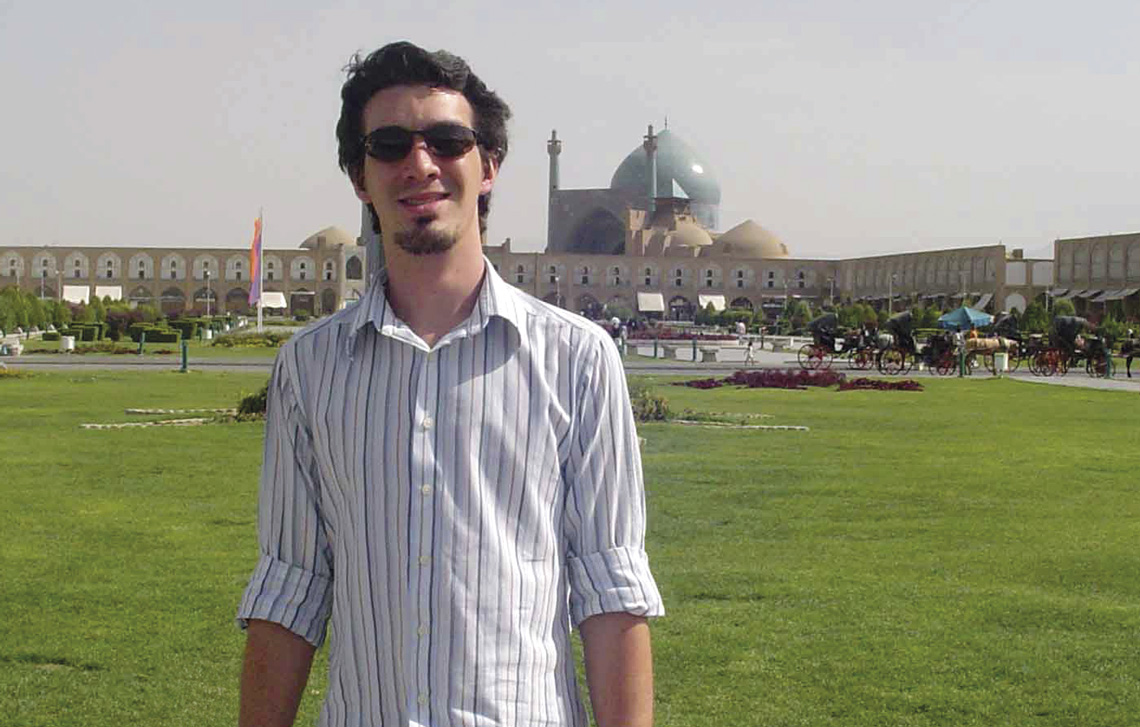
Personal archiveAt Naqsh-e Jahan Square, Isfahan (Iran) in 2010Personal archive
For my master’s research, I did a comparative analysis of trade relations between Brazil and Iran in two periods: the 1970s and the 2000s. I examined how political regimes and the international landscape affected trade between the two countries. While Iran went through a theocratic revolution that led to commercial isolation, Brazil was experiencing its “economic miracle,” marked by the arrival of multinational corporations and rapid urbanization. Over the thirty years, the trade balance between the two countries was inverted, shifting in Brazil’s favor largely due to its exports of agricultural products to Iran, primarily soy and corn.
Classical Persian was a supplementary course on the program. As an Indo-European language, Persian sets Iran apart from its neighbors, which share a cultural heritage rooted in Arabic. I continued studying Persian at a linguistics institute affiliated with the University of Tehran after I finished my master’s degree, eventually achieving fluency, including in the colloquial language.
In 2010, during my master’s, the Brazilian Embassy in Tehran invited me to help them prepare for an official visit by President Luiz Inácio Lula da Silva, who would be accompanied by a delegation of 200 business leaders. One of the goals was to increase trade with Iran.
That experience led to another invitation a short time later, after I finished my degree. This time, it was a permanent position at the embassy as a trade promotion assistant. My work involved strengthening bilateral relations by organizing business meetings between Brazilians and Iranians.
At the same time, I put my knowledge of communication to use. From 2001 to 2004, I studied advertising at FAAP [Fundação Armando Álvares Penteado] in the mornings, while studying geography at night. As a teenager, one of my dreams was to be a copywriter. I worked briefly in the field after graduating, but soon realized it was not for me.
In 2012, I returned to Brazil to be closer to my family and to help my mother care for my grandmother, who at the time was in the advanced stages of Alzheimer’s. She passed away the following year.
Back in Brazil, I taught international relations at private universities, including at FAAP, where I had studied advertising. In 2021, I was accepted onto USP’s graduate program in human geography. I got a scholarship from CAPES [the Brazilian Federal Agency for Support and Evaluation of Graduate Education], which allowed me to dedicate myself fully to my doctoral research. Part of my work was carried out at the Indian Ocean World Center [IOWC] in Canada, where I am now an associate researcher.
My thesis, titled “Mauritius: The crossroad of Brazilian meridionalism in the Indian Ocean,” was based on the theory of “meridionalism” proposed by Professor Martin, who was my advisor. Martin suggested creating a “Southern Committee” of regional powers, such as Brazil, India, South Africa, and Australia, to advance a shared agenda and develop networks for economic, political, technological, and military collaboration.
In my work, I argued that strengthening relations between Brazil and Mauritius could improve Brazil’s presence in the Indian Ocean, helping to consolidate a meridionalist agenda for the twenty-first century.
I defended my thesis in April 2025. Later this year, I will begin teaching geopolitics of the contemporary world, an online graduate program offered by PUC-MG [Pontifical Catholic University of Minas Gerais]. I am really excited about this new challenge.
The story above was published with the title “Global travels” in issue 354 of August/2025.
Republish