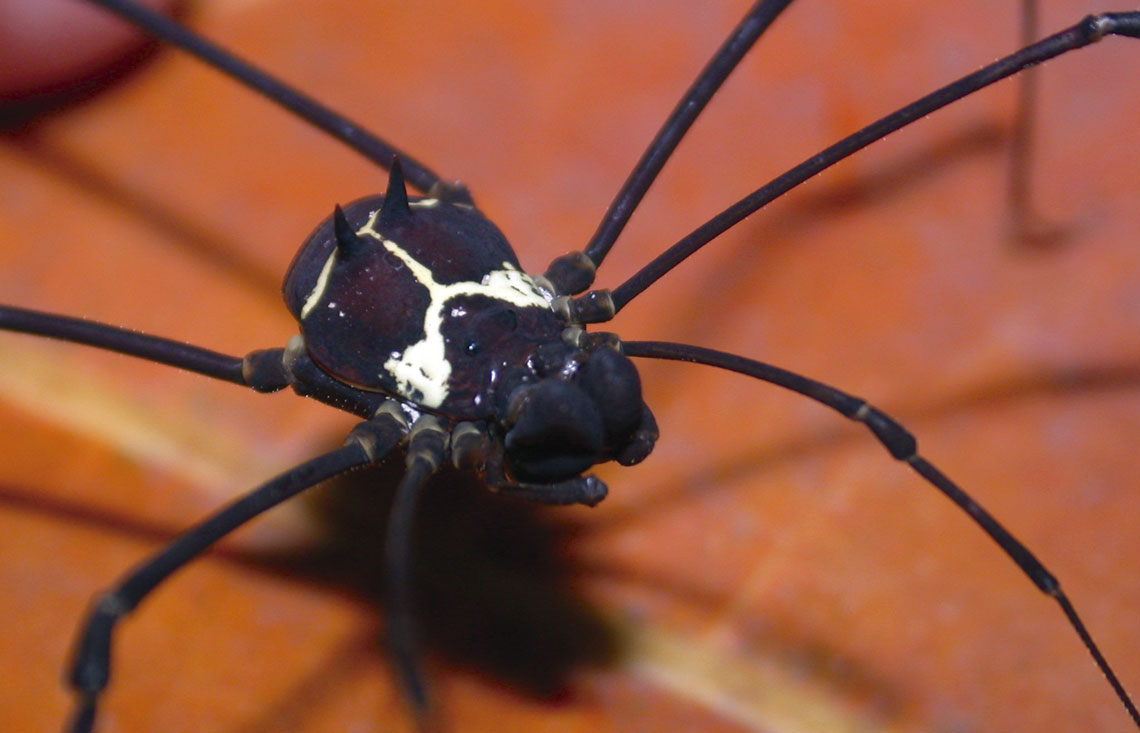
Between 2018 and 2024, while pursuing her PhD at the University of São Paulo (USP), biologist Bruna Cassettari spent much of the time in the lab observing harvestmen mate. These tiny spiders have bodies barely 5 millimeters (mm) long—but with their spindly legs, they can stretch up to 5 centimeters (cm) across. The Amazonian species she studied, Poecilaemula lavarrei, comes in two male types: territorial males with strong claws, and sneaky males with smaller, weaker ones.
Under a dim red light—bright enough to film, but dim enough not to startle the nocturnal creatures—Cassettari would place a territorial male and a female on a bit of tree bark that mimicked their natural habitat. The pair would quickly engage, and their courtship and copulation typically lasted about ten minutes. Alternately, Cassettari would introduce a stealthy male who, if he managed to charm the female, would mate with her.
“Both male types perform almost the same courtship ritual,” Cassettari explains. “They nibble different parts of the female with their chelicerae—the paired claws near their mouths used for hunting—and rub their legs intensely against hers.” When a female isn’t impressed, she simply lowers the front of her body, blocking access to her genital organs. The male may persist with more vigorous touches, and only if she’s convinced of his charms does she lift her body to allow mating. After 90 experimental pairings, both male types proved equally successful: females mated with 87% of the strong-clawed males and 89% of the weaker ones, according to a study published in Evolution in July.
“Harvestmen live in a sensory world completely different from ours,” says biologist Glauco Machado, Cassettari’s advisor at USP. They are almost blind and rely on their sense of smell to locate other animals. “But they don’t have nostrils—their olfactory organs are spread across the body’s surface,” he explains. “They can only ‘smell’ by touch or at very close range.”
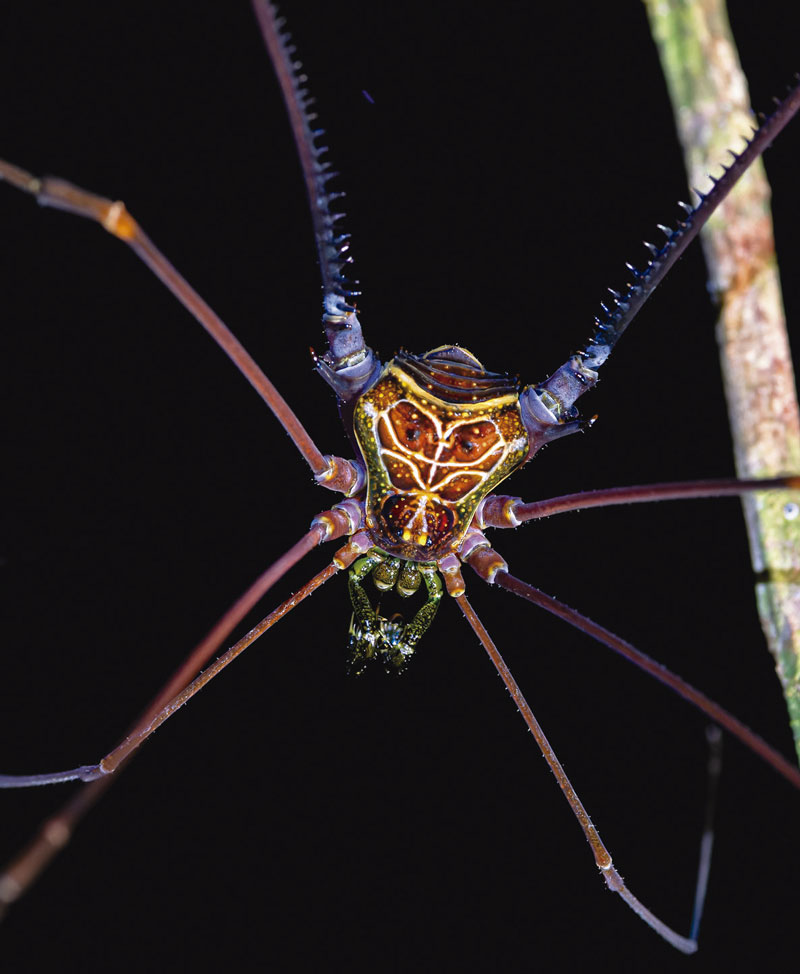
Paulo MascarettiStrong Serracutisoma proximum males guard the female after matingPaulo Mascaretti
Genital differences
The biggest distinction between dominant and sneaky males comes down to their chelicerae. Dominant males sport chelicerae about 4 millimeters long, which they use both to hunt and to fight rivals. When two of these males face off over territory, the battle can get brutal: one often retreats to avoid losing a leg, which the opponent may rip off with his claws. Sneaky males, on the other hand, have lighter, shorter chelicerae—about 1.5 millimeters long—and can dart away more quickly.
“Because smaller males are at a disadvantage when it comes to defending territory or winning fights, we suspected they might have evolved some strategy to compensate,” says Cassettari, the study’s lead author, whose work received grant funding from FAPESP, CAPES, CNPq, and the American Arachnological Society’s Research Fund. Under the microscope, Cassettari and her colleagues found that the two male types also differ in the proportions of their genital structures.
Females play a more active role in reproduction than is usual in the animal kingdom. Because the sperm of harvestmen are immobile—unlike in most animals—the females contract the muscles of the vagina to push the male gametes toward their sperm-storage organ. Machado believes that females may actually use their muscular control to choose which male’s sperm to keep, as in some other animal groups. “If the contractions go both ways,” he suggests, “the female might expel sperm from an unwanted partner and draw in that of her preferred one.”
“As far as I know, this is the first report of genital differences, albeit subtle, between males in a species with two morphs,” says Argentine biologist Mariela Oviedo-Diego of the Smithsonian’s National Museum of Natural History in Washington, DC, speaking to Pesquisa FAPESP via video call. She calls it one of the most detailed investigations of its kind. “The study describes in detail the interplay between behavior and morphology.”
Harvestmen live in a sensory world completely different from ours
The tactics of sneaky harvestmen may vary. In an Atlantic Forest species (Serracutisoma proximum), the dominant male stays close to his mate after copulation, guarding her from rivals. The weaker male, meanwhile, slips in unnoticed and mates with her as she lays eggs already fertilized by the dominant one.
According to Machado, the oldest known harvestman penis is preserved in a fossil dating back some 430 million years, though it is still unclear when distinct male forms first emerged within the same species.
Although rare, different forms within the same sex have evolved independently in some species of insects, spiders, fish, and lizards.
“Dominant and sneaky males are genetically identical,” Machado says. Their differences arise from an interplay between genes and environment. Well-fed males trigger one set of genes that makes their chelicerae larger and more robust. Poorly nourished males activate another set of genes that suppresses the growth of these structures. But being the big, muscular type doesn’t guarantee your offspring will take after you. If the following year turns out dry and food is scarce, most of the offspring are likely to grow up as sneaky males instead.
Behavior, too, can shift with circumstance. “A dominant male without a territory may behave like a sneaker,” Machado explains. “But a sneaker male, with his small chelicerae, can’t switch roles—he simply doesn’t have the tools to defend a territory.”
The story above was published with the title “A spider species with two types of males” in issue 355 of September/2025.
Projects
1. Male intrasexual dimorphism and alternative reproductive tactics: A multidisciplinary approach (nº 21/00915-5); Grant Mechanism Regular Research Grant; Biota Program; Principal Investigator Glauco Machado (USP); Investment R$268,971.01.
2. Evolution of genital complexity: An evo-devo approach using pentatomids as models (nº 18/18184-4); Grant Mechanism Postdoctoral Fellowship; Supervisor Tatiana Teixeira Torres (USP); Beneficiary Bruno Celso Feltrin Genevcius; Investment R$313,641.63.
Scientific articles
CASSETTARI, B. O. et al. Can sexual selection promote within-species divergence of male genitalia? A study case with a male-dimorphic arachnid. Evolution. v. 79, n. 10, p. 2086-99. Oct. 2025.