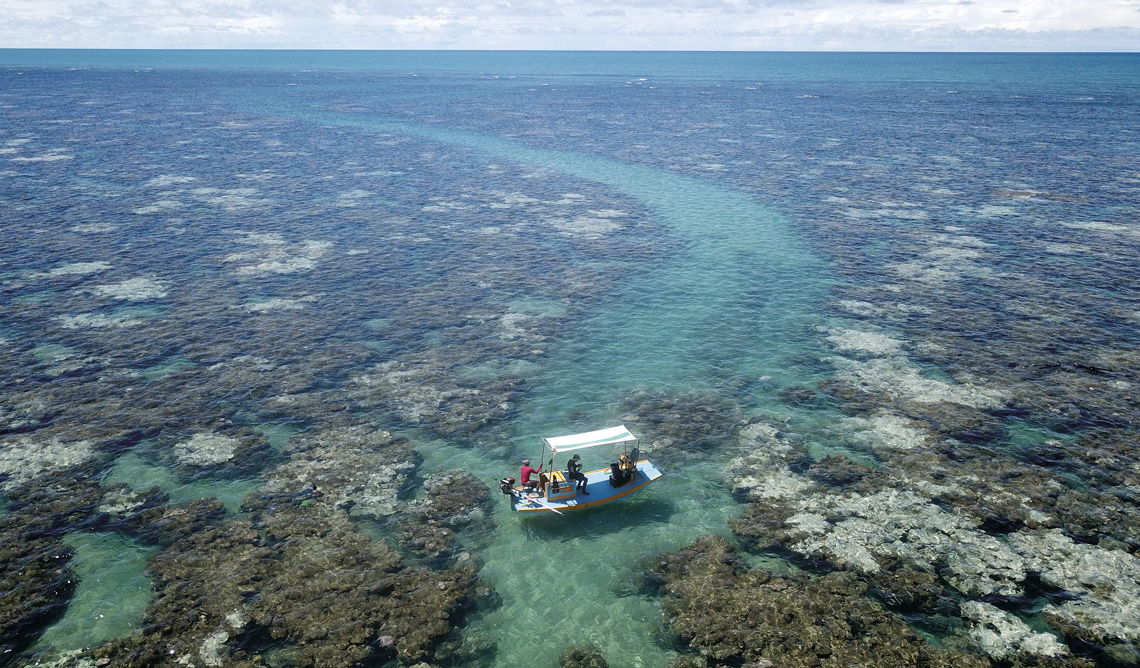
A triple extreme event that was virtually unheard of in the South Atlantic 20 years ago—a combination of marine heatwaves, chlorophyll shortages, and severe sea acidification—has begun to occur more frequently in the subequatorial region of the ocean since 2009, according to an article published in the journal Nature Communications on April 16. It is the first time a study has mapped the frequency and intensity of the compound phenomenon in this area of the Atlantic.
The event’s occurrence was analyzed over two consecutive 10-year periods (from 1999 to 2008 and 2009 to 2018) in six regions of the South Atlantic: three near the Brazilian coast and three off the coast of Africa. In the first time period, there was no record of all three extremes occurring simultaneously in any of the six areas. In the second period, the story changed completely. The triple event episodes began to emerge and to become relatively common. Depending on the region, the minimum cumulative duration of the triple events ranged from 17 to 49 months in the second decade covered by the study (see comparative table). The most severe episodes combining heatwaves, high acidity, and low chlorophyll availability covered areas representing between 4% and 18% of the total area of each region.
“Starting in 2016, the triple phenomenon began to occur almost every year,” says physical oceanographer Regina Rodrigues of the Federal University of Santa Catarina (UFSC), lead author of the article. According to the study, the summer of 2015–2016 was exceptional in terms of intensity and spatial coverage of triple compound events in the six regions studied.
The areas analyzed in the western Atlantic, near the Brazilian coast, were the Equatorial Atlantic (off the coast of Northeast Brazil), the Subtropical Atlantic (Southeast Brazil), and the Brazil-Falkland Confluence (South). On the eastern side, off the coast of Africa, the research looked at the regions known as the Eastern Equatorial Atlantic (near Nigeria, Cameroon, and Gabon), the Angola Front (off the coast of Angola and Namibia), and the Agulhas Leakage (southwest of South Africa).
Intense climate disturbances that occur in these areas can affect local fishing and mariculture. Warmer, more acidic water increases the mortality of marine species and causes coral bleaching, an indicator of enormous stress. A low level of marine chlorophyll, a natural green pigment essential for photosynthesis in plants and algae, indicates a reduction in the availability of phytoplankton, which are essential to the diets of many marine organisms.
To be classified as a triple event, all three of the extreme phenomena must occur simultaneously in at least 1% of the area of interest. The study focused its analysis on the summer months, from December to March. The incidence of heatwaves in the South Atlantic was determined based on information from the US National Oceanic and Atmospheric Administration (NOAA). The occurrence of extreme high acidity events was obtained from data from the Met Office Hadley Centre, UK. Extremely low concentrations of chlorophyll in the South Atlantic were inferred from a NASA model that calculates the concentration of the natural green pigment in the oceans.
Oceanographer Leticia Cotrim of the State University of Rio de Janeiro (UERJ), who did not participate in the study, believes the article is unique in that it presents data on the frequency and extent of extreme marine events that consist of three concomitant changes. “It is an innovative study. Previous research has only analyzed one type of extreme event in isolation, or two together at most, and usually in other oceans rather than the South Atlantic,” says Cotrim. “The results of this study could be used by ocean conservation projects, in addition to serving as a guide for economic activities that depend on the sea.”
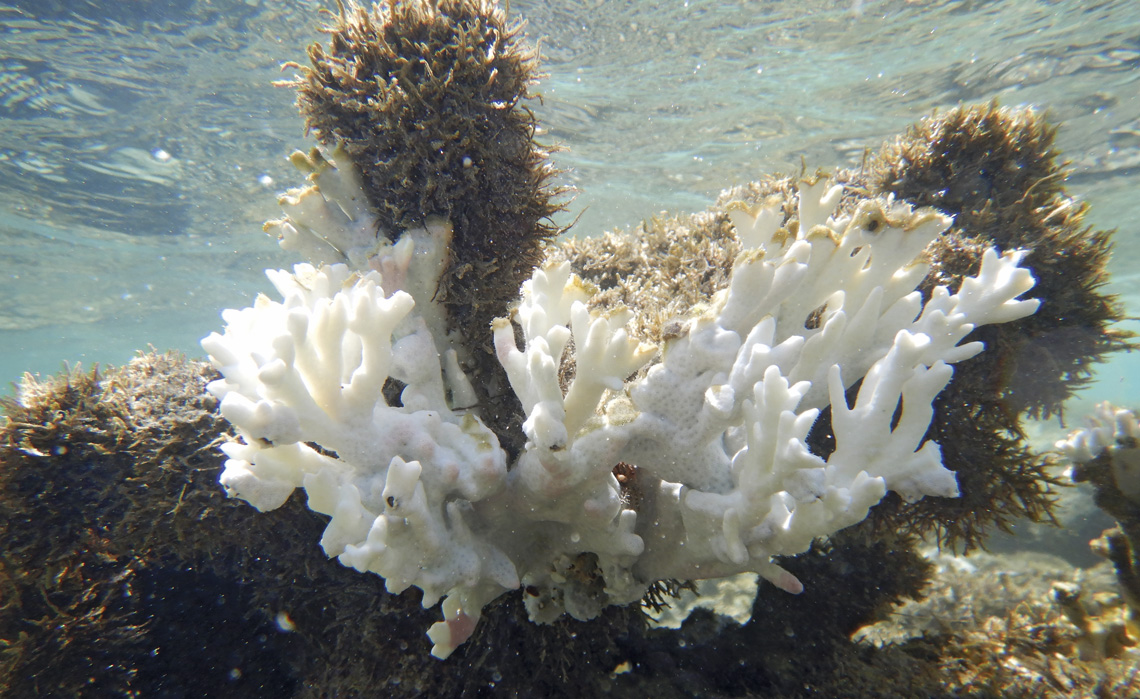
Marine Ecology Laboratory / UFRNUnderwater image of coral that has lost its colorMarine Ecology Laboratory / UFRN
One concerning fact raised by the study is an increase in the acidification process in the South Atlantic. Between 1998 and 2008, the phenomenon was practically nonexistent in this part of the ocean, with the exception of two locations further north, near the African continent. Since 2009, the South Atlantic has been becoming much more acidic. The change is linked to the rising average global temperature in recent decades caused by the increase in greenhouse gas emissions, such as carbon dioxide (CO₂) and methane (CH₄), which are heating up the planet. “We are seeing increasingly frequent episodes of marine acidification. This trend appears to have increased the occurrence of these triple compound events over the past 10 years,” oceanographer Thomas Frölicher of the University of Bern in Switzerland, another author of the article, said in an interview with Pesquisa FAPESP.
The earth’s climate, which has warmed by about 1.5 degrees Celsius (ºC) since the mid-nineteenth century due to greenhouse gas emissions from human activities, would be even hotter today without the oceans. They absorb 90% of the heat from the earth’s atmosphere and 30% of CO₂ emissions, but these environmental services come at a cost to the seas. Absorbing most of the earth’s heat leads to marine heatwaves. Removing almost a third of greenhouse gases makes the water more acidic.
In years of El Niño, a phenomenon characterized by abnormal warming of surface waters in the central and eastern equatorial Pacific Ocean, all of this is intensified. The change in climate triggers alterations in the atmosphere that interact with oceanic conditions. “El Niño acts as a remote agent on the local factors we observed. The incidence of triple extreme events in the six regions of the South Atlantic is therefore higher in El Niño years, such as 2015 and 2016,” explains Rodrigues.
In another article coauthored by the UFSC researcher, published in the journal Communications Earth & Environment in March 2025, heatwaves alone were shown to be sufficient to cause extensive damage to coral reefs in areas near the Equator, even at times when there is no sharp increase in marine acidity. In very warm waters and with other stress factors, such as excess sunlight, corals expel the algae that give them their color, known as bleaching. Since the 1980s, this type of extreme event has become 5.1 times more frequent and 4.7 times more intense in tropical waters of the North and South Atlantic.
One recent episode that attracted attention was a severe marine heatwave that occurred near Rio do Fogo, a coastal town in the Brazilian state of Rio Grande do Norte, in the summer and autumn of 2020. Rising water temperatures in the region resulted in the bleaching of 85% of hard corals and 70% of zoanthids (softer-bodied organisms that inhabit reefs). “The water reached 32 °C—the normal summer temperature there is 28 °C,” says biologist Guilherme Longo of the Federal University of Rio Grande do Norte (UFRN), another author of the article. “Several coral species in the region have an average thermal limit of 29.7 °C. If exposed to temperatures above this threshold, they begin to suffer biological damage.”
According to Longo, heatwaves have increased in frequency, intensity, and scale, affecting more areas along the Northeast coastline. In 2024, the hottest year in the planet’s recent history, the region was affected by an unprecedented extreme thermal event. “The extent of the phenomenon and species mortality were slightly greater last year than in 2020. Many species had just come out of a very intense period of disturbance and were then subjected to another one,” says the biologist. With global warming on the rise, new negative records are expected to be set in the Atlantic.
The story above was published with the title “Triple suffocation in the ocean” in issue 351 of May/2025.
Scientific articles
RODRIGUES, R. R. et al. Extreme compound events in the equatorial and South Atlantic. Nature Communications. Apr. 16, 2025.
RODRIGUES, R. R. et al. The severe 2020 coral bleaching event in the tropical Atlantic linked to marine heatwaves. Communications Earth & Environment. Mar. 18, 2025.
Republish