Dinosaurs and flying reptiles weren’t the only dangers on Earth 100 million years ago. Closer to the ground, winged ants measuring about 1.5 centimeters (cm), equipped with sharp sickle-shaped jaws and a stinger, could be a real nuisance.
The hostile appearance of these insects, which belonged to the Haidomyrmecinae subfamily, earned them the nickname “hell ants.” An article published in May in the journal Current Biology revealed that a species from this extinct group, Vulcanidris cratensis, lived 113 million years ago in what is now the municipality of Araripe. The fossil was discovered in the Crato Formation, located at the border of three Brazilian states: Ceará, Pernambuco, and Piauí.
This is the first species of hell ant found in Brazil. Since 2008, paleoentomologists have classified 12 species from fossils preserved in amber from Myanmar in Asia, one species in the United States, and another in France. The Brazilian fossil is the oldest among them.
The presence of these ants in Brazil reveals that their distribution was far broader than previously believed. “Now we know that they existed in both the Northern and Southern Hemispheres,” says entomologist Gabriela Procópio Camacho of the Museum of Zoology at the University of São Paulo (MZ-USP).
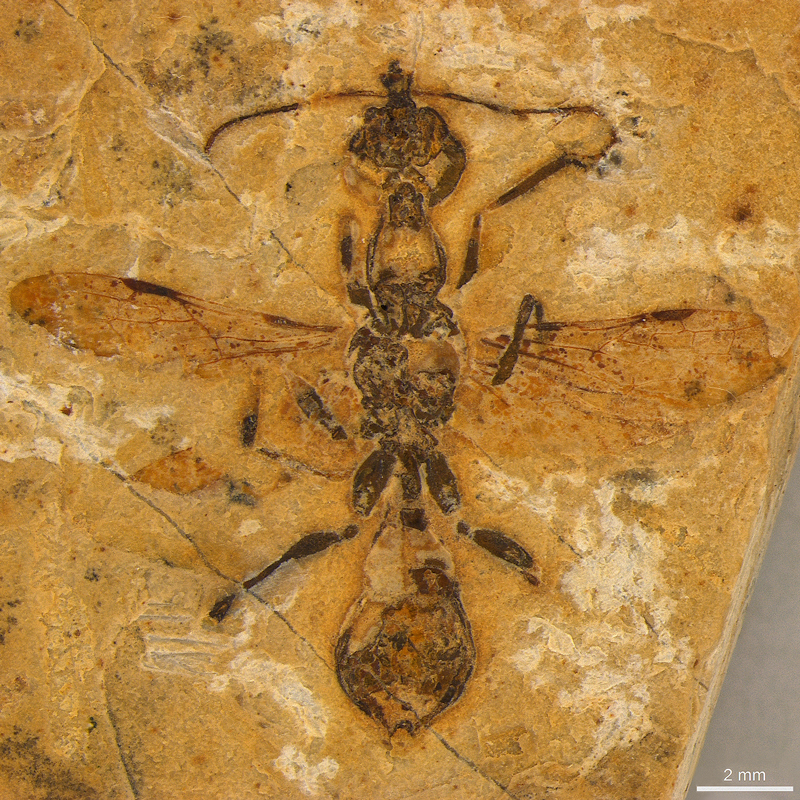
Anderson Lepeco / USPFossil from the Crato Formation: entire body preservedAnderson Lepeco / USP
Before this recent discovery, genetic studies of present-day ants in South America and Africa had already indicated that the earliest species likely originated on the South American continent. “The problem was that despite this, the oldest known fossils were from the Northern Hemisphere, particularly Asia,” recounts Camacho. The discovery of this new species in Ceará—approximately 110 million years old—makes it the oldest known ant to date, belonging to a very primitive group. This strengthens the idea that South America played a key role in the early evolutionary history of ants and may have been one of the regions where they first began to diversify.”
One hundred million years ago, the area now known as Myanmar was hot, rainy, and blanketed in dense vegetation typical of tropical rainforests. In contrast, the Crato Formation in Brazil recorded a dry climate with shallow lakes, marked seasons, and a variety of plant life—including conifers, ferns, and some of the world’s first flowering plants. “This suggests that hell ants were highly adaptable, which may explain how they managed to spread to different parts of the planet during the Cretaceous period.”
The discovery was made by chance. “The fossil was donated along with others by a family who had a private collection. While curating the specimens, we noticed an insect unlike any we had seen in Brazil,” says Camacho. Anderson Lepeco, the article’s lead author and a biologist undergoing technical training at MZ-USP with a FAPESP grant, recognized similarities with hell ant fossils from Myanmar. The team then performed a tomographic scan to examine the insect’s body in 3D and confirm its identification.
The fossil’s exceptional state of preservation—and the distinctive anatomy of these ancient insects—made the analysis easier. “Hell ants had vertical mandibles, which allowed them to bite upward. Modern ants, by contrast, feed using horizontal jaw movements,” Camacho explains.
South America played a central role in the early evolution of ants
These tiny sickle-shaped jaws were used to transport plant material, such as tree sap, and to capture other insects. One hell ant from Myanmar, described by researchers from the United States and France in a 2020 Current Biology article, was found fossilized in amber with its jaws embedded in another insect.
The Brazilian authors concluded that the rarity of these ants in the Crato Formation, where the only identified species is V. cratensis, suggests they were not dominant predators in that environment. In 1989, zoologist Carlos Roberto Brandão of MZ-USP named a fossil ant species from Crato Cariridris bipetiolata. “The issue is that the fossil was held in a private collection to which scientists later lost access, and Brandão’s description was based on a drawing and a photograph—not on a 3D scan like the one used for V. cratensis,” says Camacho. “Some researchers later classified the specimen as a wasp, and its identity became disputed.” The new publication provides a stronger foundation for Brandão’s work. Still, Camacho notes that due to the advanced imaging methods used, “this new discovery is currently considered the first fossil ant from Crato to be reliably validated by science.”
“Tomography is extremely important because the anatomical details it reveals help us infer the lifestyles of these animals,” says paleontologist Gabriel Osés, a collaborating researcher at the Institute of Physics at USP, who studies insect fossils from the Crato Formation and was not involved in the study. He notes that, in the case of insects, it is even possible to understand their ecological relationships with plants.
The Brazilian fossil stands out from Asian finds because it is the only one discovered in rock rather than amber. “This is a unique feature of the Crato Formation, which is renowned for its exceptional preservation of both large animals and arthropods,” says Osés. Fossils in this formation are found in two types of limestone. One type, dark in color due to the abundance of ancient organic matter, tends to preserve animal remains more poorly. The other, a lighter beige, is rich in pyrite—a mineral that, when oxidized, transforms into iron hydroxides (see Pesquisa FAPESP issue no. 283).
In some cases, these minerals replaced the original tissues of ancient organisms in the Crato Formation, preserving their structures. For insects—delicate creatures that are especially difficult to preserve—fossilization is rarer than for vertebrates. But when it does occur, it can preserve the entire body of an arthropod, including soft tissues.
Studying these ancient life forms is essential to better understand prehistoric ecosystems. “Modern ants are major ecosystem engineers,” says Camacho. “They make the soil more porous, improving water absorption and promoting fertility.” They also disperse seeds and help control populations of pests and invasive plants that make up part of their diet. “We can assume they played an important role in the past as well,” he adds.
The story above was published with the title “A small predator among giants” in issue 353 of July/2025.
Republish