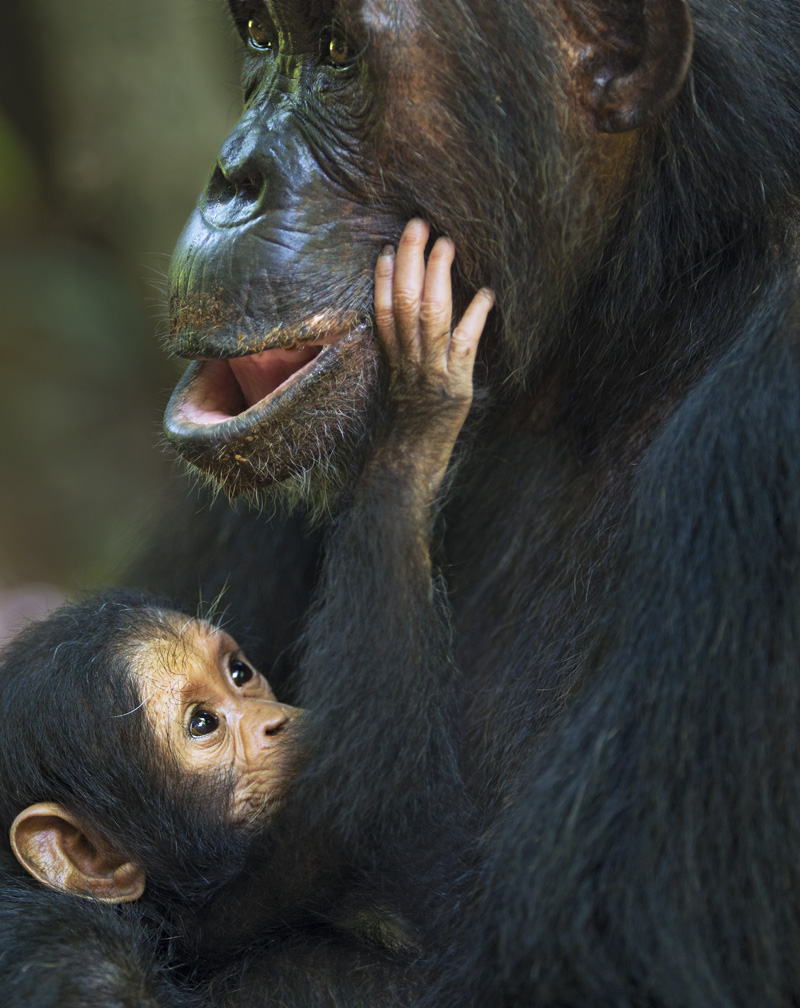
Anup Shah / Getty ImagesA 2-month-old baby chimpanzee explores the face of an adult in TanzaniaAnup Shah / Getty Images
For human and chimpanzee babies, there are similar functions behind the habit of touching the faces or heads of adults of their species: the practice serves as a way of creating emotional relationships with older individuals, playing, or asking for food. “Touch can be used to communicate emotions, relax, strengthen bonds, and regulate social relations within a group in various species of primates and even other mammals,” concluded psychologist Beatriz Felício of the University of São Paulo (USP). Together with Kim Bard of the University of Michigan, USA, she observed eight babies from families living in urban settings in the UK, 10 from rural communities in Cameroon, and 12 from the Central African Republic for 36 hours each. The pair also studied four baby chimpanzees at a zoo in the UK, three at an animal shelter in Japan, and 12 at a wildlife reserve in Tanzania, Africa. They recorded 222 moments of face touching and 47 of touching other parts of the head. Babies of both species touched the faces of female adults more than those of male adults. Humans used touch at the same frequency in both play and food sharing. Chimpanzees in Tanzania and the UK touched adults’ faces more often as a form of play than chimpanzees in Japan. “This behavior has already been identified in capuchin monkeys in the early years of life,” says Felício (Animal Cognition, February).
Republish