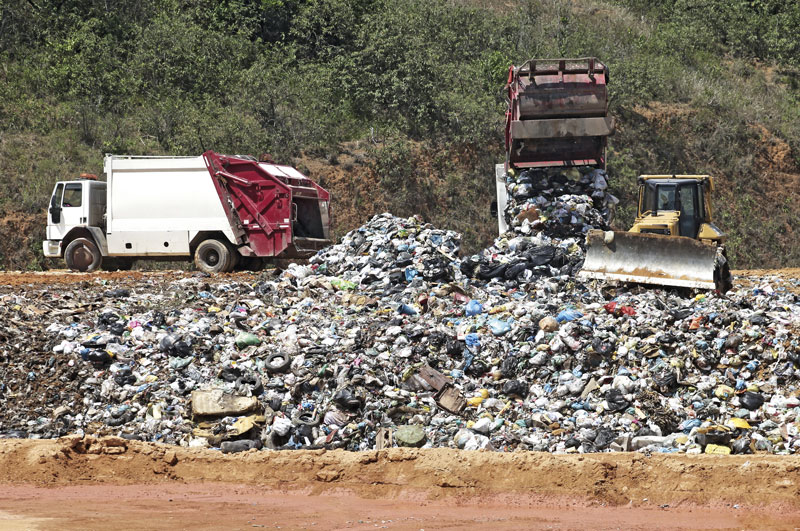
luoman / Getty ImagesGarbage dumps, one of the sources of methaneluoman / Getty Images
One of the gases that contributes most to global warming, produced through livestock farming, the burning of natural gas, and garbage dumps, methane could be converted into useful and environmentally harmless compounds using a hybrid catalyst developed at the Massachusetts Institute of Technology (MIT), USA. Functional at ambient temperatures and pressures, the catalyst particles are suspended in water, which absorbs methane from the air. Two components are used: the mineral zeolite (an iron-modified aluminum silicate), which is capable of absorbing methane, and the enzyme alcohol oxidase, which bacteria, fungi, and plants use to degrade alcohols. The zeolite converts methane to methanol and the enzyme converts methanol to formaldehyde. Formaldehyde, when added to urea, a nitrogen-containing molecule found in urine, can generate urea-formaldehyde, a resin used in agricultural products and cork boards. In the future, the catalyst could potentially be applied as a film to coat surfaces exposed to methane or adopted at facilities known to produce methane, such as power plants and livestock farms (Nature Catalysis and MIT News, December 4).
Republish