I chose the field of education when I was still a teenager. Aged 14, I started studying at the Center for Teacher Training and Improvement [CEFAM] in Campinas, a city close to my hometown of Hortolândia in the interior of São Paulo. The fruit of a state public policy, the center offered students a full scholarship for a full-time four-year course. My mother is a housewife and my father is a metalworker. Growing up in a working-class family, a vocational secondary education seemed like a secure career opportunity.
I noticed that in the town I grew up in, at school and at work, racism and discrimination were (and still are) very much alive, although it is often subtle or hidden. From an early age I realized that while it is possible to improve your socioeconomic status as my father did, you cannot to escape racist oppression. It was at university that I began to find answers to the deep indignation I felt about this injustice.
In 2005, I enrolled on a pedagogy night course at the School of Education at UNICAMP [University of Campinas]. In my first year, I started researching racism in education. For my final project, I investigated the mechanisms of racial discrimination in early childhood education. I interviewed teachers who worked in municipal daycare centers in Paulínia [São Paulo State], as I did at the time. Using a social psychology approach, I sought to understand social representations in teaching material, such as books and games, and how these resources, as pedagogical choices, reinforce mechanisms of ethnoracial discrimination.
After finishing my degree in 2008, I began combining my work at the daycare center with teacher training activities in several towns across the state of São Paulo, making use of the results of the research I did for my final project. For me, this is the true meaning of research: sharing the results of the study beyond my academic peers, which is something I still do today.
I completed my undergraduate degree at the age of 22, and at the encouragement of my supervisor, Professor Ângela Fátima Soligo, I submitted a research proposal to the master’s program in education at UNICAMP, and was accepted. I started in 2010. For my master’s research, I investigated social representations of school among Black children. I interviewed 57 elementary school students aged 8 and 9 from schools in the 19 municipalities of the Metropolitan Region of Campinas, including Hortolândia. The title of my dissertation was based on a comment by one of the girls I interviewed: “’There is racism here!’: A study of the social representations and identities of Black school children.” It ended up becoming a book with the same title [Editora Livraria da Física, 2018], which is now part of the teacher training content of the São Paulo State Department of Education.
In 2013, a year after I completed my master’s degree, I got a role as an education specialist at the Federal Institute of São Paulo, Hortolândia campus, (IFSP-HTO), and soon after, I was invited to take on the newly created position of deputy director of community development at the institute’s Office for Scientific Outreach, based in the capital of São Paulo. I had the opportunity to take part in developing this project, and it ultimately inspired the topic of my doctorate, which I also did at UNICAMP and defended in 2018. In my thesis, I tried to shed light on the potential of the office for promoting African and Afro-Brazilian history and culture.

Personal archiveJango at the Center for Teacher Training and Improvement (far right)Personal archive
During my time in the role, I participated in the creation of the Center for Afro-Brazilian and Indigenous Studies [NEABI], which I headed for five years and which will celebrate its tenth year in 2025. Composed of IFSP faculty, researchers, and students, NEABI seeks new ways to include Indigenous people and Afro-Brazilians in all spheres of society, from many of which they have been and still are excluded. Even today, less than 20% of IFSP employees are Black. There are huge challenges to overcome and I believe that one of the ways to do so is to create repertoires for different audiences based on African and Afro-Brazilian culture.
It was with this in mind that in 2019, back at the Hortolândia campus, I came up with a new research project: “AfroIF: Curriculum, decolonial thinking, and teacher training.” Between 2020 and 2022, with the help of researchers from NEABI and resources from the nongovernmental organization Center for Studies on Labor Relations and Inequality [CEERT], we diagnosed the pedagogical practices of teachers working in basic technical education at IFSP’s 36 campuses. Then, based on the information we collected, we established a training cycle aimed at re-educating people on ethnoracial and gender relations.
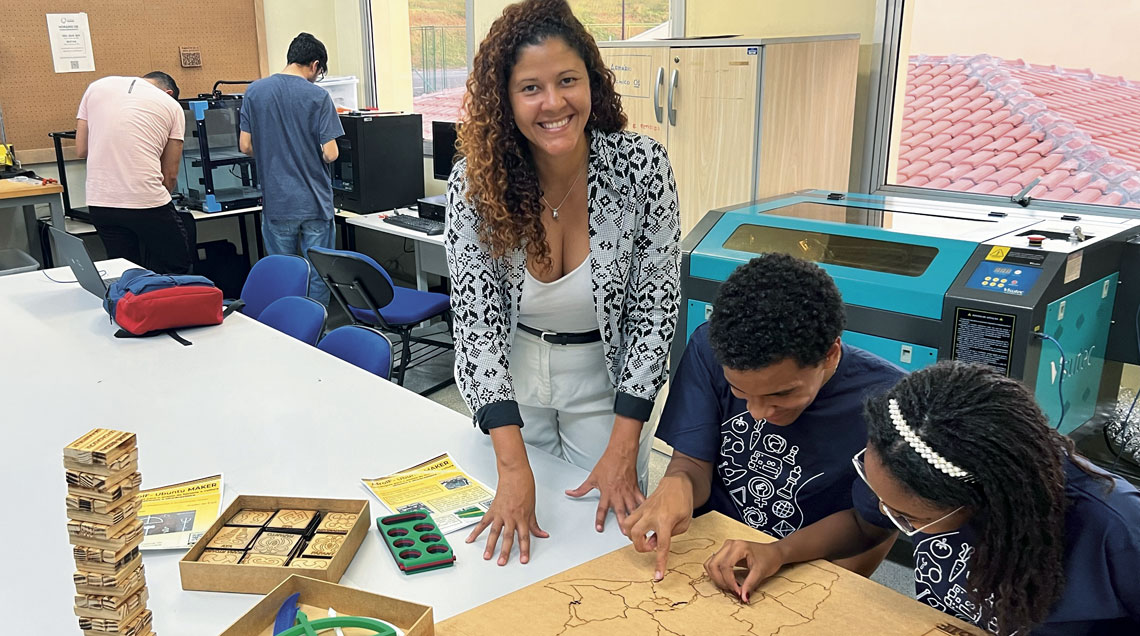
I still need to consider how to extend the project further. This happened in 2020, when I became director-general of the Hortolândia campus at IFSP and dedicated myself to setting up the Ubuntu Maker laboratory. Students and teachers alike from the institute are involved in the lab, which is equipped with 3D printers. We produce Afrocentric teaching materials—such as games and maps—that can help reduce racial inequality in education.
The name is inspired by the African philosophy of Ubuntu, which stands for solidarity and collective work. Over the last year, with resources from a federal parliamentary amendment, Ubuntu Maker has evolved into a citizen science and scientific outreach program that serves 10 state schools in Hortolândia, Sumaré, and Paulínia, focusing on antiracist and antisexist education.
As head of IFSP-HTO, I was also able to contribute to the creation of a partnership with CEERT and the Department for Continuing Education, Youth and Adult Literacy, Diversity, and Inclusion [SECADI], linked to the Brazilian Ministry of Education, to implement a training program in racial equity for managers. Between June and December of last year, roughly 450 educational managers from more than 120 municipalities nationwide took the course.
I will be the director of the institute until 2029. One of my goals is to enable expansion of the Ubuntu Maker program by consolidating suitable spaces at IFSP-HTO and other institutions, giving more students access to its projects. I also intend to make our campus a reference in antiracist education, but I know that this is something that depends not only on me. And I want to write a book about feminist and antiracist management, to share my experiences and who knows, maybe inspire other women—especially other Black women—to get into research and management.
Republish