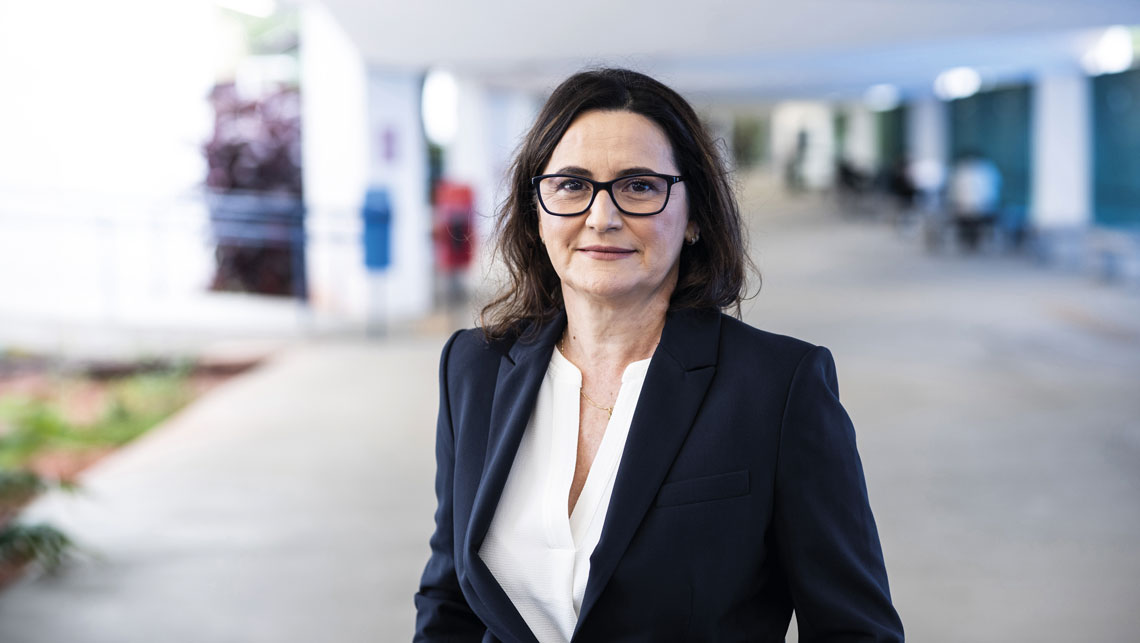
Liane Marcia Rossi, a chemical engineer with a PhD in chemistry and a professor at the Institute of Chemistry of the University of São Paulo (IQ-USP), is at the cutting edge of global decarbonization research. Her work focuses on carbon dioxide (CO₂) capture and use as a raw material for fuels and chemicals—an approach that could help mitigate global warming by removing CO2 either directly from the atmosphere or from industrial emissions.
Her work builds on an established field: catalysis. Converting CO2 into valuable products is a challenge that can be overcome through catalysts and adjustments in reaction conditions. Rossi and her colleagues at IQ-USP have developed a novel process for converting CO2 into methanol using a catalyst made from titanium and rhenium oxides. Methanol fuel could help in the energy transition of hard-to-electrify sectors, such as maritime transport.
Conducted at the Research Center for Greenhouse Gas Innovation (RCGI)—a collaboration between FAPESP and Shell—her research has already spun off a dedicated startup. “The goal is to develop this technology to full commercial maturity,” says Rossi, who also serves as director of RCGI’s Carbon Capture and Utilization Program.
In recognition of her contributions to green chemistry and catalysis, Rossi was awarded the King Carl XVI Gustaf Professorship in Environmental Science, granted by a fund chaired by the Swedish monarch. She is the 28th recipient—and the first from Latin America. She gave the following interview via a video conferencing application.
How can carbon capture help fight global warming?
There are two main approaches to carbon capture. One approach is direct air capture. This method is costly because CO2 in the atmosphere exists at very low concentrations, making it difficult to capture. However, even at these low levels, it is enough to drive global warming and climate change. A potentially more viable alternative is capturing CO2 directly from emission sources, before it disperses into the atmosphere [see Pesquisa FAPESP issue nº 340]. By intercepting the gas at the point of emission—where CO₂ concentrations are significantly higher—this method improves efficiency and reduces costs. Regardless of the method, captured CO2 must be either stored or repurposed.
Which industries generate the most significant CO2 emissions?
Key sources include industrial processes like cement and steel manufacturing, fossil fuel power plants, and oil extraction. In Brazil, carbon emissions are also generated in ethanol production, particularly during sugar fermentation and the combustion of bagasse for cogeneration. CO2 from sugar fermentation is highly pure and could be directly utilized in chemical conversion processes to produce valuable products. Conversely, CO2 from fossil-fuel power plants and heavy industries often requires costly purification before it can be repurposed.
Where can captured carbon be stored?
The most well-known storage method is injecting CO2 into oil wells to enhance oil recovery. CO2 is pumped into underground reservoirs, increasing recovery while remaining securely stored. Brazil also has significant capacity for storing CO2 in underground rock formations. The country has a significant overlap between ethanol plant locations and underground geological formations suitable for carbon storage. However, storage alone does not create economic value for CO2—it merely prevents it from remaining in or reentering the atmosphere.
Is utilizing captured CO2 a viable option?
Yes. There are several possibilities, including fairly straightforward applications such as after a single purification step in the food and beverage industry. Another possibility is using CO2 as a carbon source in chemical processes that alter its molecular structure to create different chemical products. This requires precise control over reaction conditions, such as reagent selection, temperature, and pressure, along with catalysts—substances that accelerate reactions without being consumed in the final product. The major challenge is designing a catalyst formulation that directs the reaction toward a specific product. In most cases, chemical reactions yield mixtures of products.
Synthesizing ethanol from CO₂ emissions in sugarcane ethanol plants would be a major breakthrough
What products can be derived from CO2 conversion?
One key pathway for converting CO2 into chemical products is hydrogenation, a process in which CO2 reacts with hydrogen gas (H2) in the presence of specialized catalysts. This reaction can yield three primary products: carbon monoxide (CO), methane (CH4), and methanol (CH3OH). Each of these compounds contains a single carbon atom. In this process, no carbon-carbon bonds are formed; only the neighboring atoms around the carbon change. Carbon monoxide is not an end product but a chemical intermediate. In industrial applications, CO is typically combined with H2 to create synthesis gas [syngas]. Syngas is used as a precursor for manufacturing methanol, hydrocarbons, paraffins [a component of gasoline], and olefins [hydrocarbons used in polymer production]. Although the ability to convert syngas into paraffins and olefins has been known for over a century, it has yet to become economically viable. In contrast, methanol production from syngas or syngas-CO2 mixtures is a widely used process. Today, most syngas is derived from fossil fuels, including coal and natural gas. Here lies an open research question: can CO2 be a viable renewable carbon source for methanol production? This depends on several factors, including the cost and availability of green hydrogen, access to clean energy, process efficiency, and catalytic performance. One of the main challenges in directly converting CO2 into methanol is the reliance on hydrogen.
Why is that?
Because producing hydrogen is energy-intensive and has environmental impacts. The most sustainable option is green hydrogen, produced via water electrolysis using renewable energy sources. However, green hydrogen remains significantly more expensive than conventional hydrogen, which is primarily produced from natural gas—a process that emits CO2 [see Pesquisa FAPESP issue nº 333].
What is the current status of CO2-to-methanol conversion?
We’re currently researching direct conversion of CO2 into methanol without the need to first isolate carbon monoxide. We are also working on the synthesis of higher alcohols—compounds with two or more carbon atoms—such as ethanol (C2H6O). In the case of methanol, we had a successful PhD project led by chemist Maitê Lippel Gothe, under the supervision of Professor Pedro Miguel Vidinha Gomes at IQ-USP. We have also filed a patent for a novel catalyst that efficiently converts CO2 into methanol with high selectivity. We founded a startup, Carbonic, two years ago to advance this technology toward market readiness.
What does catalyst selectivity mean?
Catalyst selectivity refers to the ability of a catalyst to direct a chemical reaction toward a specific product. In this case, it means that more than 90% of the CO2 is converted into methanol. In this process, methane is a minor byproduct, and trace amounts of carbon monoxide (CO) are produced. This is expected because catalytic processes involve multiple reactions occurring simultaneously.
What are some of the applications for methanol?
Global methanol production stands at about 100 million tons annually. Methanol is widely used in both traditional industries—as a solvent or reagent—and in clean energy applications. It is used in the production of biodiesel, formaldehyde, and acetic acid, as well as in the synthesis of olefins, aromatics, and even gasoline through specific catalytic processes. Depending on national regulations, methanol can be blended with gasoline or used as a standalone fuel. In Brazil, gasoline is blended with ethanol, whereas in some other countries it is blended with methanol. Methanol is categorized by color, depending on the source of carbon and the energy used in its production. Methanol produced from fossil fuels like coal or natural gas is classified as gray methanol, as its production process generates CO2 emissions. If carbon capture is implemented during production, it is referred to as blue methanol. Green methanol is produced from biomass, organic waste, or captured CO2, using renewable energy sources. All three types of methanol rely on hydrogen to be produced. The key distinction, beyond the carbon source, is whether green hydrogen is used—this is a defining factor for classification as green methanol. For methanol to be carbon-neutral or even carbon-negative, the best approach is to use biogenic CO2 or CO2 captured directly from the atmosphere.
Can green methanol support the energy transition?
Yes. It is increasingly seen as a viable solution for hard-to-electrify sectors, particularly maritime shipping. A key strategy is retrofitting ship engines, which traditionally run on heavy fuel oil, to operate on methanol—helping accelerate the shift from fossil fuels to low-carbon alternatives. Methanol’s biodegradability, liquid state, and ability to be transported under normal atmospheric conditions provide significant advantages. Unlike alternative fuels such as ammonia or hydrogen, methanol does not require pressurization or cryogenic cooling for storage and transport. This simplifies logistics, as methanol can be handled, stored, and distributed using existing fuel infrastructure and safety procedures. It is also a cleaner-burning fuel that does not produce soot. Compared to conventional fuels, gray methanol lowers carbon emissions by 15%, while green methanol can cut them by as much as 95%. If the shipping industry adopts methanol as a fuel, demand is expected to surge. Projected consumption is five times higher than current global methanol production. And the maritime sector isn’t interested in gray methanol—it wants the green variant.
Is your group’s catalyst a world first?
We selected rhenium, a metal that is not commonly used in industrial catalysis. We knew that rhenium had been used for reducing carboxylic acids, which share structural similarities with carbon dioxide. This led us to test rhenium oxide in combination with other oxide supports. Methanol production from fossil sources dates back to 1923. The earliest industrial methanol catalysts, made from chromium oxide, remained in use for roughly four decades. In the 1960s, scientists developed catalysts composed of copper, zinc, and alumina. These CZA (copper-zinc-alumina) catalysts are still the dominant choice for methanol synthesis. The challenge now is shifting from coal- and gas-derived methanol to CO2-based methanol. Many research teams are attempting to adapt CZA catalysts for direct CO2-to-methanol conversion. However, these catalysts still struggle with stability and selectivity. New catalysts need to be developed to make this process more viable.

Jonas BorgRossi and King Carl XVI Gustaf at an event held at the Swedish Royal PalaceJonas Borg
What are the key challenges?
Although CO2-to-methanol conversion holds great potential, it faces significant technical, economic, and scalability hurdles. Reaction conditions need to be optimized to enhance catalyst performance in terms of activity, selectivity, and longevity. The reaction follows this principle: the higher the reaction temperature, the greater the CO2 conversion. However, higher temperatures reduce methanol yield and favor the formation of methane and carbon monoxide instead. The key challenge is designing a catalyst that maintains high activity at lower reaction temperatures. In our catalytic system, the ideal reaction temperature is 200 degrees Celsius [°C]. At temperatures above 250 °C or 300 °C, methanol selectivity declines, leading to the formation of unwanted gases. Literature reports indicate that commercial CZA catalysts, operating at 220 °C to 300 °C and pressures of 5 to 10 megapascals, typically achieve methanol selectivity in the range of 40% to 60%.
What is the current stage of Carbonic’s research?
Our startup, Carbonic, was founded in 2022 to develop technologies to combat climate change. In the near term, our focus is on further developing CO2-to-green methanol technology. While our laboratory results are promising, the long-term success of this technology hinges on a successful scale-up. We plan to use biogenic CO2 from ethanol plants as a feedstock. However, scaling up is a long process. On average, moving from bench-scale experiments to demonstration-scale implementation takes about 10 years.
Is your research group also working on CO2-to-ethanol conversion?
Yes, two of our PhD students are researching this pathway. Synthesizing ethanol and other higher alcohols from CO2 emissions at ethanol plants would be a major breakthrough. This would create a circular process—recycling CO2 from ethanol production to generate more ethanol. Shifting the reaction to produce ethanol instead of methanol would require a much more complex catalyst capable of forming carbon-carbon bonds in a controlled manner while maintaining the formation of oxygenates. We have successfully developed iron- and copper-based catalysts with strong activity, but ethanol selectivity is still low—currently below 5%. Going forward, we plan to explore new catalytic routes for CO2-to-ethanol conversion.
Is the award you received in Sweden related to your research on new catalysts and CO2 conversion into environmentally sustainable products?
In a way, yes. I have worked in green chemistry for many years. This field applies across all branches of chemistry, with goals such as reducing waste, minimizing or eliminating hazardous substances, and utilizing renewable resources. My interest in green chemistry started early in my career, in the 2000s. Catalysis, a fundamental aspect of green chemistry that enables chemical transformations using more sustainable reagents, was already a key part of my research in the 1990s.
How did your nomination for the King Carl XVI Gustaf Professorship in Environmental Science come about?
In 2022, Professor Belén Martín-Matute from Stockholm University nominated me for the position. I first met her virtually in 2020 when I was invited to present a seminar for a Nordic university consortium specializing in carbon emissions. This professorship was created in 1996 to commemorate King Carl XVI Gustaf’s 50th birthday, and Swedish universities put forward nominees. Every year, one or two international scientists are selected. Awardees are expected to spend a year in Sweden as visiting professors, collaborating with local researchers on environmental science initiatives. However, my experience has been somewhat different. I have already made three visits to Sweden, each lasting up to three months, and I have applied for a 12-month extension of my tenure. During my time there, I have been delivering lectures at multiple universities, visiting research groups, and collaborating with colleagues at Stockholm University.
What is your work in Sweden focused on?
We are developing a CO2-to-methanol conversion process with a novel approach. We plan to perform the conversion under milder conditions by integrating CO2 capture with heterogeneous catalysis—my specialty—and homogeneous catalysis, where the catalyst is dissolved in the same liquid phase as the reactants. We’re working to design a more sustainable process in terms of energy consumption, temperature, and other factors needed to overcome current hurdles in producing green methanol and other high-value products.
Have you interacted with King Carl XVI Gustaf?
Yes, I have met the king twice. The first time was at an exclusive event at the Royal Palace, where I delivered a lecture on Brazil’s challenges in transitioning to a low-carbon economy. I showed how Brazil has huge potential for leading the energy transition. The widespread adoption of ethanol as a fuel and the success of flex-fuel engine technology could play an important role. The second occasion was at a symposium dedicated to the professorship I was awarded. The event centered on my research in catalysis and CO2 conversion into sustainable chemical products. While the king is not a chemist himself, he showed a genuine curiosity about science, particularly environmental sciences. I opened my talk by discussing the urgent environmental crisis Brazil was experiencing at that time (September 2024), as wildfires raged across various regions, releasing massive amounts of CO2 and exacerbating climate change. I also highlighted the work of Svante Arrhenius, the Swedish chemist who, in 1896, quantified the relationship between atmospheric CO2 concentrations and global temperature rise. More than 100 years ago, he predicted that human-induced CO2 emissions from fossil fuel combustion could reach levels capable of altering Earth’s climate through the greenhouse effect.
The story above was published with the title “Liane Rossi: A scientist with a king for patron” in issue 347 of january/2025.
Republish