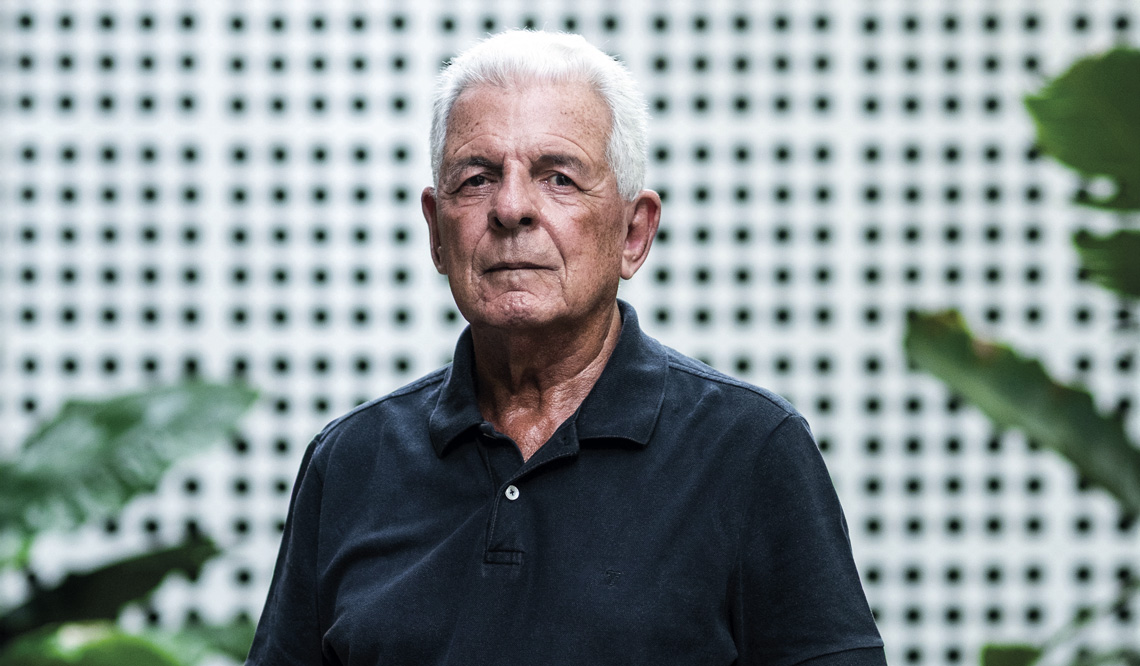
In 1972, at just 22 years of age, Luiz Henrique Lopes dos Santos became a faculty member in the Philosophy Department at the School of Philosophy, Languages and Literature, and Human Sciences at the University of São Paulo (FFLCH-USP), where he had earned his bachelor’s degree and is now a senior professor. At the time, he was part of a group of young researchers invited to fill the gap left by the compulsory and early retirement of professors persecuted by the military regime. Under the guidance of big names such as Otília Arantes, José Arthur Giannotti (1930–2021), and Oswaldo Porchat (1933–2017), Santos forged a career that spanned the philosophy of logic and history of philosophy, and he worked at institutions such as USP, the University of Campinas (UNICAMP), École Normale Supérieure in Paris, Paris Diderot University, and the Federal University of Rio de Janeiro (UFRJ). His academic production involved mainly the works of German mathematician, logician, and philosopher Gottlob Frege (1848–1925), the topic of his PhD thesis defended in 1989 at USP, and of Austrian philosopher Ludwig Wittgenstein (1889–1951). One of his most notable contributions was the translation into Portuguese, accompanied by a critical introduction, of Tractatus logico-philosophicus, written in 1921 by Wittgenstein.
In addition to his teaching and academic work in philosophy, he was involved in the management of research funding. For more than three decades, he was the philosophy and humanities coordinator of FAPESP’s Scientific Board where he assessed thousands of projects proposed by researchers and helped formulate programs for the Foundation. His work at FAPESP included the scientific coordination of Pesquisa FAPESP magazine for 21 years and the formulation of the Foundation’s Code of Good Practices in 2011. On a summer afternoon with heavy rain, he received Pesquisa FAPESP at his apartment in São Paulo for the following interview.
Philosophy of logic and history of philosophy
Institution
School of Philosophy, Languages and Literature, and Human Sciences at the University of São Paulo (FFLCH-USP)
Education
Bachelor’s degree (1971) and PhD (1981) from USP
Where did your interest in philosophy come from?
When I joined the high school movement, at approximately 15 years old, I began reading political philosophy and soon moved on to philosophy in general. However, when it was time to choose which career to pursue, I was undecided between the more classic route of law, in my case, and philosophy. I come from a family with many lawyers, and my father, who was a stockbroker, wanted me to study law. I took the university entrance exam for both courses, and in 1968, I began law at USP in the morning and philosophy at PUC-SP (Pontifical Catholic University of São Paulo) in the afternoon.
When did you decide your professional path?
In the 1960s, for an academic career, the natural path for a philosopher was minimally institutionalized. This caused a certain degree of insecurity. The person who put me on the philosophy path was Otília Arantes, who was my professor at PUC and one of my main academic references. She showed me that such a professional path was possible. When I decided to transfer my philosophy course to USP, mainly because of Otília’s influence, I already felt that the balance was tipping toward philosophy. I took the entrance exam again and enrolled in the class of 1969.
How was the transition to studying philosophy at USP?
It was a little frustrating. At the time, the department had lost professors who had been persecuted by the military regime. In my first month, I had a class with José Arthur Giannotti, who was soon forced into early retirement, just like Bento Prado Júnior (1937–2007). Others had to flee Brazil, such as Ruy Fausto (1935–2020). The department was left completely understaffed. In mid-1969, I went ahead and bravely scheduled an interview with Giannotti at CEBRAP (Brazilian Center of Analysis and Planning), which he helped to fund. I said, “I came to study philosophy at USP because of professors like yourself, who are no longer here. What do I do? Giannotti was preparing an article about Durkheim (1858–1917), who is a sociology theorist, and asked me to read some texts and make a presentation for him. I passed the test, and from then on, I informally began what is now called scientific initiation under Giannotti’s guidance. Every 15 days, I would go to his house to talk about Kant. We became good friends.
Did you graduate in law and philosophy?
For three years, I took both courses simultaneously. It continued like this until Oswaldo Porchat’s assistant, who was my logic professor, accepted a great job offer in financial terms at Banco do Brasil. At the end of 1970, Porchat came looking for me and said that if I finished the course the following year, I could be hired as his assistant. To be able to complete two years in one, I had to give up law, but I left it knowing that I was beginning a career in philosophy. The call from Porchat was decisive because I was undecided between aesthetics and logic.
What was it like becoming a university professor at such a young age?
Of course, I was very nervous. I was 22 years old, younger than most of the students. But, as I said, the department was really understaffed. I remember that other professors my age were hired such as Carlos Alberto de Moura, Ricardo Ribeiro Terra, and Olgária Mattos. Some of them were invited by Giannotti to take part in a seminar at CEBRAP, which ran between 1971 and 1973. This experience was truly important for my training because of the high level of the debates.
When my father died, my mother had to go to work, and at the same time, at around age 43, she enrolled in the social sciences course at USP.
Did the news of the job leave your father more relaxed regarding your career choice?
He was relieved when he heard the news because he was extremely concerned about my future. Unfortunately, he died soon after, at age 49, at the end of 1971. He was a well-off man, but he was never rich. He preferred traveling to saving money. With his death, my mother, who was a housewife, had to support herself. She went to work with her brother and decided to study social sciences. At around 43 years of age, she passed the entrance exam at USP in the 1970s. We used to cross paths at university, me as a professor and she as a student. After graduating, she went to work at the Support Foundation for Imprisoned Workers, where she remained until she retired in the 1990s. Her role was taking care of the literacy part, and in this job, she had contact with inmates such as Chico Picadinho, the famous serial killer from the 1960s and 1970s. My mother was very dynamic and even back when she was a housewife, she participated in progressive Catholic activism. In fact, her actions even influenced me to join the high school movement in 1964, just before the military coup.
What did you study for your master’s degree?
I do not have a master’s degree. I started doing the research for my master’s degree in 1972 at USP on mathematics, logic, and the German philosopher Gottlob Frege under Porchat’s guidance. However, when I was about to start writing the dissertation, Porchat called me to be his right-hand man not only at the Center of Logic, Epistemology, and History of Science but also at the Department of Philosophy that he was going to set up at UNICAMP. This was in 1975. On accepting the invitation, he warned me that it would be unfeasible to continue the research for my master’s degree at that time.
How did the idea of the center come about?
Porchat had the idea to create it at USP, but the department of philosophy rejected the proposal because of ideological differences. We were living in a highly polarized environment. Those of us in the field of logic were considered reactionary and were alienated because some people from the department believed that the discipline was linked to capitalism. However, Porchat was a good friend of the then-vice dean of UNICAMP, engineer and physicist Rogério Cesar de Cerqueira Leite (1931–2024). He told the dean of UNICAMP at the time, Zeferino Vaz (1908–1981), that it was a golden opportunity for the university in the field of philosophy. Zeferino fell in love with the idea of an interdisciplinary center and provided the material resources that no initiative linked to philosophy had in Brazil at the time. This made it possible, for example, to bring in visiting researchers from abroad and organize international conferences. The center was founded in 1977 and remains active.
What was its composition?
It was composed of researchers from the Department of Philosophy at UNICAMP and from areas such as mathematics, sociology, physics, linguistics, and theology. I was assigned to make the link to the Institute of Language, where I gave classes between 1977 and 1981.
Was there a community of logicians in Brazil?
There was, but it was, and still is, very small. The most well-known was Newton da Costa (1929–2024), who was at USP at the time but was a major influence on some members of the center, such as Ayda Arruda and Itala D’Ottaviano. At that time, I also became closer to Newton and his paraconsistent logic, after having published a few papers. Beyond its contributions to the realm of logic, the center was fundamental in shaping an academic philosophy community in Brazil. At the time, several centers had very qualified people spread across various states in Brazil. By connecting these islands of knowledge through its activities, the center contributed, for example, to the creation of ANPOF (the National Association of Graduate Studies in Philosophy) in 1983.
The center that we created at UNICAMP in the 1970s was fundamental in shaping the academic philosophy community in Brazil.
What did you study in the PhD program?
My PhD, supervised by Porchat, was an extension of that unfinished research from my master’s degree. I sought to understand how Frege, in the second half of the nineteenth century, caused a break from the Aristotelian model of logic, which had prevailed for approximately 2,000 years. To answer the questions that arose during his research into the fundamentals of mathematics, he was obliged to rethink logic. Thus, he conceived what we today call mathematical logic. I was hired by UNICAMP as a professor with a PhD on the condition of finishing my thesis in 1980, but it was a battle to complete the research. Between 1975 and 1978, I barely touched my thesis because I was immersed in the bureaucracy of the department and center, teaching classes, and holding seminars. In 1978, I returned to my thesis and defended it in 1981. The work was published in 2008 as O olho e o microscópio (The eye and the microscope; Nau Editora]).
You stayed at UNICAMP until 1981. Why did you decide to go back to USP?
I returned for personal reasons. I had separated from my wife, and my children, who were still small, lived with their mother in São Paulo. Since I did not want to be on the road all the time, I returned to the department of philosophy at USP. At that time, Giannotti had also returned to USP, and together, we taught Introduction to Philosophy to first-year undergraduates. He gave what he called an introductory lecture, and I held seminars with the students while dissecting the texts, reading, and rereading them several times. We educated several generations of philosophers.
In the 1990s, you translated Tractatus Logico-Philosophicus for EDUSP, a book written in 1921 by Austrian philosopher Ludwig Wittgenstein. What were the challenges of this work?
It is not easy translating such complex writing as that of Wittgenstein, who is one of the great philosophers of language, from German to Portuguese. To give you an idea, the introductory study that I wrote to explain the place of the Tractatus in the history of philosophy is longer than the book itself. Giannotti had already translated this work and written an introduction to it back in 1968. It was the second translation in the world, after the English one, and it was a Herculean task on Giannotti’s part, considering that Wittgenstein had only been dead for 17 years. He was a contemporary, and there was practically no literature on his work. In the 1990s, EDUSP proposed that Giannotti produce a new edition of his Portuguese version.
Giannotti himself said that the work that he did in the 1960s contained many errors. Do you agree?
There were some errors, not so much in the translation from German, but conceptual errors, because there was very little familiarity with the field at the time. This is the case with the specific German philosophy terms from the nineteenth century that related to philosophers such as Franz Brentano (1838–1917), who few people had read in Brazil. Upon receiving an invitation from EDUSP in the 1990s, Giannotti asked me to review the work, but I felt that it would become Frankenstein’s monster and proposed redoing the translation. Giannotti agreed and handed the mission over to me.
Between 1986 and 2007, Giannotti was in charge of CEBRAP’s Professional Training Program. What was your role in it?
This was an interdisciplinary training program aimed at postgraduate students from different fields of knowledge, which was made possible by an agreement between CAPES (the Brazilian Federal Agency for Support and Evaluation of Graduate Education) and CEBRAP. It was difficult to enter. Over the course of two years, students participated in activities such as seminars on anthropology, political science, sociology, economics, and philosophy. The meetings were held twice a week, and the teaching staff included Paul Singer (1932–2018) and Ruth Cardoso (1930–2008). I actively participated in the philosophy center until going to Paris in the late 1990s.
You joined FAPESP in 1986. What was the Foundation like at that time?
In 1986, Flavio Fava de Moraes, who was the scientific director at FAPESP, invited me to substitute for João Paulo Monteiro (1938–2016) in the field of philosophy on the Board of Human and Social Sciences. There was no general coordinator, but the role, because of his personality and background, was filled by Leôncio Martins Rodrigues (1934–2021). There was Boris Fausto (1930–2023) in history, Maria Alice Vanzolini in psychology, Cláudia Lemos in linguistics, and me in philosophy.
One of the first thematic projects in humanities was by filmmaker Jean-Claude Bernardet from USP, whose product was a film.
The workload at the time was small compared to what it is today, right?
We would go in on Mondays, and in the first part of the meeting, we would discuss Sunday’s soccer results—Boris, like me, was a die-hard Corinthians fan. We had approximately 15 or 20 proposals to analyze each week. Each of us would get around four. We studied them, produced a report, and decided whether to approve the grant or funding. Then, we went home. It was another world. A change had just taken place that would transform the profile of FAPESP in the shape of an amendment to the State Constitution proposed by congressman Fernando Leça and approved in 1983. It determined that allocations from the Treasury to FAPESP, then fixed at 0.5% of tax revenue, be calculated based on the current year and allocated in twelve monthly installments. Previously, the calculation was made on the basis of the previous year’s revenue, and by the time that the funds arrived, they were eroded by 13 months of inflation. After the Leça Amendment, the Foundation became aware that it had financial power to reach much further. This was completed in 1989, when the new State Constitution increased funding for the Foundation to 1% of the state’s tax revenue.
In practice, how did this ambition materialize?
One of the milestones was the thematic projects initiative. FAPESP had had large projects in the 1960s and 1970s, but they were one-offs, such as the biodiversity survey of the Amazon performed by zoologist Paulo Vanzolini (1924–2013) in the 1960s. Thematic projects were the first regular line of major funding. A discussion arose within FAPESP about whether it was worth giving so much money to the humanities—it was one thing awarding grants for master’s degrees, but approving the budget for a thematic project was something very different. The credit goes to Fava, who really put his foot down. One of the first thematic projects in humanities was by filmmaker Jean-Claude Bernardet, from USP, whose product was a film. I remained a philosophy coordinator until 1989. Leôncio left, and Fava invited me to take over as adjunct coordinator. Until 1989, area coordinators would go to FAPESP once a week and did not have any organic relationship with the Foundation. With the creation of the adjunct coordinator role by Fava, the adjunct coordinator began to mediate between the area coordinators and the scientific director. In 1993, José Fernando Perez took over the Scientific Board, he asked me to continue, and I accepted.
In 1997, you stepped away from FAPESP to spend a period in France but returned to the Foundation upon returning to Brazil. How was that return?
I spent two years in Paris as a visiting researcher at the École Normale Supérieure and as a professor at Paris Diderot University. Paula Montero replaced me. When I returned, in early 1999, I was called to work with Paula because there was already the need for two adjunct coordinators in the humanities. Perez had his own creative dynamic and restructured the Scientific Board. He increased the number of adjunct coordinators, and every week, we met for two or three hours in a discussion circle to discuss what was happening. Many FAPESP programs were born from these meetings. The vibrancy of Perez’s tenure came from having people from all areas talking to one another. This was taken to an even larger scale when Carlos Henrique de Brito Cruz took control of the Scientific Board in 2005. Everything went through the adjunct coordinators. Once a month, 15 adjunct coordinators met and spent the entire afternoon talking.
How many scientific directors have you worked with?
There were four. The last tenure, of Luiz Eugênio Mello, was heavily disrupted by the pandemic. He worked miracles. He replaced me as an adjunct coordinator with Ângela Alonso, but I got to know her personally only at the end of his term. He kept the Scientific Board working and accomplished important things such as the effort to create research on COVID-19 and the first projects from the Generation Program, which was aimed at younger researchers still without employment relationships. He also promoted the adoption of equality and inclusion policies. Fava’s administration gave FAPESP greater ambition and created an institutional structure so that the Foundation could work creatively. Perez took advantage of this and was assisted by his personality. He was the embodiment of enthusiasm. When Brito took over, many programs were already in their fourth or fifth year. Brito, also because of his personality of being rational and systematic, brought order, formalized things, and assessed what was working and what was not. He improved and refined the existing programs and began a strong push to internationalize research in São Paulo.
What was your contribution to implementing the Public Education Program?
One of the revolutions that Perez implemented was creating technological research programs, especially in partnership with companies. However, he had the wisdom to consider a broad view of applied research. Research in the humanities can be applied and result in the formulation and implementation of public policies. Perez believed that applied research requires a partner who will potentially use it. From there, the idea emerged of starting with public education and conducting research in partnership with public schools. We called Maria Malta Campos from PUC-SP and the Carlos Chagas Foundation to assist us. I coordinated for a period and passed the baton to Marilia Sposito. Because it was successful, there was demand and partnership; it had everything, and then, the Public Policy Program was launched.
The good practices policy should be pedagogical, but one way of educating is by not allowing the wrong things that happen to go unpunished.
How did Pesquisa FAPESP magazine come about, of which you were the scientific coordinator between 2001 and 2022?
The concept was born out of a conversation between then-Editor-in-Chief Mariluce Moura and Perez. I came on board when it was already in motion because I was in Paris when the idea first came up. From the beginning, the goal was to create a magazine, not for FAPESP, but for scientific communication in Brazil and especially São Paulo. Second, it had to be a journalistic outlet and guided by scientists. For this, it was fundamental for the magazine to be a project linked to the Scientific Board. This enabled the creation of standards that guaranteed the quality that the magazine developed.
Do you mean, for example, that the magazine has a Scientific Committee composed of area coordinators and adjunct coordinators from the Scientific Board?
From the outset, the articles in the magazine were read by the coordinators of their respective areas. The idea was to have a balance between journalistic language and scientific rigor. On the one hand, some people said that the magazine was not rigorous enough from a scientific point of view. On the other hand, it presented things that were difficult for the lay public to understand. Criticism from both sides indicated to us that the magazine was on the right path by taking the middle road.
In 2001, you and Professor Perez wrote an article about conflicts of interest in research. Was this the beginning of the debate that would lead to the Code of Good Practices a decade later?
It was a localized issue. FAPESP did not have a conflict of interest policy because there had never been a serious problem related to it. There was a serious problem with a research project that assessed the health risks of asbestos. A large amount of money was invested, and the results were favorable to asbestos. It was subsequently discovered that the researcher had a relationship with a company that produced asbestos.
How did the Code of Good Practices come about?
It just came out of the blue for me. In September 2010, I had undergone appendix surgery in Rio, and while recovering, I received a request from Brito to study what existed in the world regarding good practices. I performed this study, which resulted in a text in early 2011 that today is on the FAPESP website. Then, Brito asked me to write a preliminary draft of a Code of Good Practices. For six months, I dedicated myself to this task. I discussed the preliminary draft with Celso Lafer, then the president of FAPESP, who gave it the necessary legal backing. The second version was completed, which Brito circulated among the associate deans and scientific societies. We conducted a wide-scale consultation and published it at the end of 2011. Ten years after the code, all of the public universities in São Paulo have a good practices commission.
Afterward, you began overseeing the cases of misconduct that reached the Foundation.
I always insisted, and Brito strongly supported this, that the main axis of the good practices policy must be pedagogical. However, one way of educating is by not allowing the wrong things that happen to go unpunished. It is necessary to have a rigorous and fair system for receiving complaints, investigating, and ensuring the transparency of the results. This requires a lot of work. When you receive a complaint, you have to guarantee time for a defense. It is the institutions that are equipped to investigate what happens on their premises. They can do so impartially and objectively, but there are situations in which they can be swayed by corporatism. In such cases, it is necessary to reject the institution’s investigation, which results in a political crisis. I took care of this from 2011 until 2023. The majority of the cases did not cause confusion, but the few that did were difficult.
Do you divide your time between São Paulo and Rio de Janeiro currently?
Yes. I am a senior professor at USP and supervise postgraduate studies in philosophy. Additionally, I am a collaborating professor at UFRJ, where I participate in seminars and teach short courses. As I am retired, I now have more time to dedicate to academic writing. In the past five years, I have been delving into Aristotle’s way of thinking and have already published some articles on the topic. But I am in no rush. Theoretical production in philosophy is a task that requires patience.