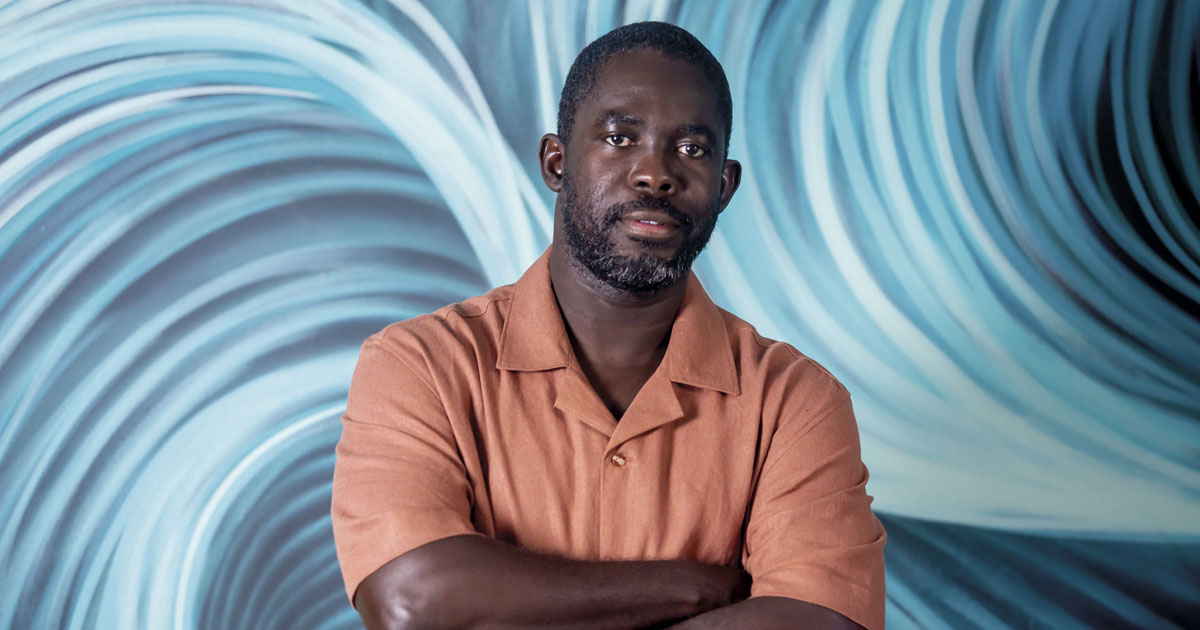
In 2018, Bissau-Guinean sociologist Miguel de Barros was named West Africa’s most influential personality by the Confederation of West African Youth (CWAY), which covers 16 countries. One of them is Guinea-Bissau, a former Portuguese colony around the size of the state of Sergipe that became independent in 1973. Barros was born in 1980 in Bissau, the largest city and capital of Guinea-Bissau, home to half a million people—almost a quarter of the country’s entire population, which comprises 33 ethnic groups. The young nation is one of the poorest in the world, and its economy is based on agriculture. Its biggest export is cashew nuts.
A graduate of the University Institute of Lisbon in Portugal, Barros now works as a researcher at the Amílcar Cabral Center for Social Studies in Bissau. For 12 years he has been executive director of the nongovernmental organization Tiniguena, which protects local biodiversity and helps farmers implement sustainable practices. The sociologist works on a wide range of topics, generally with an emphasis on planning what he considers fairer public policy.
Something he has spoken about repeatedly is the impact climate change is having on Guinea-Bissau, one of the countries most threatened by rising sea levels, as well as on Africa as a whole. The continent contributes the least to global greenhouse gas emissions, but it is also the poorest and most vulnerable to the harmful effects of global warming.
Barros, who has visited Brazil several times, spoke about the topic at the 6th FAPESP Conference in São Paulo at the end of July 2024. Before giving his presentation, he talked to Pesquisa FAPESP.
How is climate change affecting Guinea-Bissau and Africa?
When we talk about climate change, we have to position it not as a cause, but as a consequence of the neocolonial, extractivist model that governs the world. We are talking above all about a system associated with the exploitation of natural resources and labor in the Global South and the privatization of collective assets. Its rationale does not seek equity, much less social justice. The global agenda is built on a completely vertical logic of geostrategic relations; it does not take into account the needs, capabilities, or limits of the model itself. I will give you some concrete examples before addressing the issue of Guinea-Bissau. If you look at the forms of production and consumption, for example, you can see that the Global North has an enormous responsibility in terms of the world’s climate, energy, and food security. Recent data shows that 9 million people die in Africa every year from air and water pollution. That is more than the 6.7 million people who died worldwide during the COVID-19 pandemic. Of the 10 countries that suffer the greatest impact from air and water pollution, seven are in Africa: Chad, Niger, the Central African Republic, Somalia, Lesotho, Burkina Faso, and South Africa. But of the 54 countries in Africa, only 10 have the capacity to monitor climate pollution: South Africa, Egypt, Ghana, Liberia, Mauritius, Morocco, Nigeria, Tanzania, Uganda, and Kenya.
And Africa suffers more from climate change than any other continent?
Exactly. Now, look at the issue from another perspective. When it comes to energy consumption, more than half of Africa’s population—1.5 billion people in total—has no access to electricity. The African population without electricity is larger than the entire population of the European Union. Two European countries—Germany and France—consume nine times more electricity than the entire African continent. And Africa’s pollutive output is residual: it is the least polluting continent on Earth. It contributes no more than 4% of global greenhouse gas emissions, a trend that is expected to continue until 2040. Carbon dioxide [CO2] emissions related to energy production in Africa represent 2% of total global emissions. Although the African continent has the greatest potential in the world for solar energy generation, it has only installed 5 gigawatts [GW] worth of photovoltaic panels, less than 1% of the current global capacity. Despite being home to 17% of the world’s population, Africa currently represents only 4% of global investment in electricity supply.
What economic impact is the climate crisis having on Africa?
At the moment, Africa’s gross domestic product is falling by 11% per year due to climate change. In 2050, it is forecast to reach 27%. We are losing around 2.9% of our arable land per year. In 2050, it will be 18%. This means more than 200 million poor people with no way to grow food and facing hunger, which will lead to forced migration. From Ukraine, people are forced to migrate by plane. From Africa, they have to journey across the Mediterranean on boat crossings, which we see every day. And what is the result? A loss of knowledge associated with production and a loss of labor, especially young people, for agricultural work. Above all, it impoverishes the economic capacity of our countries.
How does Guinea-Bissau fit into this situation?
Guinea-Bissau is the world’s second most vulnerable country to rising sea levels, after Bangladesh. One major problem is the erosion of coastal areas. The sea is eating away at the land in both southern and northern Guinea-Bissau and across West Africa. Erosion has a massive impact on agricultural land, but it is also beginning to affect residential communities, and governments in Africa are not capable of relocating people. This has led to a significant loss of biodiversity and agricultural viability, which affects soil regeneration and income. Guinea-Bissau is completely flat. This allowed people to settle and grow crops in coastal areas. The region was at the heart of the global boom in rice production and consumption. The species Oryza glaberrima [commonly known as African rice] was taken from Guinea-Bissau and Burkina Faso in West Africa to North Carolina in the USA and to Brazil. It was widely consumed in the Portuguese Empire and was spread by enslaved people.
Africa’s gross domestic product is falling by 11% per year due to climate change
Could you explain the natural characteristics of your country in a little more detail?
Guinea-Bissau is located in a hot region called the Sahel, which is near the Sahara Desert and has some very distinctive natural features. It rains in the country for seven months a year, from May to November. I often say that if you were to remove Guinea-Bissau from the map, it would cause an imbalance in West Africa and consequently throughout Africa and the world. Why? Because it has an enormous 350-kilometer Atlantic coastline and the second largest fishing reserve in West Africa, after Mauritania. There are more than 210 varieties of fish in the country’s waters. The meeting of the warm Benguela current and the cold current from the Canary Islands causes a phenomenon known as resurgence [the rising of colder waters, rich in nutrients, to the ocean surface], which means many species visit the region in search of food. We also have the second largest continuous mangrove territory in Africa, after Nigeria. As a result, Guinea-Bissau is the biggest shrimp farming country in West Africa. It is also home to both freshwater and saltwater hippopotamus species and five of the world’s seven species of sea turtles. The country is home to the last area of subtropical rainforest in West Africa: the Cantanhez Forests National Park, which is sacred to the local people.
Sacred in what sense?
There are communities living within protected areas whose ways of life have allowed the conservation of this natural heritage. Scientists saw that animal breeding grounds coincided with areas considered sacred by these communities. So we sacralize sensitive areas that play a fundamental role in animal reproduction. Protected areas represent the best way of responding to climate issues, because they allow natural life to occur and perform its functions without disturbance. At the same time, it also ensures that food is available to inhabitants and improves air quality. That is why 26.3% of Guinea-Bissau’s territory is protected.
China is investing heavily in Africa. Is the Asian country’s presence also felt in Guinea-Bissau?
Yes. They are major players in the timber and fishing industries. We have the French in oil and tourism, the European Union in fishing. Local governments think in the short term and the calculation of cost and benefit often does not correspond to the country’s capacity to withstand the impact in terms of exploitation. There are no longer any primary forests in the north of the country because of Chinese exploitation. But what does China give Africa in return? Infrastructure—albeit unreliable—such as the construction of palaces, conference centers, universities, roads. These relationships are extremely unequal.
What other climate-related problems would you highlight?
There is the issue of droughts, which have a major impact on livestock farming and are forcing communities to migrate. There is also population growth in cities, which is now a cross-sectional issue in Africa. It puts pressure on coastal areas, which have greater access to the resources that allow the people to live. Above all, this pressure also results in the generation of large amounts of garbage, which is then discarded into the sea. The biggest problem with garbage, however, is not what we produce, but what arrives on our shores from the Global North.
Are the international mechanisms created to fund forest conservation in Africa working?
Carbon taxes are hypocritical. Most of the money goes to certification agencies in the Global North that operate on the basis of speculation in the financial market. Nobody eats shares. People eat food. Major investment is needed in family farming, to produce healthy foods that are part of people’s cultural heritage and come from near where people live. This is how you provide nutritional security.
How is the climate crisis perceived by the African population?
That is a question that comes from a very elitist perspective. In Africa, people do not care about the issue of the ozone layer. We seek a more instrumental understanding of what climate change is, what happens to our soil, to our farms, to our vegetable gardens. People want to know how to put food on the table when they are unable to grow it after three consecutive cycles of floods. Southern Angola, for example, has suffered seven consecutive years of severe drought. When family farmers and rural families began to perceive the impact of these transformations on their diet and on their economic system, Africa began to take notice.

Erikson Mendonça / Tiniguena & Sofia Conde / Malmon 2022A field during the rainy season and village threatened by rising sea levels, both in northern Guinea-BissauErikson Mendonça / Tiniguena & Sofia Conde / Malmon 2022
When would you say that this perception occurred, roughly?
In the last 10 years or so. Today there is a strong movement among Africans. They saw that they were losing their genetic heritage, their lands, the ability to feed their families and finance their economy. They made an effort to understand why this was happening and their reaction was direct. The speed at which agricultural land is being lost in Africa is brutal—it has a huge impact.
What is Brazil’s role in climate and environmental issues?
I don’t like to analyze this issue from the perspective of Brazil’s macroeconomic data, such as its capacity to export raw materials or the size of its consumer market. I don’t see it that way. In my view, Brazil has four responsibilities. The first is ecological. Brazil is fortunate to be home to the greatest gift nature has given the world: the Amazon. And it is responsible for preserving it so that the world remains habitable. The country must ensure that the Amazon is a heritage not only for the world, but first and foremost, for Brazilians themselves, especially for the Indigenous peoples who inhabit the region. It must set an example of conservation and use based on nature, fostering a culture of protecting the ecological transition. The second responsibility is historical. Brazil as a society was a victim of colonization, developed based on slave labor. It must now ensure that the colonial system of labor exploitation also ends. This means creating ways to regulate labor relations, to make them more humane and set an example for the world. The country must not think that its economy will prosper through the exploitation of Indigenous peoples, Black people, and women.
What are the other two responsibilities you attribute to Brazil?
The third is demographic. Brazil has one of the largest populations in the world. The country needs to create forms of education that give its citizens the opportunity to contribute to environmental conservation, the assessment and preservation of civil rights, and a fair and supportive economy. The fourth is political responsibility. Brazil must not run the risk of electing regimes like the one it had until recently. A regime that was out of touch with contemporary challenges, that was populist, misogynistic, racist, and made innovation and social technology obsolete.
But what is the country’s role?
As soon as it assumes these four responsibilities—environmental, historical, demographic, and political—Brazil will have the potential to influence the construction of a new world order. It would be able to influence Russia, China, and India, for example, encouraging them to also adopt behaviors and practices that favor popular democracy instead of new forms of neocolonialism and imperialism, which is the emerging international stance of these countries. Brazil, which is the largest food producer in the world, therefore has an enormous responsibility in this sense.
What topics does your research cover?
I do research at the Amílcar Cabral Center for Social Studies in Bissau, where I am head of the history, anthropology, and sociology unit. My research involves a wide range of topics, from issues related to international cooperation and transparency in the governance of natural resources and public finances, to youth and gender issues relating to the informal economy, political participation, and food security. I have also been looking at the issue of environmental racism a lot lately. When production or exploitation in a territory jeopardizes the