According to an analysis by IPEA, the percentage of people of color leading research teams rose from 8.1% to 22.6% between 2000 and 2023
Emerson Rocha / A flecha que aponta o caminho (2024)
The proportion of Black and mixed-race researchers leading research groups in Brazil nearly tripled between 2000 and 2023: rising from 8.1% to 22.6% of the total, accounting for nearly 15,000 of the country’s 66,000 leaders. The analysis was done by researchers from the Institute of Applied Economic Research (IPEA) and the Federal Institute of North Minas Gerais (IFNMG), based on a recent census by the Directory of Research Groups (DPG) of the Brazilian National Council for Scientific and Technological Development (CNPq). “There was significant growth, but there is still a large underrepresentation of Black and mixed-race individuals coordinating research groups in all regions and areas of knowledge,” evaluates economist Tulio Chiarini, from IPEA, one of the authors of the study. According to the 2022 Demographic Census by the Brazilian Institute of Geography and Statistics (IBGE), the Black population—which includes Black and mixed-race individuals—represents 55.5% of Brazil’s total population.
Even in regions of Brazil where a majority of the population is Black, such as the North (76% of the population), the Northeast (72.6%), and the Midwest (61.6%), the share of leaders who self-identify as Black or mixed-race remains below their proportion in the general population (44.4%, 37.7%, and 24.2%, respectively). In the Southeast and South, regions with a lower percentage of Black individuals (49.3% and 26.7% of inhabitants, respectively), only 15.1% and 7.8% of the coordinators of research groups self-identify as Black or mixed-race. The number of groups with at least one Black researcher—leader or otherwise—also increased: from 48.6% in 2000 to 89.6% in 2023 (the same researcher can be in more than one group). “But structural barriers persist that block access to leadership positions,” observes Chiarini.
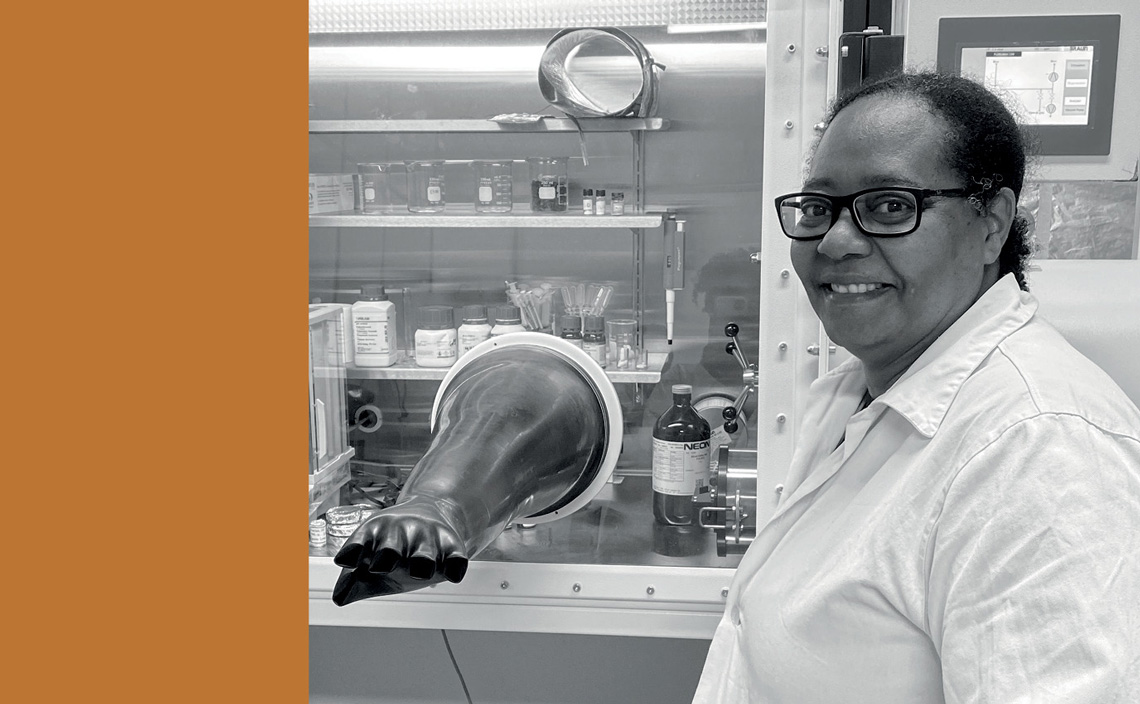
Physicist Zélia Maria da Costa Ludwig, from the Federal University of Juiz de Fora (UFJF), reports that it was a major challenge to create the Synthesis and Characterization of Nanostructured Materials Group in 2008, which she leads. She works with quantum dots—semiconductor nanocrystals with optical properties, used in sensors and solar cells—and is among the 4.4% of Black women who coordinate groups in the field of physics. “As a Black woman, it took years to secure funding and build a basic infrastructure for experimental research,” says the researcher, who established connections and partnerships with other groups as a way to develop her research. “I had a privileged trajectory with a support network and access to opportunities. I was able to study, travel, and learn English, but this is not the reality for most Black girls,” she adds. She criticizes the low number of productivity-based grants in the CNPq, according to data from 2023 compiled by the Parent in Science group. “Of all the scholarship beneficiaries, only 0.8% are Black women and 4.8% are mixed-race women. Reaching the top requires a lot.”
Alexandre Affonso / Pesquisa FAPESP
The survey by IPEA did not analyze the reasons for increased participation by Black and mixed-race individuals in research groups, but the authors are working with a set of hypotheses. “We imagine that some public policies from recent years were fundamental,” says Chiarini. One action that appears to have contributed was the Support Program for the Restructuring and Expansion Plans of Federal Universities (REUNI), established in 2007, which almost doubled the number of places for students in federal institutions and led to the hiring of around 20,000 new professors. “With the opening of faculty positions, opportunities emerged for the inclusion of Black and mixed-race individuals, especially in regions where they are more strongly represented within the population,” explains the economist. Between 2000 and 2023, the number of Black and mixed-race leaders in the Northeast rose from 22.3% to 37.7%. In the Midwest, the increase went from 10.2% to 24.2%. In the North, from 33% to 44.4%.
According to Chiarini, the Quota Law, which established reserved places for Black, mixed-race, and Indigenous individuals in federal higher education institutions starting in 2012, may also have contributed. However, its results are expected to become apparent over the next few years, when those who benefited from affirmative action policies during their undergraduate studies begin to progress in their scientific careers. For physicist Débora Menezes, director of Analysis of Results and Digital Solutions of CNPq, who did not participate in the research, the effects of these public policies are becoming more evident.
Between 2005 and 2025, the proportion of mixed-race individuals receiving scientific initiation, master’s, and PhD grants from CNPq increased from 14.1% to 27.5%, 13.9% to 26.6%, and 13.2% to 26%, respectively. Among those who self-identified as Black, over the same period, the share of CNPq scientific initiation, master’s, and PhD grant recipients rose from 2.9% to 8.8%, 2.9% to 10.7%, and 2.8% to 9.5%, respectively.
Personal archiveZélia Ludwig is among the 4.4% of Black women who lead research groups in the field of physicsPersonal archive
Affirmative action policies may also have encouraged Black and mixed-race individuals to publicly self-identify this way. “Today, it is more common for people to self-identify as Black, but historically, the Brazilian population has struggled with this recognition,” observes social scientist Carla Pereira Silva, from IFNMG, one of the authors of the study. In her assessment, one of the effects of the quota policies has been to prompt individuals to reflect on their racial identity. “This experience was well described by Brazilian psychiatrist Neusa Santos Souza [1948–2008], with the concept of ‘becoming Black,’ which addresses this process of racial consciousness.” Menezes, from CNPq, confirms that the profile of racial self-identification data in the Directory of Research Groups has undergone a change. “The number of people who previously selected ‘not declared’ has decreased, while the number of people self-identifying as mixed-race has increased.”
In 2000, Black men accounted for 4.9% of all research group leaders, while Black women accounted for 3.2%. By 2023, those figures had risen to 12.2% and 10.4%, respectively. In life sciences, the fields of nursing, pharmacy, and public health continue to be the areas with the highest presence of Black women (with 19.8%, 12.3%, and 18.4%, respectively). In medicine, Black men went from 2.4% to 7% in the period and Black women from 1.4% to 9.2%. However, in the physical sciences, the presence of Black and mixed-race men increased more markedly in areas such as computer science (from 4.9% to 17.3%) and nuclear engineering (from 4.8% to 15.4%). Black women have increased their presence but still do not exceed 12% in any field—there are still none in leadership positions in aerospace and naval engineering. In the humanities, they lead in areas such as home economics (33.3%) and social work (25.7%).
“The number of women participating in research groups has grown in all regions, but this growth is only modestly reflected in leadership positions,” highlights Silva. The social scientist, besides being a coauthor of the study, is among the 15.7% of Black women who coordinated research groups in the field of sociology in Brazil in 2023 (White women accounted for 25.7%). She leads the group Ponto de Vista: Sociology of Knowledge Studies, at IFNMG, created in 2019. “I’m the leader because I created the group. But, throughout our careers, we are always dealing with systemic racism.” She says that, recently, she has noticed a greater appreciation of her perspective as a Black female researcher. “With the creation of diversity policies at some institutions, more opportunities have emerged.”
Alexandre Affonso / Pesquisa FAPESP
Physicist Antonio Carlos Fontes dos Santos, one of the coordinators of the Atomic and Molecular Collisions Laboratory of the Institute of Physics at the Federal University of Rio de Janeiro (UFRJ), notes that obstacles usually appear early on in the academic careers of Black and mixed-race individuals. “At the beginning it is necessary to live off grants. For a young Black researcher, who is generally not from a middle class background, reality kicks in, and many end up giving up in order to fund themselves by other means,” he says.
Another major issue, he affirms, is prejudice. “We constantly have to prove that we are capable and deserve to be there.” In December 2017, Santos published an article in the journal The Physics Teacher titled “You Don’t Look Like a Physicist,” drawing attention to the stereotypes, discrimination, and prejudices faced by Black people in academia. He cites phrases that he has heard throughout his career: “You don’t look like a physicist;” “Oh, so you’re a university professor? But you’re a substitute, right?” “Okay, you’re a professor, but do you do research?”
Antonio Scarpinetti / SEC UNICAMP Débora Jeffrey is the first Black woman to lead a research, teaching, and outreach unit at UNICAMPAntonio Scarpinetti / SEC UNICAMP
“The growth of both male and female Black researchers represents progress, but it is still far from where it should be in academia,” says pedagogue Débora Cristina Jeffrey, director of the School of Education at the University of Campinas (UNICAMP) since 2024. She was the first Black woman to hold a leadership role in a research, teaching, and outreach unit in the history of the university.
Jeffrey is among the 16.3% of Black women who led a research group in the field of education (as opposed to 40.9% of White women) in 2023. Since 2014, she has coordinated the Study and Research Group on Educational Policy and Assessment (GEPALE). As a faculty member at UNICAMP, she says she has faced institutional resistance to obtain a room for her group.
“We started in a tiny space. They promised us another, but gave it to other groups, claiming they had lost our request,” she reports. Today, the group is in a new temporary space and should move soon to a new permanent room. “Even so, we have become a safe haven for Black students. Those who don’t have a computer, for example, can use our facilities,” she says.
This year, the group began a study on affirmative action policies at the federal and state levels, funded by CNPq. “With the advance of quotas and the greater presence of Black students and faculty members, we want to understand how these policies have actually been implemented in the institutions. Is there effective management in the Associate Dean’s Offices for Research? Is there dialogue with the funding agencies?” she asks. For her, the progress highlighted in the IPEA study poses the challenge of creating funding access policies aimed at Black and mixed-race researchers.
The story above was published with the title “More Black leadership” in issue 353 of July/2025.
This article may be republished online under the CC-BY-NC-ND Creative Commons license. The Pesquisa FAPESP Digital Content Republishing Policy, specified here, must be followed. In summary, the text must not be edited and the author(s) and source (Pesquisa FAPESP) must be credited. Using the HTML button will ensure that these standards are followed. If reproducing only the text, please consult the Digital Republishing Policy.