In a cassava field in the village of Ulupuwene, located in Alto Xingu, Mato Grosso State, an elder of the Wauja people pushes cuttings of different varieties of cassava into the ground, all of which are near one another. Each cutting sprouts leaves and roots. As they grow into bushy shrubs, the plants interbreed with each other. This cultivation technique stimulates the seed production of new varieties, preventing the genetic impoverishment typical of cloned plants, according to a study published in the journal Science in March.
“Cassava was domesticated by indigenous peoples approximately 6,000 years ago on the southern border of the Amazon, which today corresponds to the states of Rondônia and Mato Grosso,” says ethnobiologist Fábio Oliveira Freitas of the Genetic Resources and Biotechnology division at the Brazilian Agricultural Research Corporation (EMBRAPA), who led a team of researchers from eight countries. The cassava plant became so central to the diet that it was spread in the form of cuttings long before the colonial period through exchanges between neighboring communities ranging from the southern United States to the southern end of South America.
The scientists arrived at this conclusion after analyzing the genomes of 282 cassava samples—both domesticated (Manihot esculenta) and wild (Manihot flabellifolia)—collected from living collections at research institutions or traditional farms, in addition to DNA extracted from herbarium collections and artifacts found at archaeological sites. They also used DNA data from 291 samples used in previous studies, analyzing a total of 573 genomes.
“Many traditional farmers, indigenous or not, identify the plants that sprout from seeds and let them grow,” says Freitas. If the plants have the qualities the farmers are looking for—such as a larger tuberous root or a higher starch content—they start using them as a source of cuttings, which form clones identical to the mother plant. According to Freitas, the shrub can also crossbreed with wild species found near the farms, increasing variability in the genome.
“As a result of cloning, all cassava plants in the Americas have the same genetic markers of kinship, as if they were siblings,” says British biologist Robin Allaby of the University of Warwick, UK, one of the authors of the article. In a conversation with Pesquisa FAPESP, he highlighted that the pattern differs from that of crops such as corn, which form distinct lineages.
“The study involved a comprehensive genetic analysis of cassava, confirming genetic patterns that were observed in other more limited studies,” says Nivaldo Peroni, an ethnobiologist from the Federal University of Santa Catarina (UFSC), who did not participate in the research. “However, it could have placed a greater emphasis on the important role that non-indigenous traditional communities played in generating diversity—not only in the Amazon, but elsewhere in Brazil and the Americas.”
According to Peroni, there are more than 7,000 varieties of cassava, created by communities with their own preferences when plants are selected. Researchers have studied the origin and circulation of varieties in traditional Brazilian communities and highlight that farmers of Azorean origin living on the Atlantic coast in the central–south region of the country, such as in the state of Santa Catarina, learned how to cultivate cassava from local indigenous peoples.
“In the south, extremely white varieties predominate, reflecting the desire to produce something similar to European wheat flour,” adds Peroni. On the coast of the state of São Paulo, he found more than 50 varieties in the municipality of Cananéia and more than 30 in Ubatuba, each with their own characteristics. Many of these varieties were generated from sprouting seeds in the farms and gardens of caiçara communities.
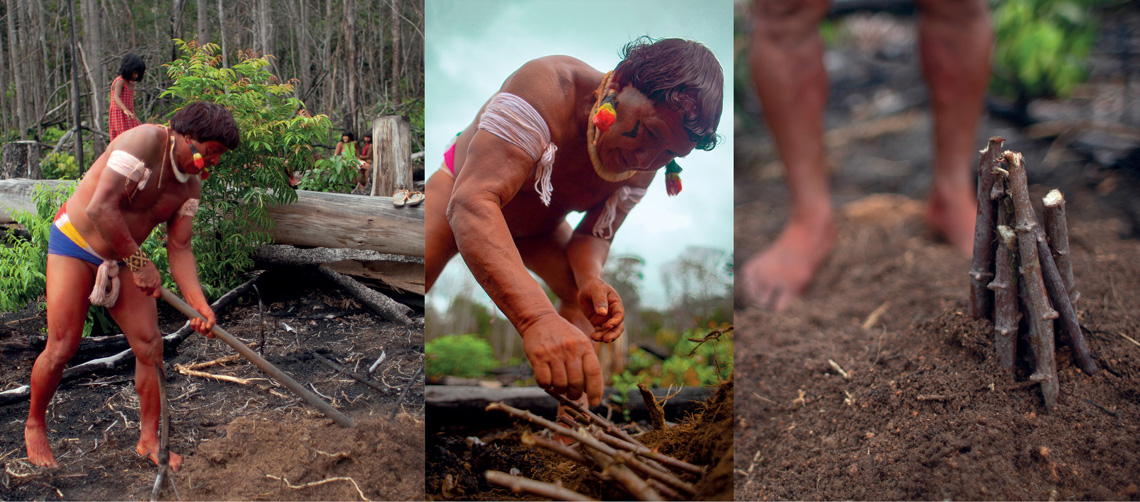
Celso VivianiElder Kuratu Wauja builds a Kukurro house by planting cassava cuttings.Celso Viviani
Because cassava is rich in nutrients and easy to reproduce and transport, the tuber has become one of the main food items for indigenous people and is part of the diet of one billion people worldwide, according to the UN Food and Agriculture Organization (FAO).
Freitas and Allaby visited the village of Ulupuwene several times between 2018 and 2023 to investigate traditional cassava farming methods, collect samples of different varieties, and interview residents. “It is a unique technique, mastered by just a few families,” says Freitas, who has been studying Wauja agriculture since 1997.
After preparing the land, the indigenous people form mounds of loose earth to make it easier to harvest the tubers later and then stick cuttings into the mounds. These cuttings represent elements of a cassava farming legend: they call the set of branches a Kukurro house, in honor of their caterpillar god, who eats cassava leaves. They believe that the plant’s growth is strengthened by ritual chants to Kukurro. The seeds formed by this mixture of plants are important sources of genetic variety and usually remain dormant until germination is stimulated the following year by fires used to clear the land before crop planting.
“Women play a crucial role in this process,” explains UFSC biologist Carolina Levis, who did not participate in the study. “They are usually the ones responsible for taking care of the crops. They are curious and let new plants grow, observing their characteristics.”
“The Wauja are very selective,” adds Freitas. “They chose four varieties that originated from seeds during our visits but discarded them all after deciding that they did not have any new characteristics.” If a new plant is approved, they name it and incorporate it into the village’s live collection.
The video Casa de Kukurro (Kukurro house), produced by EMBRAPA in 2019 and available on YouTube, shows the ritual that accompanies the planting process. The Wauja are not concerned with the caterpillars that eat the cassava leaves: in the village’s mythology, it is Kukurro who feeds and takes care of the plants. Seedlings that grow from seeds are called kukurromalacati and are considered plants that fall from the sky.
“We identified 19 varieties of bitter cassava in Ulupuwene,” says Allaby. According to researchers, unlike sweet cassava varieties, bitter tubers can be lethal if not properly processed to eliminate the hydrocyanic acid, which is toxic. “You need to peel the root, grate and press the pulp, boil it to evaporate the hydrocyanic acid, and then put the cassava starch in the sun to dry,” says Freitas. The starch is used to make biju, the main component of the Wauja diet, alongside fish.
When women marry, they often take their family’s plant collection with them when they move to live with their husband and then continue to exchange plants with relatives when they return to visit. “Marriage can be interethnic and can involve great distances, increasing the circulation of cuttings,” adds Levis.
“The study shows how important small-scale agriculture is to food security,” says Allaby. He points out that of the 20 varieties of banana that exist in Brazil, only the nanica—which is genetically deteriorating and could disappear in a matter of decades—can withstand being transported to Europe by ship. “Indigenous people know much more about cassava farming than we do,” he acknowledges. According to him, the Kukurro house is a technique that can help genetically rejuvenate the diversity of cassava and other plants, representing an important example of how academic science can benefit from exchanges with the science of indigenous and traditional peoples.
Scientific article
KISTLER, L. et al. Historic manioc genomes illuminate maintenance of diversity under long-lived clonal cultivation. Science. Vol. 387, no. 6738. mar. 7, 2025.