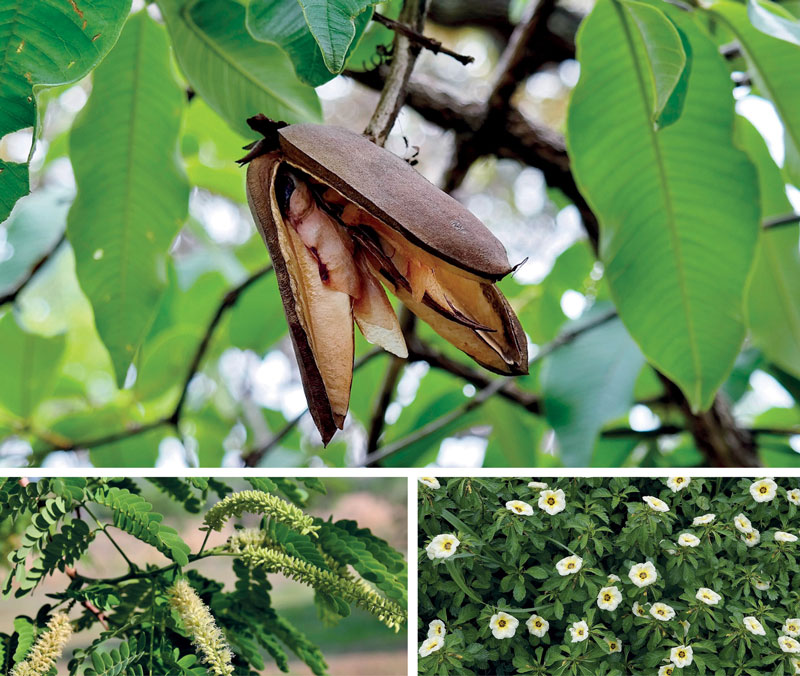
Mauricio Mercadant / FLICKR | Vengolis / Wikimedia CommonsQualea grandiflora (above), Plathymenia reticulata (far left), and Turnera subulata feed ants, which help keep away leaf-eating insectsMauricio Mercadant / FLICKR | Vengolis / Wikimedia Commons
Two trees (Qualea grandiflora and Plathymenia reticulata) and a shrub (Turnera subulata) were highlighted in a national survey of extrafloral nectaries: glands that produce nectar in leaves, fruits, or flower bases, fed on primarily by ants and other insects. The three species produce high amounts of nectar outside their flowers, as well as linking different biomes and increasing the integration of plant communities. Biologists from the Goiano Federal Institute of Education, Science, and Technology, Urutaí campus, and the Federal University of Uberlândia, Minas Gerais, identified 249 species from 47 botanical families with extrafloral nectaries in the Cerrado (92 species), Amazon (82), Caatinga (39), Atlantic Forest (34), and Pampas (2); only 13 species were observed in more than one biome. The small nectar sacs attract insects, such as ants, which in turn ward off herbivores that could feed not only on the leaves, but also on various other parts of the plants. “The results of this research reveal Brazil as one of the countries with the greatest biodiversity of plants with extrafloral nectaries in the world, presenting several possibilities for understanding the evolution and relationships between plant and insect species,” says Estevão Alves da Silva of the Goiano Institute, one of the authors of the resulting article (Flora, February).
Republish