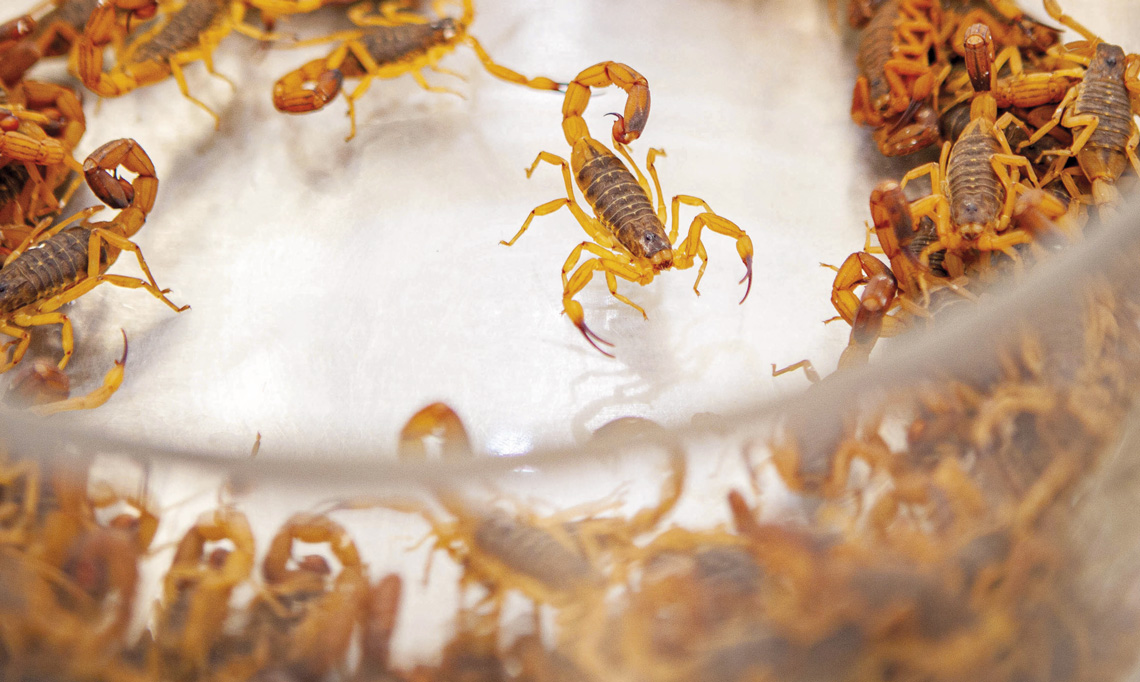
In mid-May, residents of São Paulo’s mid-upper class neighborhood of Perdizes, not used to encounters with scorpions, were alarmed by news of several accidents involving the arachnids. Scorpions are more frequently found in the city’s poorer peripheral areas, although they do occasionally appear in more central neighborhoods. Despite the initial scare, there are so far no signs that the São Paulo state capital is facing an invasion of the animals, which can enter houses and apartments through unprotected electrical conduits or water and sewage pipes. The São Paulo State Health Department’s dashboard on accidents involving venomous animals shows there have been 161 scorpion stings in the city as of June 2025, compared to 426 in the entire previous year and 451 in 2023 (see graph below). Over a longer time period, however, there has been a significant increase in recent decades in the total number of stings in the state capital, in the interior of the state, and nationwide.
“In the past, you never heard of people being stung inside their homes. Now, it happens frequently. I myself have found scorpions in my house,” says biomedical scientist Manuela Pucca, a professor at the School of Pharmaceutical Sciences at São Paulo State University (UNESP), Araraquara campus, where she lives. Pucca is the lead author of an article published in the journal Frontiers in Public Health in May that shows the number of stings that occurred in different regions of Brazil between 2014 and 2023. The total number nationwide grew by 154% in the period. According to Ministry of Health data made available at the time the paper was written, the figure jumped from 67,000 in 2014 to 170,600 in 2023.

The highest number of stings occurred in the two most populous regions of Brazil—the Southeast, home to 84.8 million people, and the Northeast, with 54.6 million. In 2023, 84,500 and 57,600 cases were recorded in each region respectively, approximately one for every 1,000 inhabitants. With 30.2 million residents, the South region is proportionally the least affected, with one sting for every 4,000 people. Scientists suspect that the officially recorded numbers are likely only the visible part of a silent epidemic, since adults, when stung, do not usually seek health services (responsible for mandatory reporting), choosing to take care of themselves at home instead. “Scorpion stings are a neglected problem within the neglected diseases,” says Pucca.
With a slightly alarmist title that suggests Brazilian cities are being taken over by scorpions, the study also provides a projection of what could happen if nothing is done to change the conditions that are allowing the animals to proliferate. The total number of stings per year is forecast to continue to rise, reaching 274,300 cases in 2033 (see graph below). “Although the historical data are known, the projection exposes the problem very clearly,” says biologist Gabriel Murayama of the Laboratory of Sensory Ecology and Arachnid Behavior (LESCA) at the University of São Paulo (USP), who is researching chemical and biological scorpion-control methods but did not participate in the study.

In the Frontiers in Public Health article, Pucca and five colleagues listed some of the reasons behind the increase in scorpion incidents, which included fast and unplanned urban growth (particularly in regions lacking in infrastructure); inadequate treatment and disposal of waste; a lack of basic sanitation; an absence of regular control actions in cities; and the occurrence of hotter summers and periods of heavy rain alternating with intense droughts, driven by climate change. “The increase in stings can also be partly attributed to the expansion and improvement of surveillance and reporting systems, especially in municipalities that have begun reporting data more systematically and regularly in recent years,” says the researcher.
The yellow scorpion (Tityus serrulatus) and the northeastern yellow scorpion (T. stigmurus) are spreading across different regions of the country, possibly transported in the packaging of various goods. Native to regions with hot, dry climates, the two species have adapted to life in cities, where they easily establish new populations and appear to withstand the cold well. “In recent years, there have even been reports of accidents involving them in places with colder climates, such as Santa Catarina and Rio Grande do Sul,” says Rogério Bertani, lead author of an article published in the journal Bioinvasions Records in 2018, in which he described the 2012 arrival of T. stigmurus in the city of São Paulo, probably brought in fruit boxes.
The two scorpion species are considered invasive in some states. In São Paulo, they seem to have replaced the brown scorpion (T. bahiensis), which lives in wetter environments near forests and was the most common in the city until the 1960s. In the Atlas escorpiônico de São Paulo (Scorpion atlas of São Paulo), published in 2024, biologist Sergio Cominato Ferraz of the city’s Zoonosis Control Center and epidemiologist Francisco Chiaravalloti Neto of the USP School of Public Health reported that between 2013 and 2018, the yellow scorpion had been observed in 89 of the capital’s 96 administrative districts, while the northeastern yellow scorpion had been found in 64 and the brown scorpion in just four.

Rafael Simões / Butantan Institute Communications Fluorescent compound in the exoskeleton makes scorpions glow when illuminated by black lightRafael Simões / Butantan Institute Communications
Scorpions were among the first animals to occupy dry land. Paleontological records indicate that the first specimens appeared around 435 million years ago, when the world’s continents were grouped into the supercontinent known as Gondwana. Of the approximately 2,500 species described worldwide, approximately 170 are found in Brazil. Four of them are considered to be of medical interest due to the serious health impacts they can cause: the three mentioned above and the Amazonian black scorpion (T. obscurus).
Scorpions have four pairs of legs, a pair of pincers, and a stinger at the end of their tail through which they inject venom, but they are smaller than most people think. Individuals of the first three species reach up to 7 centimeters (cm) in length, while the largest of them, the Amazonian black scorpion, can grow to 12 cm. “Scorpions are synanthropic animals, meaning they live near humans because they have adapted well to the urban environment, primarily because it provides water, food, shelter, and access,” biologist Denise Maria Candido of the Arthropod Bioterium at the Butantan Institute told the Agência de Notícias do Estado de S. Paulo news agency in February this year. “Thanks to these four conditions, they end up moving in, reproducing, and proliferating,” she said.
In Brazil, the most serious cases are associated with the yellow scorpion. With light yellow legs and tail and a darker body, the species is found in almost every state. One of the characteristics that helps it proliferate so easily is that it can reproduce asexually through parthenogenesis, when the egg produces another individual without needing to be fertilized—males are rare and in some places nonexistent.
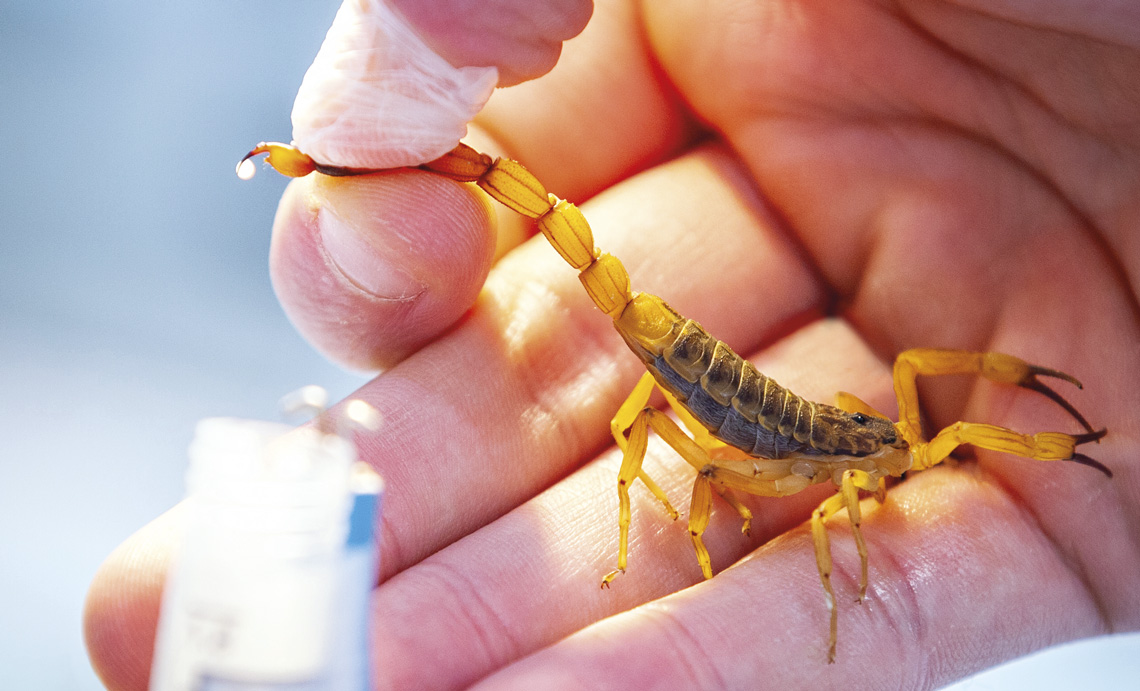
Rafael Simões / Butantan Institute Communications Extraction of venom for the production of anti-scorpion-venom serumRafael Simões / Butantan Institute Communications
The toxic compounds injected in the sting often cause local symptoms, such as pain, burning, tingling, and swelling, and systemic problems, such as headache, nausea, salivation, drowsiness, accelerated heart rate, body temperature drop or increase, and muscle spasms. More severe cases can result in shortness of breath, a significant drop in blood pressure, impaired blood circulation and lack of blood supply to organs, and even death.
In the event of being stung, victims are advised to seek emergency medical attention as quickly as possible; although the death rate is low, some cases require hospitalization. A 2019 letter published in the journal Revista Brasileira de Medicina Tropical by researchers from USP and the Butantan Institute, including Bertani, warned that 80% of deaths occur within 48 hours of a sting and that the chance of death depends on age.
Children are most likely to die. Among children under the age of 10, there are 32 deaths for every 10,000 stings, more than three times higher than the rate observed in adolescents and adults (9 per 10,000).
Because their bodies are smaller and heart rates naturally higher than adults’, the scorpion’s toxins reach their central nervous system faster. “The symptoms are generally more severe in children because the blood-brain barrier, a structure that protects the brain and regulates the transfer of substances between the blood and the central nervous system, is not yet mature,” says Eliane Candiani Arantes, a pharmacist and biochemist from USP’s Ribeirão Preto School of Pharmaceutical Sciences (FCFRP), coauthor of the paper published in Frontiers in Public Health. “Neurotoxins can therefore reach the nervous system very quickly and cause cerebral edema,” she explains.
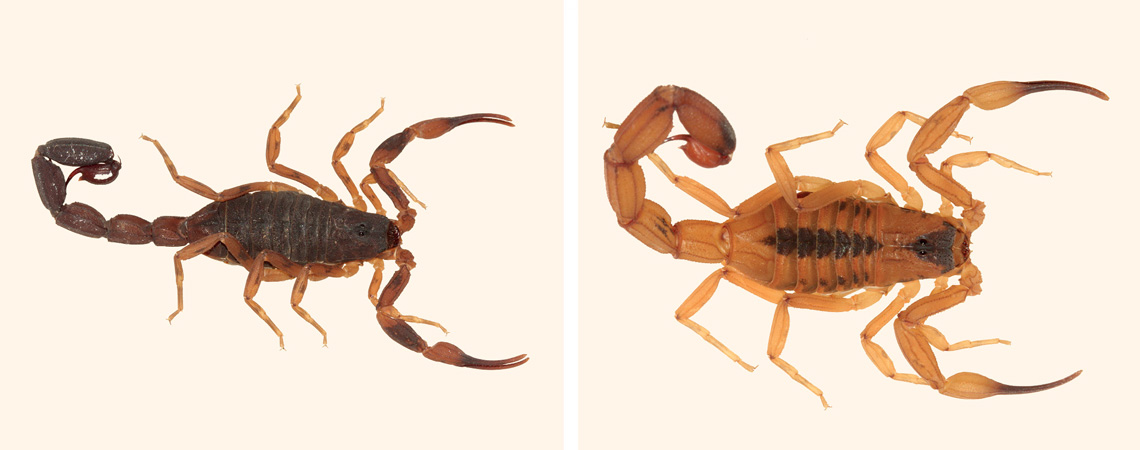
Rogerio Bertani / Butantan InstituteThe brown Scorpion (T. bahiensis), with a dark brown body, and the northeastern yellow scorpion (T. stigmurus), with a dark marking on its backRogerio Bertani / Butantan Institute
Not seeking care for children quickly enough increases the likelihood of hospitalization to deal with the changes in their bodies, according to an article published in the journal Toxicon in April. In the study, a group led by pharmacist Edmarlon Girotto of the State University of Londrina (UEL) monitored the progress of 450 children aged under 12 who were stung by scorpions and treated at the Toxicological Information and Care Center (CIATOX) at the university’s hospital between 2017 and 2022. Of these cases, 11% needed to receive anti-scorpion-venom serum and 8.4% had to be admitted to hospital. They were 11 times more likely to be hospitalized when the sting was inflicted by a yellow scorpion and 2.5 times more likely if they waited more than three hours before seeking treatment.
The toxins, the authors write, cause changes to the circulation of sodium, potassium, and calcium ions in the cells of the nervous system, leading to what experts call an autonomic storm. The parasympathetic nervous system, which usually slows the heart rate and lowers blood pressure, is temporarily stimulated, followed by prolonged activation of the sympathetic nervous system, which is responsible for activating fight-or-flight responses and increasing heartbeat speed and intensity and blood pressure, in addition to facilitating breathing. “An autonomic storm makes fast treatment difficult because the patient may arrive at hospital with hypotension and then suddenly develop hypertension,” says Arantes, from FCFRP-USP.
Adults are not immune to the effects of the toxins and can also experience severe reactions, especially if they are elderly or have existing health problems. “Stings can be deadly to people with heart and lung problems because the main causes of death are heart problems and pulmonary edema [accumulation of fluid in the alveoli],” explains Arantes.
Anti-scorpion-venom serum produced at Butantan, São Paulo, and the Ezequiel Dias Foundation, Minas Gerais, is used to treat stings by the four species of the genus Tityus. It is only kept in stock at some emergency departments and major hospitals. The Ministry of Health provides a list of the major hospitals that treat accidents involving venomous animals in each city.

Butantan Institute CommunicationsAnti-scorpion-venom serum being packaged at the Butantan InstituteButantan Institute Communications
The serum is only indicated for severe cases because it can cause allergic reactions—although they are usually mild and can be managed with appropriate medication. These reactions occur because the serum is produced by injecting the scorpion venom into the blood of horses, then later collecting the blood and filtering the plasma (the liquid part) to extract antibodies for the scorpion toxins. “Horse antibodies are not the same as human antibodies and are often recognized as foreign bodies in humans. When injected into humans, they can cause allergic reactions and even anaphylactic shock,” explains Pucca, who is trying to produce a serum using biotechnology in a lab, without horses.
Scorpions are predatory animals—they generally hunt insects, spiders, and other arthropods—and are most active at night. In nature, they hide among leaves, in the bark of trees, under stones or fallen branches, and in rock crevices or burrows. In cities, they are found in vacant lots, storm drains, gardens, and cemeteries. There are no effective chemical products on the market for scorpion control and little is known about the natural enemies of the species found in Brazil. “Studies urgently need to be carried out to test control methods,” says USP’s Murayama.
The best way to avoid the unwanted presence of scorpions is to keep houses and surrounding areas free of garbage and clutter, which can serve as shelter and a food source, and to seal cracks, doors, windows, drains, and plug sockets—they can enter through the plumbing or electrical conduits (see chart below). To avoid being stung, gloves and shoes should be worn when working outside or gardening. Shaking out clothes and inspecting the inside of shoes before putting them on is also advised. Scorpions do not generally attack humans. According to experts, their instinct when threatened is to flee. They usually only sting people when touched or stepped on. If you find one, do not try to pick it up, even if wearing gloves. Contact your city’s Animal Control Center (in the city of São Paulo, call 156, followed by option 2 and then option 3).