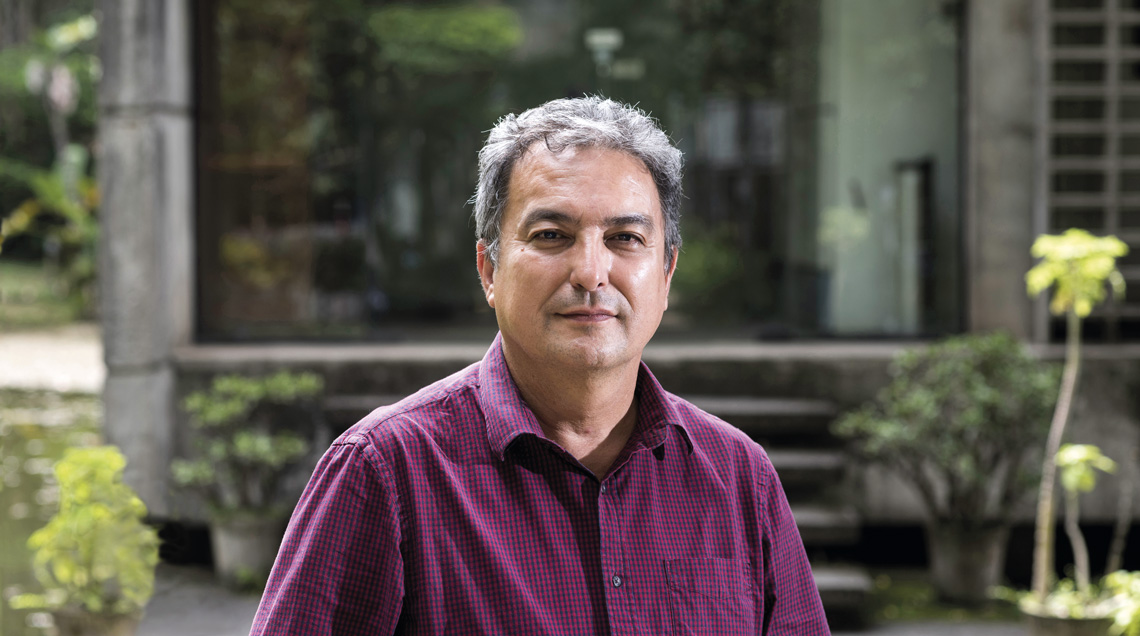
I was born in São Paulo, but from the age of 6 to 15 I lived in Santo Antônio do Jardim, a small town in the interior of São Paulo State, on the border with Minas Gerais. I lived in close contact with nature there, an experience that was crucial to my decision to become a biologist. As a child, when people asked me what I wanted to be when I grew up, I would say that I wanted to work with plants or rocks. One day, my father said to me, “To work with plants, you have to be an agronomist, a biologist, or a forestry engineer. For rocks, a geologist.” I started studying biological sciences at UNESP [São Paulo State University], Rio Claro campus, in 1985.
In my first semester, I was chosen to participate in a trip to Germany funded by an NGO [nongovernmental organization] that took students from developing nations to spend a month there. We did a tour of several cities, we got to know a bit about the local culture, and we learned about the work of German philosophers. I was captivated by the subject, so when I got back to Brazil, I decided to switch from my biology course to philosophy.
I studied philosophy for two years, from 1986 to 1987, at the Santa Maria Franciscan University of Rio Grande do Sul. It was an important experience because it opened my mind to the humanities. I studied Greek and Latin, two of the foundational languages of Western culture. However, I dropped out halfway through the course because I realized that what I really wanted to do was biology.
So I applied again and was accepted onto the biological sciences course at the University of São Paulo [USP]. In the second semester, I took part in a field trip to the Serra do Cipó mountains in Minas Gerais. We traveled 11 hours by minibus and arrived late at night. The next morning, I opened my bedroom window and saw the rocky landscape and the plants, exactly what had fascinated me as a child. In that moment, I knew for sure that this was what I wanted to do for the rest of my life.
Rupestrian grasslands are found in areas of Brazil above 900 meters in altitude, interspersed with rocky outcrops. These environments are home to everlasting plants, which are the object of my studies to this day. The name comes from the fact that the plants maintain a vivid appearance even after being harvested. The best-known are the comanthera, common in the Espinhaço mountain range [in Minas Gerais], and Syngonanthus nitens, known locally as golden grass, found in the Jalapão region of Tocantins. These plants are of commercial interest—they are widely used to produce artisanal goods, jewelry, and decorations.
During the 1990s, there was a boom in the export of everlasting flowers to the European market. A picker from Serra do Cipó would spend hours collecting a kilogram of plants to sell to a local warehouse for just R$3. This warehouse would sell the same kilogram to a middleman in the state capital, Belo Horizonte, for up to R$30. Then, a 100-gram bouquet would be sold in Germany for US$100. This disparity was something that really troubled me. I felt like I had to do something to improve the income and quality of life of these local communities.
I completed my bachelor’s and teaching degree in 1991. I did my master’s degree and PhD at USP, both on the topic of everlasting plants and supervised by Professor Ana Maria Giulietti. At the age of 28, I successfully applied to become a professor at USP’s Department of Botany. I am now a full professor in the department, where I started teaching in 1995.
I did a postdoctoral fellowship at Kew Royal Botanic Gardens, England, in 1999. When I returned to Brazil, I resumed my life of teaching classes, supervising postgraduate students, doing research, and working on administrative tasks. Alongside my academic life, I got married and had two children.

Personal archiveSano with a resident of the Durões community in Diamantina, Minas GeraisPersonal archive
In 2016, my eldest son took a mock university entrance exam. He got very anxious and froze during the test. To help him, I decided to take the real entrance exam with him the following year. I applied to study law, but with no intention of passing. My son ended up not going to USP. Instead, he enrolled in the automation engineering course at UNICAMP [University of Campinas]. To my surprise, I was accepted onto USP’s Largo de São Francisco School of Law.
My wife convinced me to take the course. She argued, “You keep saying that these communities in the Cerrado are very deprived, that there is no one to look out for them. By studying law, you would have a mixed education and you could help these people. Why not give it a try?” So that’s what I did.
I was afraid of being discriminated against by my younger colleagues, but it was the opposite: I was welcomed by them. The experience of going back to college also helped me in my teaching. Before, I used to feel irritated by students using their cell phones in class. Now I understand that they often use technology to research what is being taught in the classroom. I started to see media as an ally and not an opponent.
What I learned in law helps me in my work as a biologist, especially with respect to my relationship with the Cerrado communities that make a living from everlasting plants. For a long time, we in the biological sciences have only concerned ourselves with preserving nature, not giving due attention to the people who live in these places.
Today it is clear that we need to adopt an approach that focuses both on preserving biomes and protecting the rights of traditional communities that live in them, such as the residents of quilombos in Jalapão. Much of their income comes from handicrafts made from golden grass. These communities have a great interest in preserving the environment because it is where they live and it forms the basis of their history, identity, way of life, and livelihood.
I am the coordinator of the Cajuí Group: Coproduction of Knowledge, Sustainability, and Education in Biodiversity. As a result of our research, the government of Tocantins invited my team and I to help draft the Golden Grass State Law [Law 3,976, of July 20, 2022], which regulates the collection and use of these plants.
I did my final project in environmental law, supervised by Professor Ana Maria de Oliveira Nusdeo. I addressed the issue of the conflict between laws that encourage agribusiness and laws that protect traditional communities in the Brazilian Cerrado.
In August 2024, I started a master’s degree in environmental law. My research is about climate justice and adaptation linked to these traditional communities. I have also had a research proposal approved by FAPESP which will involve working with groups from the Cerrado and the Atlantic Forest. The idea is to promote dialogue and coproduction of knowledge related to environmental conservation in traditional communities. These populations have a lot to teach us about how to live in harmony with nature, which is a particularly urgent topic in light of the current climate emergency.
The story above was published with the title “No conflicts” in issue 348 of february/2025.
Republish